
En resumen
Mexico's axolotl 50 peso bill won the world's best banknote award in 2022, but it's worth about 3 US dollars in practice. Here's what actually drives its value and how to spot the real thing.
If you inherited or picked up a Mexican 50 peso bill with a strange amphibian on the back, here is the honest answer first: it is worth its face value, roughly 2.50 to 3 US dollars, in almost every case. Videos claiming it sells for hundreds are wrong. That said, this is one of the most celebrated banknotes in the world, and a very small number of them do carry a real premium.
In 2026, the axolotl 50 peso bill is still legal tender, still being printed, and still one of the most recognized modern banknotes on the planet. Here is what it is, why it won a global award, and when yours might actually be worth more than face value.
The quick answer on value
The axolotl 50 peso bill is worth 50 Mexican pesos, which is about 2.50 to 3 US dollars at typical exchange rates. That is what it trades for at a bank, a store, or an exchange counter.
Why so little? Because it is not rare. Banco de México (Banxico), the country's central bank, issued it on October 28, 2021, and continues to print it. Tens of millions are in circulation. Age, rarity, and demand drive collector value, and this bill fails on all three for now. The claims you see on Facebook Marketplace and TikTok, that it sells for 500, 5,000, or 50,000 pesos, are myths.
There are narrow exceptions, covered below, where a premium of 10 to 30 percent is realistic. Not 100 times face value.
What this banknote actually is
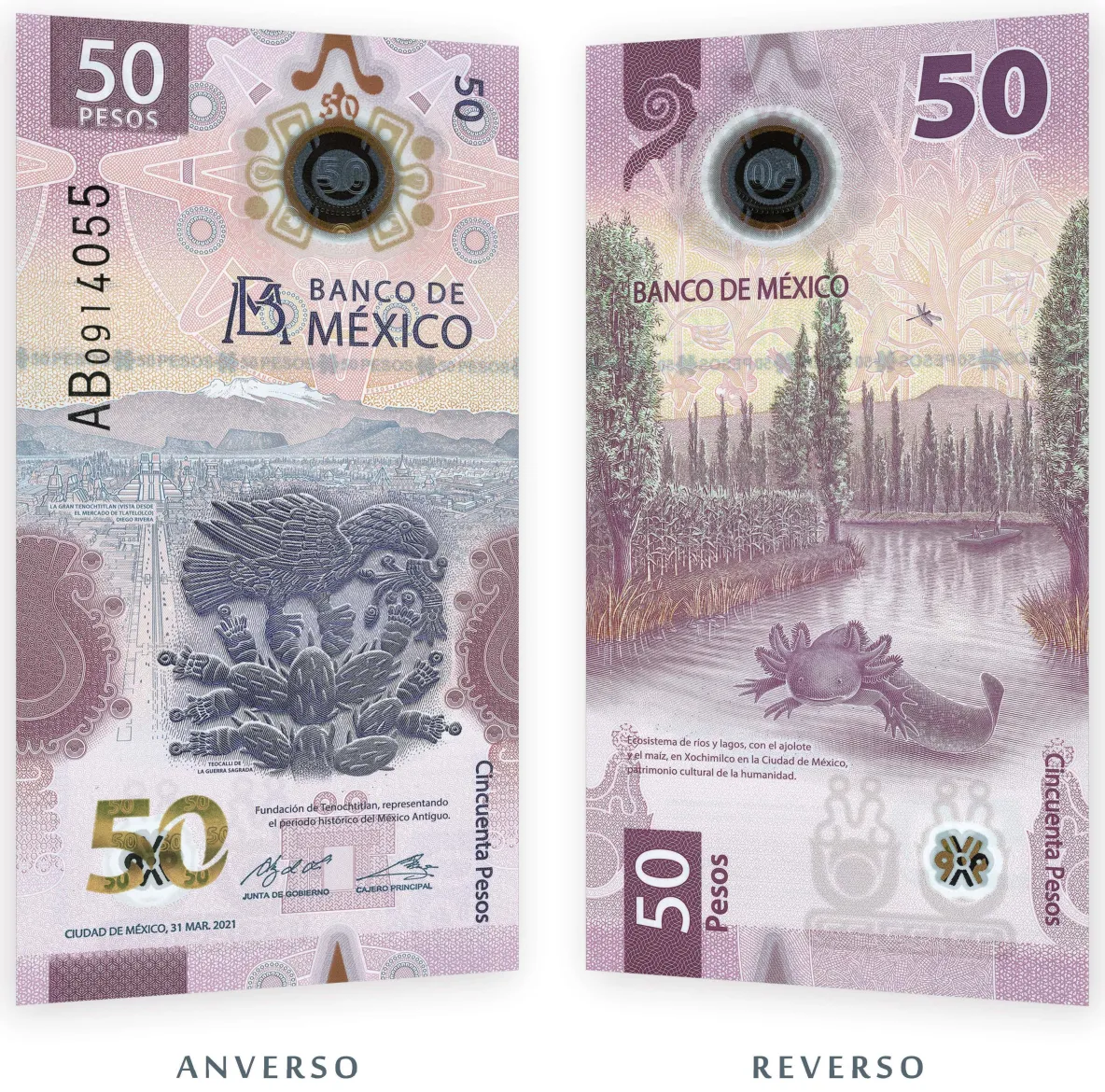
Its official name is the 50 peso note of the Familia G (Series G) from Banco de México. It replaced the older Familia F design (the one that featured Benito Juárez) with a full redesign. Three features set it apart from any earlier Mexican bill:
- It is printed on polymer, not traditional cotton paper. This is the same plastic-based substrate used by Australia, Canada, and the United Kingdom. It is more water-resistant, more durable, and harder to counterfeit.
- The orientation is vertical on the front and horizontal on the back. That deliberate asymmetry was a first for Banxico.
- It won the Bank Note of the Year 2022 from the International Bank Note Society (IBNS), the most respected award in world banknote collecting. It beat central bank issues from around the globe. It was the first time a Mexican banknote ever won.
Why it won the world's best banknote award
The IBNS has handed out its Bank Note of the Year Award annually since 2005. Past winners include issues from Switzerland, Canada, Sweden, Argentina, and Kazakhstan. Mexico won for the first time in 2022 with this note.
The committee cited four reasons:
- The technical innovation of the polymer substrate.
- The asymmetric design (vertical front, horizontal back) that broke convention.
- A coherent conservation message, since the axolotl is an endangered species.
- The overall quality of the engraving.
The front: ancient Mexico
According to the official Banxico page, the front commemorates the historical period of ancient Mexico. A common mistake is to think Benito Juárez appears on it. He does not. That confusion comes from the previous Familia F design. The engraved elements include:
- The eagle and nopal cactus, the founding symbol of Tenochtitlan.
- The Metztli symbol (moon, in Nahuatl).
- The Ollin symbol (movement), which sits in the transparent window and changes color when tilted.
- The texts "BANCO DE MÉXICO" and "Cincuenta Pesos" with raised, touch-sensitive relief.
The back: the axolotl
The back is the famous side. Banxico describes it officially as a "river and lake ecosystem." The star is the axolotl (Ambystoma mexicanum), an amphibian found naturally only in the lake system of Xochimilco, near Mexico City.
Why Banxico chose it:
- It is endemic to Mexico. It exists nowhere else in the wild.
- It is critically endangered. The IUCN Red List classifies it as Critically Endangered, with very little wild population left.
- It shows neoteny. The axolotl keeps its larval features (external gills, aquatic body) for its entire adult life, which is unusual among amphibians. That is why it looks like a permanent baby salamander.
- It carries pre-Hispanic meaning. In Nahua mythology, Xólotl, the twin god of Quetzalcóatl, turned into an axolotl to escape sacrifice. It became a mythical symbol of resistance.
One point of confusion: people call the axolotl a salamander. It belongs to the order Caudata, the same order as salamanders, but because it never loses its larval traits, calling it "a salamander" is imprecise.
When yours might be worth more than face value
There are real exceptions, and it helps to know them so you are not fooled either way.
- Special serial numbers. Radar serials (that read the same forward and backward), ladders (like 1234567), and solid repeats (7777777) do attract some collectors. The typical premium is 10 to 30 percent, not 100 times.
- Official proof or specimen notes that Banxico never released into circulation. These are genuine collector pieces with real value, but they do not turn up in your change at a convenience store.
- Cataloged printing errors. As far as we know, there is no officially cataloged error for this note through the Sociedad Numismática Mexicana (Mexican Numismatic Society). If someone claims their bill has "an error worth a fortune," ask for the catalog reference. Without it, it is worth 50 pesos.
Myths vs. reality
| Claim you see online | Reality |
|---|---|
| "It's worth 5,000 pesos" | Face value, about 2.50 to 3 US dollars, unless it has a documented special feature |
| "It was withdrawn" | Still legal tender and actively printed by Banxico in 2026 |
| "My bill has an error worth millions" | No official Mexican Numismatic Society catalog entry exists, so it is worth face value |
| "It's just cheap plastic" | It is technical polymer, the same substrate used by Australia, Canada, and the UK |
| "It's a salamander" | It is an axolotl, order Caudata, but it keeps larval features for life (neoteny) |
How to check that yours is genuine
Banxico documents 8 official security features. Run through them quickly:
- Touch it. Feel for raised relief on "BANCO DE MÉXICO" and the eagle. No relief means it is fake.
- Tilt it. The Ollin symbol in the transparent window should change color, and the multicolor "B" should shift too.
- Hold it to the light. The vertical serial should grow in size (ascending folio).
- Use a UV lamp if you have one; specific areas should glow.
- Bend it. Polymer springs back to shape; paper does not.
If you bought a bill online and it fails these checks, report it. Banxico runs a direct line: 800-BANXICO (800-2269426).
Should you keep one?
Three honest answers depending on why you are asking.
If you collect banknotes: yes, keep one in perfect (uncirculated) condition. It is Mexico's first internationally awarded polymer note. When Banxico eventually releases the next series, this one moves into "recent historical" territory and should gain a modest premium.
If you just like the design: keep one or two to give away. It is probably the most sought-after modern Mexican bill among foreign collectors, and it makes a nice cultural keepsake.
If you are hoping to get rich: no. Millions are in circulation and Banxico keeps printing them. There is no profit here. If you want a metal piece with investment logic instead, look at a silver Onza Libertad or at commemorative 20 peso coins in uncirculated grade for serious collecting.
Got one with an interesting serial?
If you found an axolotl bill with a radar serial, a ladder, a very low number, or any oddity, tell us in the forum. There are only so many of us tracking Mexican notes, and it is easier to compare finds together.

Loading comments…