
En resumen
Mexico issued a series of 2026 FIFA World Cup coins in bimetallic, pure silver and pure gold. Here's what each one is, what it costs, and what it's actually worth.
If you have one of Mexico's 2026 FIFA World Cup coins, or you're thinking about getting one, here's the honest answer up front: the four bimetallic 20-peso coins are worth their face value, about 1 US dollar each. The pure silver and pure gold versions are worth far more, because they carry real precious metal. Everything else is marketing.
Mexico's central bank, Banco de México (known as Banxico), released this commemorative series to mark the 2026 World Cup, which Mexico co-hosts with the United States and Canada. The series comes in three tiers, and confusing them is the most common mistake we see among new collectors.
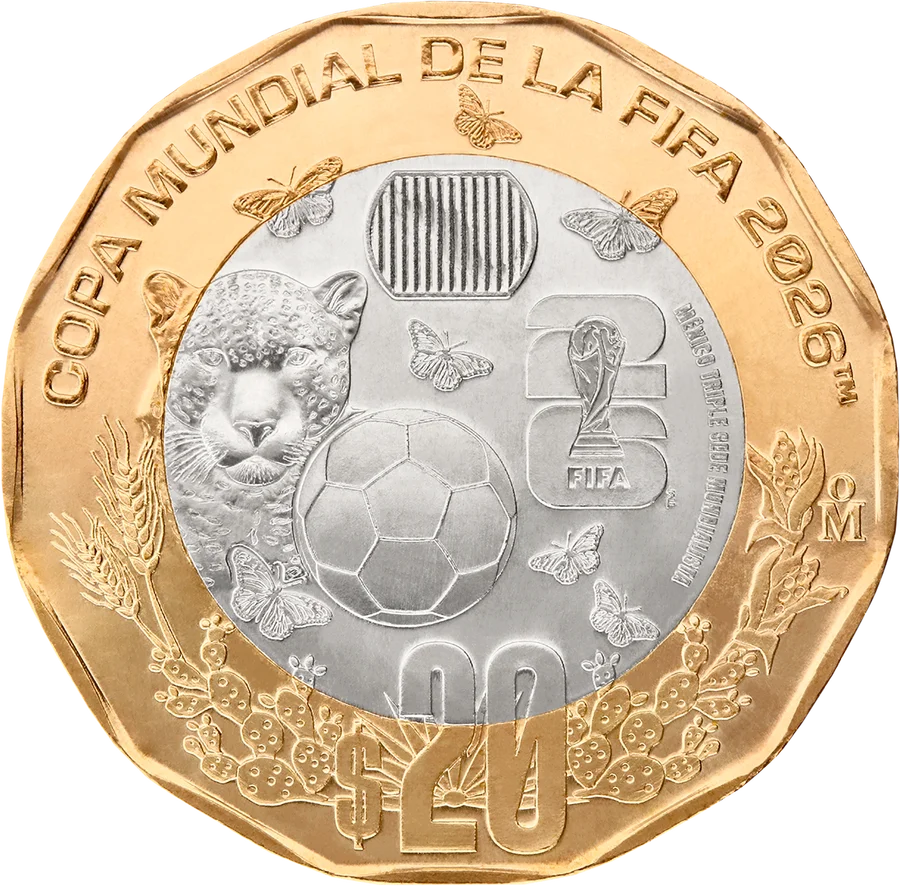
The Jaguar (triple-host) 20-peso coin, one of the four bimetallic pieces. Official Banco de México image.
The three tiers, and what each is actually worth
A "bimetallic" coin is made of two metals: an outer ring of one alloy and an inner core of another, like the US golden dollar or the two-euro coin. These are ordinary circulating coins, not precious metal.
| Tier | Metal | Face value | What it's worth |
|---|---|---|---|
| Bimetallic 20-peso (4 designs) | Base metal alloy | 20 pesos (about 1 USD) | Face value, roughly 1 USD |
| Silver 1 oz (4 designs) | .999 pure silver | Sold at premium | Silver melt value plus collector premium |
| Gold 1/4 oz (4 designs) | .999 pure gold | Sold at premium | Gold melt value plus collector premium |
The silver coins contain one full troy ounce of .999 fine silver, so they have a hard floor at the daily silver spot price. The gold coins contain a quarter troy ounce of .999 fine gold, giving them a floor tied to gold spot. Bullion coins never drop below their melt value, which is exactly why the metal versions matter and the bimetallic ones do not, financially speaking.
The four bimetallic designs
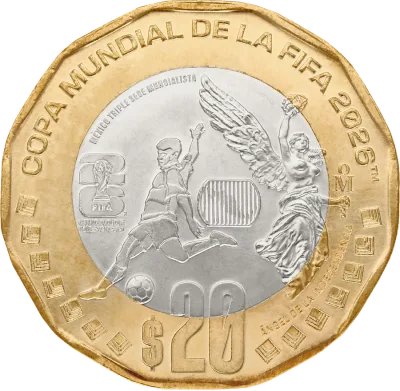
All four bimetallic coins share the same 20-peso face value. The difference is the reverse design:
- Triple Host (Jaguar): honors the three host nations, Mexico, the US and Canada
- Mexico City venue
- Guadalajara venue
- Monterrey venue
Because the face value is fixed at 20 pesos, no bimetallic version is inherently rarer than another at issue. Any premium you see later comes from demand and condition, not scarcity built into the mintage.
The myth: "World Cup coins worth a fortune"
We've seen the bimetallic coins listed on Mexican resale marketplaces at five, ten, even twenty times their face value. Do not pay that. These are recently minted coins with high production runs. Their official cost is 20 pesos, roughly 1 US dollar. Paying a large multiple is subsidizing a reseller, not buying a rarity.
The silver and gold versions are a different conversation. Those carry genuine precious metal, and a graded, well-preserved example can hold value over time. But even there, the value is driven by metal content and grade, not by the World Cup logo.
How to get them at face value
Banxico distributes the bimetallic coins through its own exchange windows, called cajas regionales (regional cash offices). The rules for the public exchange:
- Up to 10 coins of each of the 4 designs, so a maximum of 40 pieces per person
- Payment in cash at face value, 20 pesos each
- No requirement to be a bank customer
The rollout has been gradual. Mexico City had the coins at the counter first. Regional offices in Guadalajara, Monterrey, Hermosillo, Mérida and Veracruz were added afterward. For current locations and hours, Banxico maintains an official locator tool called UbicaCanje, which lists the nearest exchange window by state.
The pure silver and pure gold coins are not distributed through those exchange windows. They're sold through:
- Casa de Moneda de México (the Mexican Mint), in person in Mexico City
- Multiva, an authorized national distributor
- Banxico's online store, with limited inventory
Banxico has not announced any mass exchange of the silver or gold coins at regional offices. If someone claims otherwise, ask for the official source.
What to expect at the exchange window
Based on how the Mexico City rollout went, here's the practical reality:
- Daily limits are real. Mexico City ran roughly 250 tickets per day, with lines forming early in the morning
- Stock sells out. During busy weeks the daily allotment was gone before midday
- New batches arrive over time. A "sold out" answer one day does not mean gone forever
- Not all four designs are always in stock at once. Ask at the window before waiting in line
Each office manages its own daily quota, and those quotas are not published in advance. Arriving early is the only reliable advantage.
Where to sell yours
If you already have the bimetallic coins and want to sell, be realistic. At face value they move easily to collectors completing a set, but you won't command a large premium on common bimetallic pieces. The silver and gold versions are worth having appraised by a coin dealer who checks current spot price and condition. For any coin you believe is genuinely scarce or high grade, third-party grading from NGC or PCGS establishes both authenticity and a certified grade, which is what serious buyers pay for.
Whether you inherited a handful of these or picked them up at the counter, the value story is simple: bimetallic means face value, silver and gold mean melt value plus a modest premium. Anything beyond that is a seller's markup.
Have you tracked down the silver or gold versions, or found any of these in everyday change? Tell us what you paid and where you got them in the Pesoteca forum.
Loading comments…