
1964 Mexico 20 Centavos (Copper, Pyramid of the Sun)
Prices updated: August 2026
Old peso era · Copper
Old peso era · Copper
Design
Banxico
Reverse
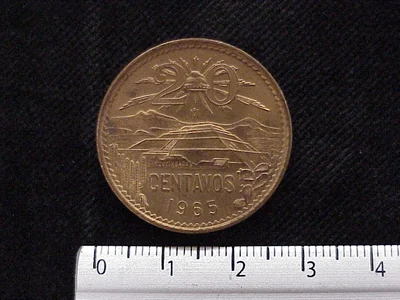
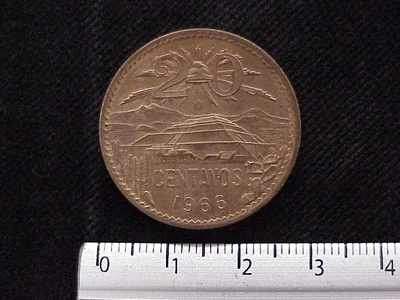
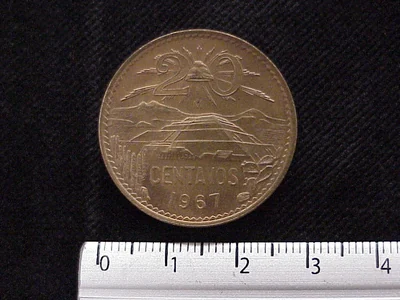
Reverse: Pyramid of the Sun at Teotihuacan at center, with the legend TEOTIHUACAN at the base. Behind it are the volcanoes Iztaccihuatl and Popocatepetl. At the top, a radiant Phrygian cap (cap of liberty) dividing the number 20. Below appears the word CENTAVOS and the date, flanked by cacti (nopal and saguaro). Design used throughout the KM#440 series (1955-1971).
Obverse
Mexican National Coat of Arms with the inscription "ESTADOS UNIDOS MEXICANOS".
How much is the 1964 Mexico 20 Centavos (Copper, Pyramid of the Sun) worth?
The market value of the 1964 Mexico 20 Centavos (Copper, Pyramid of the Sun) is not yet documented with enough data to give a firm range. Weigh and measure your piece, compare it against the specifications, and check the forum for a second opinion.
The real price depends on four factors: the grade of preservation (a circulated piece is worth the low end of the range; an uncirculated one, or one still in its official blister pack, the high end), the finish (satin vs mirror/proof), the rarity within the series based on the mintage, and the metal spot price on the day of the deal when the piece is silver or gold. Check the value-by-grade table above and compare with equivalent pieces before buying or selling.
Where to buy or sell this coin?
Browse the national directory of numismatic shops or the community forum to trade directly with other collectors.
Description
Most 1964 Mexican 20 centavos coins are worth just a few cents. Nearly 28.6 million were struck, and 1964 is one of the most common dates in the whole series, so a worn example carries little more than sentimental value. The upside comes only from condition: a fully uncirculated coin with original red copper color sells in the 1 to 2 USD range, and top certified pieces bring more. Here is exactly what yours is worth and how to check.
If you inherited a box of old Mexican coins, this large copper piece with a pyramid on the back is one you will see often. It is not rare. Its value lives or dies on how well it survived.
What this coin actually is
The 1964 20 centavos is a bronze coin struck at the Casa de Moneda de México (the Mexican Mint). "20 centavos" means 20 cents of a peso, the smaller denomination below the peso itself. Physically it is big for its face value: 10 grams, 28.5 mm across, with a plain (smooth) edge.
The reverse (back) shows the Pirámide del Sol (Pyramid of the Sun) at Teotihuacan, the ancient site outside Mexico City, with the word TEOTIHUACAN across the base. Behind it are the two volcanoes Iztaccíhuatl and Popocatépetl. Above, a radiant Phrygian cap (a liberty cap) splits the number 20. The word CENTAVOS, the date, and cactus plants fill out the design.
The front (obverse) carries the national coat of arms, the eagle on a cactus devouring a serpent, with the legend ESTADOS UNIDOS MEXICANOS ("United Mexican States," the country's official name).
Is it silver? No.
This is one of the first things US readers ask, so let us kill it fast: there is no precious metal here. The coin is bronze, 95% copper and 5% zinc. It has no melt value worth chasing and no silver or gold content. Whatever it is worth is purely numismatic, meaning it depends on rarity and condition, not metal.
What it is worth in 2026
Here is the honest picture. The 1964 date is common, so grade is everything.
| Condition | What it looks like | Typical value (USD) |
|---|---|---|
| Circulated, worn | Brown, smooth relief, obvious wear | A few cents to 0.50 |
| Extra Fine / About Uncirculated | Sharp detail, light handling | 0.50 to 1 |
| Uncirculated, brown | No wear, darkened copper | 1 to 2 |
| Uncirculated, original red (MS-63 to MS-65) | Full mint luster, red-orange color | 2 to 8 |
| Certified gem (MS-66 and up, red) | Graded by NGC or PCGS, top color | Higher, sold at specialist auction |
Catalogs place a nice uncirculated red example around 1 to 2 USD, and certified high grades (MS-65 or better with original red color) can bring more at auction. The key term is "red": copper coins are graded RD (red), RB (red-brown), or BN (brown). Red is the fresh, unhandled color and the only one that pushes the price up.
Bottom line: if yours is worn from pocket use, it is a common coin. If it is bright, spot-free, and looks like it was never spent, it is worth setting aside.
The rare dates are NOT 1964
The Pyramid of the Sun bronze series ran from 1943 to 1974. If you are hunting for the valuable dates, look for 1951, 1952, and 1959, the scarce years collectors actually pay for. The 1964 is among the most plentiful. So if a listing calls a common 1964 "rare" or "worth a fortune," that is marketing, not fact.
How to check what yours is worth
- Confirm the specs. It should weigh 10 grams, measure 28.5 mm, and have a smooth edge. The reverse must show the Pyramid of the Sun with TEOTIHUACAN and the two volcanoes. If those match, it is genuine. This coin is so common that counterfeiting it makes no economic sense, so fakes are essentially nonexistent.
- Judge the color and wear. Look at the pyramid steps and the eagle's feathers under good light. Sharp, full detail with red or red-brown luster means a better grade. Flat, smooth, brown surfaces mean a circulated coin.
- Decide if grading is worth it. For a coin worth a few dollars at best, paying for professional NGC or PCGS certification usually costs more than the coin returns. Only a clearly gem-quality, full-red example justifies it.
Where to sell it
Because the date is common, a circulated 1964 sells cheaply and moves best as part of a group lot rather than one at a time. A genuinely uncirculated red example is the one worth listing on its own. You can use the Pesoteca shop directory to find coin dealers and buyers, and it helps to know the rest of the 20 centavos series and how copper and bronze Mexican coins are graded before you price yours.
Have a whole tin of these inherited coins and not sure which ones matter? Post clear photos of the fronts and backs in the Pesoteca forum and we will help you spot the keepers from the common ones.
Historical context
The centavo coins that circulated in Mexico during the second half of the 20th century were struck in alloys that changed with the cost of metals: copper, bronze, and brass in low denominations (1¢, 5¢, 20¢); cupronickel for intermediate denominations (25¢, 50¢, late 10¢); and .720 silver for some 25¢ and 50¢ pieces in the 1950s. Each change of alloy created a distinct variant of the same face value. 1964 corresponds to the period when this variant was in circulation, before the transition to New Pesos in 1992. The Mexican Mint kept the basic design of the National Coat of Arms on the obverse and the numeric value on the reverse throughout this era.
This piece belongs to the era
México Moderno (pre-1992) →Explore all the Mexican coins of this era, their historical context and how they connect to the monetary system of the period.
Value range of this piece
Value range without enough data for this piece.
See the full breakdown by grade (VG, F, VF, EF, AU, MS-60, MS-63, MS-65) for the whole series →
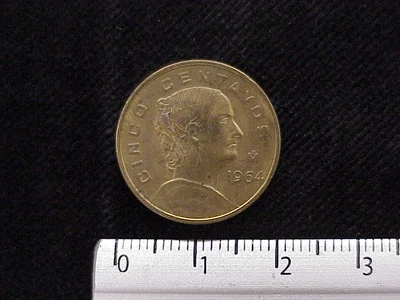
Other denominations from 1964
Centavos Mexicanos · Cobre
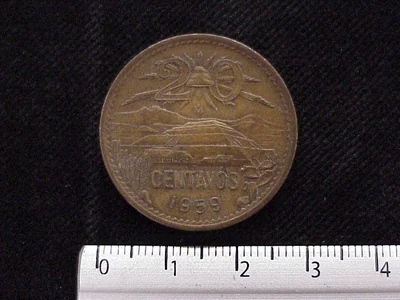
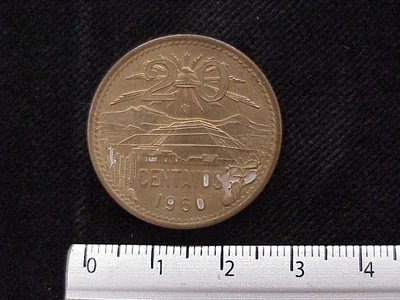
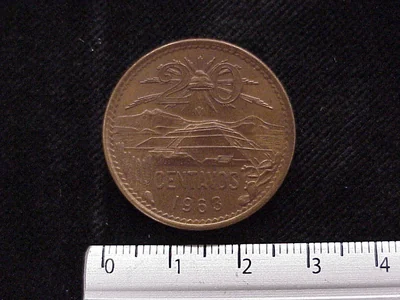
Same denomination, other years
20 centavos Cobre · Centavos Mexicanos
Frequently asked questions
How much is a 1964 Mexican 20 centavos worth?
It depends entirely on condition. A worn, circulated coin is worth only a few cents. An uncirculated example with original red copper color runs about 1 to 2 USD, and certified high grades (MS-65 or better) can bring more at specialist auction. The date itself is common, so grade is what drives the price.
Is the 1964 20 centavos rare?
No. Around 28.6 million were struck, and 1964 is one of the most common dates in the bronze series (1943 to 1974). The scarce dates collectors pay for are 1951, 1952, and 1959, not 1964.
Is this coin silver or worth anything for its metal?
No. It is bronze, 95% copper and 5% zinc, with no silver or gold. It has no melt value worth chasing. Any value is purely numismatic and comes from condition and eye appeal.
How can I tell if my 1964 20 centavos is genuine?
Check the specs: 10 grams, 28.5 mm diameter, smooth edge. The reverse should show the Pyramid of the Sun with TEOTIHUACAN at the base and the two volcanoes behind it; the obverse carries the eagle coat of arms with ESTADOS UNIDOS MEXICANOS. Because this coin is so common, counterfeits are essentially nonexistent, so if the specs match, it is real.
Conversation
0 comments
Sources
Images for informational and educational purposes, attributed to their original source. Reference values; the real price depends on the grade, the specific variant and demand.
Loading comments…