
En resumen
Banxico put it in writing: the 20-peso denomination will stop circulating as a bill and be replaced by a coin. Here is what "gradually" actually means, and the coin that takes its place.
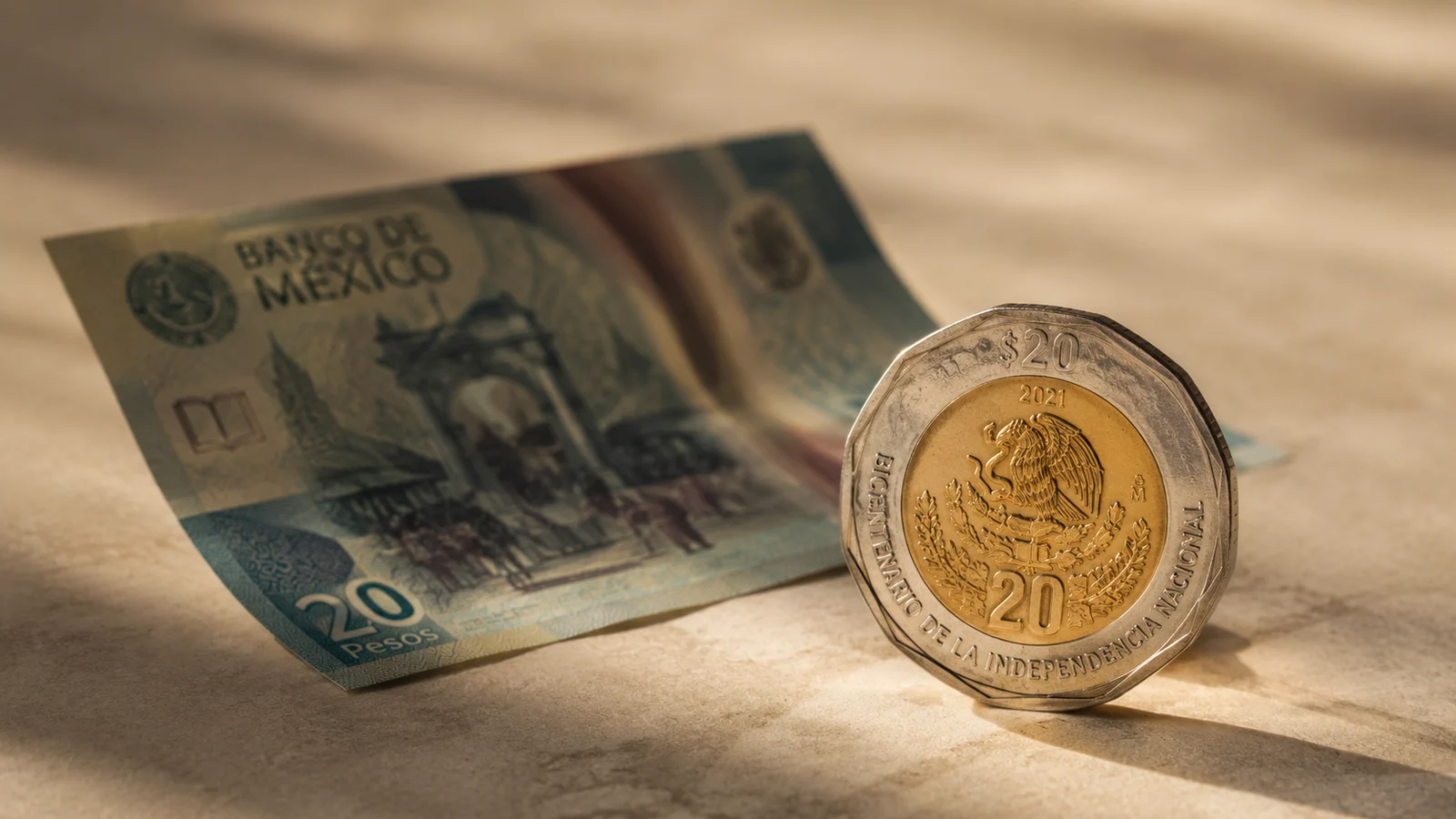
If you have Mexican pesos in a drawer or came back from a trip with change, the smallest paper note, the 20-peso bill, is on its way out. This is not a rumor or a dealer's sales pitch. The Bank of Mexico (Banco de México, known as Banxico, the country's central bank) says it in writing, in its official document on the new banknote family. The 20-peso note is being retired, and its replacement is already in circulation as a coin.
What Banxico actually says, word for word
The official Banxico document is blunt. The direct quote, translated: "the 20-peso denomination will gradually stop circulating as a bill and will be replaced by a coin, as a result of various technical and cost-benefit studies that have been carried out."
That single sentence carries everything that matters. First, the decision is made, it is not up for debate. Second, the reason is cost-benefit. A low-value bill gets handled constantly, wears out fast, and has to be reprinted often. A coin lasts years, even decades. For a central bank, keeping the 20 alive in paper simply did not pay off. Replacing it with a coin is the answer those studies pointed to.
What "gradually" means for you
Here it pays to separate what we know from what we don't. The document says "gradually." It gives no cutoff date and announces no day when the 20-peso bill stops being valid. We are not going to invent one for you.
Gradual means the 20-peso bills already in circulation remain legal tender. No one will refuse yours for now. What is happening is that Banxico stops printing the regular denomination on paper and lets the remaining notes wear out and leave the system on their own, with no replacement. It is a slow fade, not a switch flipped off. How long that takes, the document does not specify, so anyone giving you an exact date is guessing.
The exception: the Bicentennial commemorative note
There is an important asterisk, the kind that makes a collector look twice. On September 24, 2021, Banxico issued a 20-peso bill to commemorate the Bicentennial of Mexico's Independence. That note is part of the Familia G (the "G family," Mexico's newest banknote series).
What sets it apart is the material: this commemorative was printed on polymer, not the cotton paper of the regular denomination. It also carries a security feature worth checking under good light, a multicolor denomination number. Do not confuse the two. This Bicentennial note does not contradict the retirement of the denomination. It is a special piece struck for a specific date, not the return of the regular 20 to the presses. The rule still stands: the everyday 20 moves to a coin.
The coin replacing it: Kukulkán
This is where the story closes itself. If the 20-peso bill is replaced by a coin, which coin? The one Banxico already has circulating in large numbers is the 20-peso Kukulkán coin, a bimetallic, twelve-sided (dodecagonal) piece featuring the Maya feathered serpent on the reverse. Kukulkán is the Maya name for the feathered serpent deity, the same figure known as Quetzalcóatl in central Mexico.
This is not a token, short-run issue. According to Banxico's own Economic Information System, 26 million Kukulkán coins were minted. That figure is the proof the substitution is real. You do not produce 26 million coins for decoration, you produce them to replace something in daily circulation. That something is the 20-peso bill.
What this means for collectors
Here is where it gets interesting. A bill that stops being printed and starts leaving circulation is, by definition, a bill that gets harder to find in good condition every year. We are not promising your 20-peso note will be worth a fortune, that would be irresponsible. What is true, and Mexican numismatic history repeats it over and over, is that denominations pulled from circulation tend to draw collector interest over time, especially examples kept uncreased and unhandled.
The practical advice, no hype: if you come across a 20-peso bill in good shape, especially the polymer Bicentennial commemorative, it is worth setting aside. Not as a guaranteed investment, but because you are holding the final chapter of a denomination Banxico has already decided to retire. Right now, both the regular note and the coin are worth face value, roughly one US dollar. The upside, if any, is long-term and depends entirely on condition and how many survive clean.
Value snapshot
| Item | Type | Notable detail | Current worth |
|---|---|---|---|
| 20-peso regular bill | Paper (being retired) | Legal tender, no reprints | Face value (~1 USD) |
| 20-peso Bicentennial | Polymer commemorative (2021) | Multicolor security feature | Face value now, watch condition |
| 20-peso Kukulkán | Bimetallic coin | 26 million minted, replaces the bill | Face value (~1 USD) |
The source
Everything above comes from the official document "Nueva familia de billetes" (New Banknote Family) published by the Bank of Mexico, which is public. This is not a third-party interpretation or a newspaper take, it is the central bank saying in its own words that the paper 20 is going and the coin takes its place.
Are you setting aside 20-peso bills before they leave circulation, especially the Bicentennial polymer note, or spending them like any other change? Tell us in the forum.
Loading comments…