
1 Peso Real del Monte y Pachuca Note (Bank of Montreal Scrip)
Familia REV · algodón
Period: Revolución Mexicana
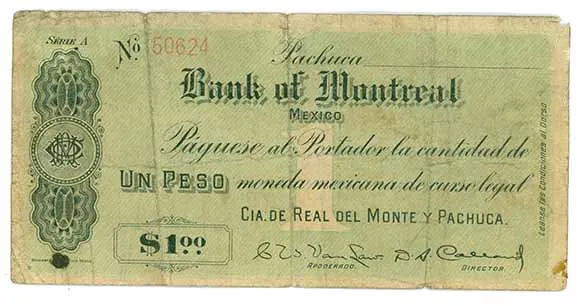
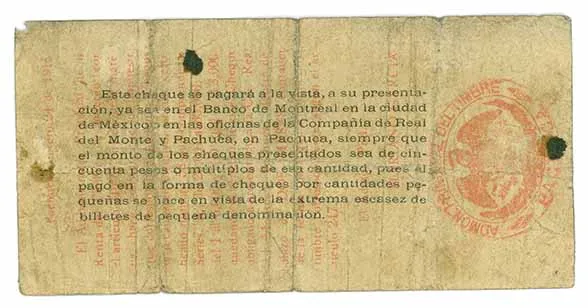
Design
Banxico
Obverse
Bank of Montreal (Pachuca)
Typographic text and the name of the Bank of Montreal, issued by the Real del Monte y Pachuca Company
Reverse
Explanatory text of the note, printed in red
About this banknote
Most Mexican Revolution scrip notes sell for a few dollars to a few hundred, depending on condition and how rare the issuing company is. This particular piece, a 1 peso note issued by the Compañía Real del Monte y Pachuca and payable at the Bank of Montreal branch in Pachuca, sits in the collectible category: its value is entirely numismatic, not face value.
If you inherited or found one, here is what actually drives the price and how to check yours.
What this note actually is
This is not a standard government banknote. It is a private vale (a scrip note or payable voucher) issued during the Mexican Revolution, when the monetary system had collapsed. Dozens of factions printed their own paper, and ordinary people could no longer tell what was valid. Small-denomination notes were especially scarce.
To keep commerce moving, the Compañía Real del Monte y Pachuca, the historic mining company of the Hidalgo region, issued these check-style vouchers redeemable at the Bank of Montreal branch in Pachuca. That makes it a document tied directly to the mining and industrial history of Hidalgo, which is part of why collectors of Mexican Revolution paper (and of Bank of Montreal history) chase it.
Design. The face carries typographic text and the name of the Bank of Montreal, with the issuer noted as the Compañía Real del Monte y Pachuca. The back shows explanatory text about the voucher, printed in red.
What it is worth in 2026
This is historic paper money, more than a century old, so its value is purely collector-driven and depends heavily on two things: condition and how rare the issuer is. Private-bank notes from the Porfiriato era and Revolution-era company scrip have their own market. Some are common, others extremely scarce, and many circulated so briefly that complete, intact examples are hard to find today.
Because survival rates and demand vary so widely note by note, a firm single price is misleading. As a working range, expect anything from a modest sum for a worn, common example to a few hundred dollars for a scarce, well-preserved piece. Exceptional survivors of rare issuers can go higher. Condition is the biggest lever: a clean, uncreased note can be worth several times a folded, stained one.
| Item | Type | Era | Value driver | Typical range (USD) |
|---|---|---|---|---|
| 1 peso Real del Monte y Pachuca scrip | Private company vale, Bank of Montreal | Mexican Revolution | Rarity of issuer + condition | Modest to a few hundred; more if rare/pristine |
What people get wrong about "old = valuable"
Age alone does not make paper money valuable. Plenty of century-old notes are worth very little because they were printed in quantity and many survived. What moves the needle for this kind of piece is genuine scarcity (few survivors), collector demand for the specific issuer, and grade. A common vale in poor shape is a curiosity, not a windfall. A scarce one in high grade is where the real money sits.
How to check what yours is worth
- Grade the condition honestly. No folds, tears, stains, or pinholes matters most. Flat and crisp beats soft and creased.
- Photograph both sides in good, even light. Any serious appraisal or offer starts with clear images of the front and back.
- Look for anything unusual: low or repeating serial numbers, printing errors, or cancellation marks can change value.
- Get a real opinion before selling. Do not trust the first internet price. Ask in the Pesoteca forum or a reputable dealer.
How to tell if it is genuine
With old company scrip, authentication is about paper, printing, and design rather than modern security threads. Genuine examples show period-correct paper (not smooth modern stock), authentic typography, and the correct red back printing. Reproductions and reprints tend to have flat colors, sharp modern paper, and inconsistent lettering. Compare against documented examples of Real del Monte y Pachuca issues before you buy or pay. If in doubt, post it in the forum so collectors can weigh in.
Where to sell it
To sell this note, your safest options are a verified dealer from the Pesoteca shop directory, who can appraise it on the spot, or the Pesoteca buy-and-sell forum where collectors of Mexican Revolution paper are already looking. Photograph both faces in good light, note any low serial number or error, and avoid dumping it to the first buyer on social media. World paper money (notaphily) is an active English-language market, so a scarce, correctly described piece will find its collector.
Have one of these Bank of Montreal vales, or another Revolution-era scrip note you cannot identify? Post clear photos of both sides in the Pesoteca forum and let the community tell you what you actually have.
Historical context
This 1-peso scrip is a direct product of the monetary chaos of the Mexican Revolution. Between 1913 and 1916 official money was scarce, the armed factions seized silver, and every company, state, or municipality was forced to print its own paper in order to keep operating.
Into that vacuum, local entities in Pachuca (Hidalgo), tied to the powerful Compañía de Real del Monte y Pachuca, one of the country's most important mining districts, turned to forced-circulation scrip to pay wages and sustain trade in the area. The backing of the Bank of Montreal, a Canadian bank present in the mining operation, sought to lend confidence to paper that, like almost all revolutionary money, was worth only what people were willing to accept.
This kind of improvised issue explains why the period left behind hundreds of different notes: there was no single national currency, but rather a puzzle of local papers. That is why they are so sought after today: each one tells a piece of the economic disorder Mexico lived through while the Revolution was being fought.
Frequently asked questions
How much is the 1 peso Real del Monte y Pachuca note worth?
Its value is purely collector-driven, since it is over a century old and no longer redeemable. Depending on condition and how rare the issuer is, expect anything from a modest amount for a worn, common example to a few hundred dollars for a scarce, well-preserved piece. Clean, uncreased notes are worth several times a folded or stained one.
Is this note rare?
It depends on the specific issue. Private-company scrip and Revolution-era vales range from common to extremely scarce. Many circulated so briefly that intact examples are hard to find today, which is what supports collector value. Have it compared against documented Real del Monte y Pachuca issues to place yours.
Where can I sell it?
Your safest options are a verified dealer from the [Pesoteca shop directory](/tiendas), who can appraise it immediately, or the [Pesoteca buy-and-sell forum](/foro/compra-venta) among collectors. Photograph both sides in good light and note any low serial number or printing error, since those raise the price. Avoid selling to the first buyer on social media.
How do I tell if it is genuine?
Check the paper, printing, and design rather than modern security features. Authentic notes show period-correct paper, correct typography, and the red back printing. Reproductions tend to have flat colors, smooth modern paper, and inconsistent lettering. Compare against official documented examples, and if in doubt post photos in the [forum](/foro).
Características Banxico
/Cía. de Real del Monte y Pachuca.
Familia REV
This banknote belongs to the BIL-REV family within the Sistema PSM . Explore all the banknotes that share origin, era and design with this piece.
Ver todos los billetes de la familia REV →