
10 Pesos Banknote (1908), Banco de Zacatecas
Familia PRIV · algodón
Period: Bancos privados de emisión
Design
Banxico
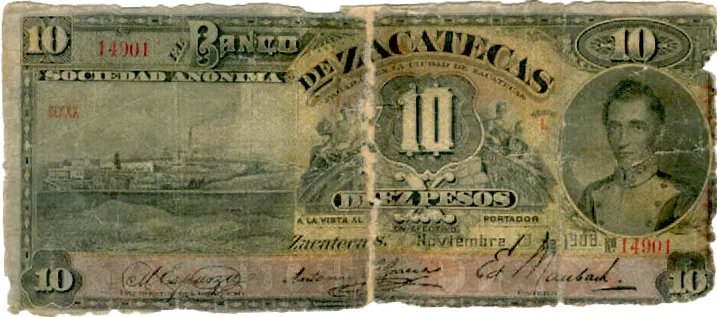
Obverse
Banco de Zacatecas
Engraved allegorical vignettes: a miner on the left, a female figure with goods in the center, and the profile portrait of a young man on the right
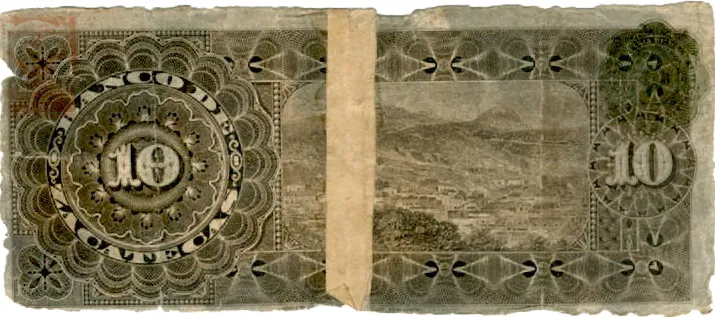
Reverse
Scenes of mining and labor, or a monument set against the mountainous landscape of Zacatecas
About this banknote
Most 1908 Mexican banknotes are not worth a fortune, but the 10 pesos note from the Banco de Zacatecas is genuine collector paper money, not spendable currency. Depending on condition, well-worn examples trade for a few dollars, while crisp, high-grade notes can bring 100 to several hundred USD to world paper money collectors. Here is what actually drives the price.
What this note is
This is a private state-bank issue from Porfirian Mexico. Before Mexico had a single central bank, individual states licensed private banks to print their own paper money, each note backed by silver. Zacatecas, one of the great mining states, had its own bank, which is why the vignettes celebrate mining: the ore was the collateral.
The front carries engraved allegorical vignettes: a miner on the left, a female figure with goods at the center, and the profile portrait of a young man on the right. The back shows mining and labor scenes, or a monument set against the mountainous Zacatecas landscape.
This system of multiple issuing banks ended in 1925, when the Banco de México was founded as the country's single central bank. That makes every Banco de Zacatecas note a fixed, finite historical object: no more were ever printed after the bank stopped issuing.
How much it is worth in 2026
Because this is historical paper money more than a century old, its value is purely collector-driven. Two factors decide almost everything: condition and rarity of the issuing bank.
- Heavily circulated (soft paper, folds, tears, stains): a few dollars to around 25 USD.
- Fine to Very Fine (intact, moderate wear, no major damage): roughly 30 to 100 USD.
- About Uncirculated to Uncirculated (crisp, bright, no folds): often 100 to several hundred USD for scarcer varieties.
Remarque and specimen proofs (marked "Specimen" or with punch-cancel holes, printed by the American Bank Note Company) can sell higher when they appear at auction, but those are specialist items, not the notes most people inherit.
| Item | Issuer | Typical range (USD) | Where it sells |
|---|---|---|---|
| 10 pesos, circulated | Banco de Zacatecas | 5 to 25 | Collector forums, dealers |
| 10 pesos, Fine to VF | Banco de Zacatecas | 30 to 100 | Numismatic dealers, eBay |
| 10 pesos, AU to Unc | Banco de Zacatecas | 100 to 300+ | Auction, world paper dealers |
| Specimen / proof | Banco de Zacatecas | Higher, varies | Heritage, Stack's Bowers |
If you have one, do not trust the first internet price you see. These state-bank notes have a real but thin market, and asking prices online are frequently inflated. Get a second opinion before you sell.
The myth to kill
Age alone does not make a banknote valuable. Plenty of people assume that a note "from 1908" must be worth thousands simply because it is old. It rarely is. What makes a Porfirian bank note command real money is scarcity of the issuing bank combined with high grade. Some issuers printed heavily and their notes are common; others survive in tiny numbers. Zacatecas notes fall in the middle: collectable and desirable, but not a lottery ticket.
How to check what yours is worth
- Grade honestly. Look for folds, tears, pinholes, stains and softness. A note with even one hard vertical fold drops several grades below a crisp one. Do not press or "repair" it; that destroys value.
- Read the details. Confirm it says Banco de Zacatecas, the 10 pesos denomination, and note the series letters and serial number. Low serial numbers and radar/palindrome serials add a premium.
- Watch for printing errors. Genuine factory errors (misaligned cuts, ink smears, mismatched serials) turn a common note into a rarity. Ordinary wear is not an error.
- Compare to references. Match the design, paper and signatures against catalog images. The standard reference for these is the Pick catalog of world paper money; look for the Mexico state-bank listings.
How to tell if it is genuine
Authentic notes of this era were engraved and printed by professional bank note companies, so the paper has texture, the engraving is sharp under magnification, and the colors have depth. Reproductions and reprints tend to have smooth, flat paper and flat, screened color that breaks into dots under a loupe. Compare the signatures and the fine engraved lines against known genuine examples. If anything looks off, get it reviewed before buying or selling.
Where to sell it
The safest routes are established world paper money dealers and collector marketplaces, not selling to the first buyer on social media. Photograph both sides in good light, note the grade and any special serial number, and ask for offers from more than one source. For a community check on grade, authenticity or a fair price, post clear front-and-back photos in the Pesoteca forum.
Have an 1908 Banco de Zacatecas note in a drawer and no idea if the grade justifies 20 dollars or 200? Post both sides in the Pesoteca forum and let collectors who trade these weigh in before you sell.
Historical context
The Banco de Zacatecas maintained a continuous issuance of notes from its founding in 1891 until 1914, sustained by the mining economy that had made the city famous for centuries. Like the other state banks of the time, it operated under the Law of 1897, which set the rules for private banks of issue across the country.
This 10-peso note of 1908 belongs to the final years of calm before the revolutionary outbreak. Its obverse brings together the iconographic set that identified the institution: a miner on the left as an emblem of Zacatecan silver, a female figure with goods in the center alluding to commerce, and the portrait of a young man in profile on the right; on the reverse, scenes of mining and labor. The printing was carried out by the American Bank Note Company of New York, which guaranteed the quality of the engraving and made counterfeiting difficult. This entire scheme of regional issuance would disappear with the creation of the Banco de México in 1925.
Frequently asked questions
How much is the 1908 Banco de Zacatecas 10 pesos note worth?
It is collector paper money, not spendable currency, so value depends on condition. A heavily circulated example trades for a few dollars up to about 25 USD, a Fine to Very Fine note runs roughly 30 to 100 USD, and a crisp uncirculated note can reach 100 to several hundred USD. Grade and rarity of the issuing bank decide the price.
Is the 1908 10 pesos Banco de Zacatecas note rare?
It is scarce but not extremely rare. It was a private state-bank issue from Porfirian Mexico, and the multiple-issuing-bank system ended in 1925, so no more were ever printed. Some Zacatecas notes survive in decent numbers in worn grades, but crisp uncirculated examples, low serial numbers or specimen proofs are genuinely hard to find and worth much more.
Where can I sell my 1908 Banco de Zacatecas banknote?
Sell through established world paper money dealers or collector marketplaces rather than to the first buyer on social media. Major auction houses like Heritage and Stack's Bowers handle higher-grade and specimen notes. Photograph both sides in good light, note the grade and serial number, and get more than one offer. For a free community valuation, post clear photos in the [Pesoteca forum](/foro).
How can I tell if my Banco de Zacatecas note is genuine?
Authentic notes were professionally engraved, so the paper has texture and the fine lines stay sharp under a loupe, with colors that have depth. Reproductions usually have smooth, flat paper and screened color that breaks into dots under magnification. Compare the design, signatures and engraving to known genuine examples. If in doubt, post front-and-back photos in the [Pesoteca forum](/foro) for review before buying or selling.
Características Banxico
CLXXX.
Familia PRIV
This banknote belongs to the BIL-PRIV family within the Sistema PSM . Explore all the banknotes that share origin, era and design with this piece.
Ver todos los billetes de la familia PRIV →