
10 Pesos 1909 Banknote (Banco de Zacatecas)
Familia PRIV · algodón
Period: Bancos privados de emisión
Design
Banxico
Obverse
Banco de Zacatecas
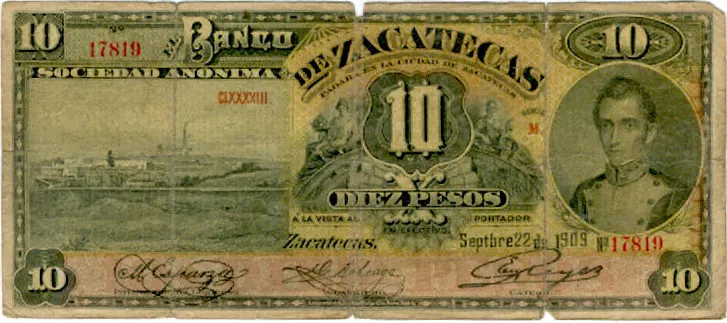
Engraved allegorical vignettes: a miner on the left, a female figure with goods in the center, and the profile portrait of a young man on the right
Reverse
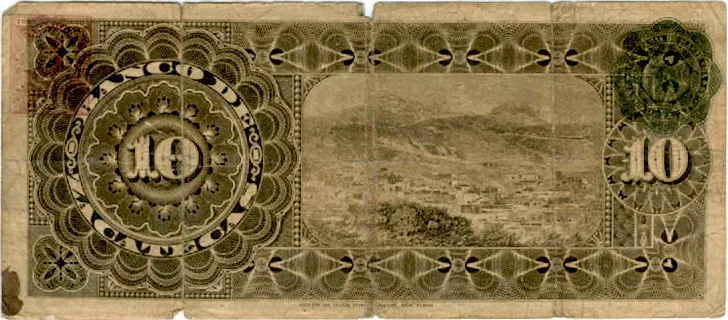
Scenes of mining and labor, or a monument set against the mountainous landscape of Zacatecas
About this banknote
Most inherited Mexican banknotes are worth a few dollars, but a private-bank note from the Porfiriato era is a different animal. The 1909 10 pesos from the Banco de Zacatecas is genuine historical paper money, over a century old, and depending on condition it can run from roughly 20 USD for a worn example to several hundred dollars for a crisp, well-preserved note. Here is what actually drives that number.
What this note actually is
Before Mexico had a single central bank, each state licensed private banks that could print their own paper money, backed by silver. This was called banca de emisión múltiple (multiple-issuance banking). Zacatecas, one of the great silver-mining regions of Mexico, had its own Banco de Zacatecas, and that mining wealth was the literal guarantee behind the paper. That is why the vignettes on this note show mining scenes: the silver in the ground was the collateral.
This whole system of competing state banks ended in 1925, when the Banco de México (Mexico's central bank) was founded and took over all note issuance. That makes any surviving private-bank note from this period a relic of an entire era of Mexican finance that no longer exists.
Design
- Obverse (front): engraved allegorical vignettes. A miner on the left, a female figure with merchandise in the center, and the profile portrait of a young man on the right.
- Reverse (back): scenes of mining and labor, or a monument set against the mountainous landscape of Zacatecas.
- Issuer: Banco de Zacatecas, a state-chartered private bank of the Porfiriato (the long rule of Porfirio Díaz, roughly 1876 to 1911).
How much is it worth in 2026
This is purely a collector item, not spendable money. The old private-bank notes are long demonetized, so there is no face value to fall back on. Everything comes down to two things: how rare the issuing bank is and how well the note survived.
The market for Porfiriato private-bank notes and Revolution-era emergency scrip is a real, active corner of world paper money collecting (notaphily). Some issues are common and trade cheaply. Others are genuinely scarce because they circulated so little, or because so few survived intact. A note that has been folded, torn, or stained is worth a fraction of a clean, uncirculated example.
| Note | Bank | Date | Typical collector range (USD) |
|---|---|---|---|
| 10 Pesos | Banco de Zacatecas | 1909 | ~20 to 300+, condition-driven |
| Same, heavily circulated | Banco de Zacatecas | 1909 | 15 to 40 |
| Same, crisp / high grade | Banco de Zacatecas | 1909 | 150 to several hundred |
These are collector-market ranges for the type. A specific note with a low serial number, a repeating (radar/palindrome) serial, or a genuine printing error can push well past the top of that range. For a firm figure on your exact note, get it graded or appraised (see below), because a photo of front and back changes the estimate completely.
The myth: "old note, so it must be a fortune"
Age alone does not make a banknote valuable. Millions of century-old notes exist and most trade for pocket change. What moves the price is rarity plus demand plus condition, in that order. A common bank in poor shape stays cheap no matter how old it is. A scarce bank in high grade is where the money is. Do not trust the first inflated price you see on a marketplace listing; those are asking prices, not what notes actually sell for.
How to check what yours is worth
- Grade the condition. Look for folds, tears, stains, pinholes, and missing corners. Uncirculated (no folds, crisp paper) is the top tier. Heavy wear drops the value fast.
- Check the serial number. A very low number, or a palindrome (reads the same both ways), is more sought-after.
- Look for printing errors. Misaligned cuts, ink smears, factory folds, off-center printing, or repeated serials turn a common note into a rarity. Note that ordinary wear from use is not a factory error.
- Confirm it's genuine before you buy or sell (see FAQ below).
For a real appraisal, use a verified dealer from the Pesoteca shop directory or post clear photos in the Pesoteca forum. If you also have coins from the same period, our guide to the most valuable Mexican coins covers the same rarity-versus-condition logic. To compare with the notes that replaced these, see our overview of Banco de México banknotes.
Have a Banco de Zacatecas 10 pesos, or another Porfiriato private-bank note, sitting in a drawer? Post both sides in the Pesoteca forum and let collectors who know this exact series tell you what it's really worth.
Historical context
By 1909, the Banco de Zacatecas was a solid institution with nearly twenty years of history, a capital of 600,000 pesos, and a presence beyond the state thanks to its branches in Aguascalientes and San Juan de los Lagos. It belonged to the system of private issuing banks that characterized Mexico before the existence of a central bank.
This 1909 10-peso note falls at the close of the Porfiriato, when the circulation of regional bank paper was a normal part of economic life. The 10-peso denomination served for mid-sized transactions. Its obverse shows the three vignettes of the series: the miner representing Zacatecan silver, a female allegory of commerce at the center, and a young man in profile on the right, with mining scenes on the reverse. Engraved by the American Bank Note Company of New York, it is a testament to a period in which each state could have its own issuer. That plurality would end with the monopoly of the Banco de México in 1925.
Frequently asked questions
How much is the 1909 Mexico 10 pesos (Banco de Zacatecas) banknote worth?
It is a collector item with no spendable face value. Heavily circulated examples trade around 15 to 40 USD, while crisp, well-preserved notes can reach 150 to several hundred dollars. A low or palindrome serial number or a genuine printing error can push it higher. Condition and rarity decide the price, so a clear photo of both sides changes the estimate.
Is the 1909 Banco de Zacatecas 10 pesos note rare?
It comes from the Porfiriato era of private state banks that were shut down when the Banco de México was founded in 1925, so all surviving examples are relics of a system that no longer exists. Some issues are common and some are genuinely scarce because they circulated little or few survived intact. High-grade, unfolded notes are the hard part to find.
Where can I sell the 1909 10 pesos Banco de Zacatecas banknote?
The safest options are a verified dealer from the [Pesoteca shop directory](/tiendas), who can appraise it on the spot, or the [Pesoteca buy-and-sell forum](/foro/compra-venta) among collectors. Photograph both sides in good light and check for a low serial, a palindrome, or a printing error, all of which raise value. Avoid dumping it on a general marketplace for the first offer.
How can I tell if the 1909 Banco de Zacatecas note is genuine?
For old notes like this, compare the engraving, paper texture, colors, and signatures against official reference images. Genuine notes use quality paper with fine engraved detail; reproductions tend to have smooth, flat paper and flat printed colors. Check the vignettes (miner, central figure, portrait) for sharpness. If in doubt, post clear photos in the [Pesoteca forum](/foro) for a second opinion before you buy or sell.
Características Banxico
CLXXXXIII
Familia PRIV
This banknote belongs to the BIL-PRIV family within the Sistema PSM . Explore all the banknotes that share origin, era and design with this piece.
Ver todos los billetes de la familia PRIV →