
10 Pesos Banco de Zacatecas (1912): Value & How to Sell
Familia PRIV · algodón
Period: Bancos privados de emisión
Design
Banxico
Obverse
Banco de Zacatecas
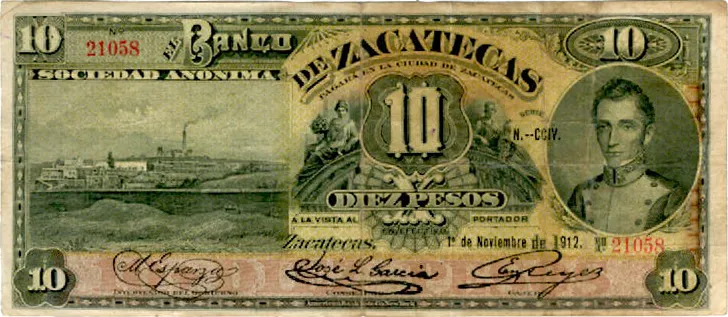
Engraved allegorical vignettes: a miner on the left, a female figure with goods in the center, and the profile portrait of a young man on the right
Reverse
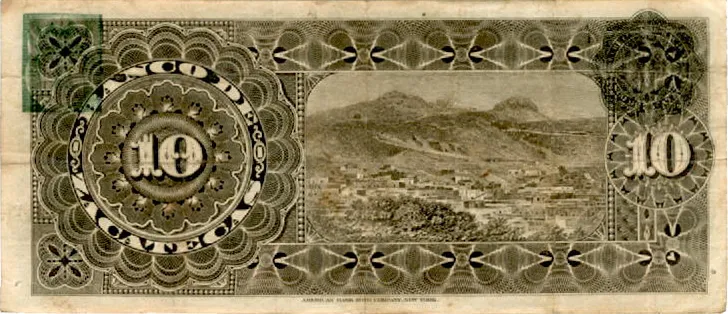
Scenes of mining and labor, or a monument set against the mountainous landscape of Zacatecas
About this banknote
Most old Mexican banknotes people find in a drawer are worth a few dollars, not a fortune. The 1912 Banco de Zacatecas 10 pesos note is a genuine collectible, but its value in 2026 depends almost entirely on condition and rarity: common grades trade for a few dollars, while a crisp, uncirculated example or a scarce variety can bring several hundred USD.
This is a private state-bank note from the Porfiriato, the era of Mexican president Porfirio Díaz, printed before Mexico had a single central bank. If you inherited one, here is what it actually is, what it's worth, and how to sell it without getting shortchanged.
What this note actually is
Before the Banco de México was founded in 1925, Mexico had no single national issuer. Each state licensed its own private banks to print paper money, backed by silver. Zacatecas, one of the great silver-mining regions of the world, had the Banco de Zacatecas. That mining backing is why the note's engraved vignettes show miners and industry: the metal was the guarantee behind the paper.
The front (anverso) carries allegorical engravings: a miner on the left, a female figure with goods at center, and the profile portrait of a young man on the right. The back (reverso) shows scenes of mining and labor, or a monument set against the mountainous Zacatecas landscape.
The entire system of multiple private issuing banks ended when the Banco de México was established in 1925, which makes these notes a closed, finite category. Nothing new can ever be printed, and that fixed supply is part of why collectors follow them.
What it's worth in 2026
This is historic paper money, over a century old, so the value is purely collectible. There is no face value to redeem: you cannot spend it. Price is driven by four things, in this order:
- Condition (grade). A note with no folds, no tears, and bright color (uncirculated) can be worth ten times a worn, soft, taped example of the same type.
- Rarity of the issuer and variety. Some Porfiriato private-bank notes are common; others are genuinely scarce because they circulated very little or few survived intact.
- Serial number. Low serials (like 000012) and radar/palindrome numbers (reads the same both ways) command premiums.
- Printing errors. Genuine factory errors (misaligned cuts, ink smears, miscut margins) turn a common note into a rarity.
As an honest range: circulated examples of Mexican revolutionary-era and private-bank notes often trade from a few dollars to around 50 USD, while high-grade or scarce pieces reach several hundred USD. The very rare issuers and top-graded survivors go higher. Do not trust the first price you see online. Many listings are wishful thinking.
| Detail | Information |
|---|---|
| Issuer | Banco de Zacatecas (private state bank) |
| Denomination | 10 pesos |
| Date | 1912 |
| Era | Porfiriato (pre-central-bank private issue) |
| Front design | Miner, allegorical female figure, young man in profile |
| Back design | Mining and labor scenes, or Zacatecas monument and landscape |
| Value driver | Condition, issuer rarity, serial, errors |
| Typical range | A few dollars to several hundred USD by grade |
The myth: "it's a hundred years old, so it's worth a fortune"
Age alone does not make paper money valuable. Millions of old banknotes exist, and most are common. What separates a 5-dollar note from a 500-dollar note is survival in high grade plus scarcity of the specific issuer and variety. A worn, folded, water-stained 1912 note is a nice piece of history, but it is not a windfall. Be skeptical of any site or seller claiming these are automatically worth thousands.
How to check what yours is worth
- Grade it honestly. Look for folds, pinholes, tears, tape, and staining under good light. Crisp and flat beats soft and creased every time.
- Read the serial number. A very low number or a palindrome adds a premium.
- Look for genuine errors. Miscuts and ink problems from the printing process add value. Ordinary wear and handling damage do not.
- Get more than one opinion. Post clear photos of both sides in the Pesoteca forum or take it to a serious dealer before you sell. For grade certainty, third-party grading (PMG) gives buyers confidence and can raise what you get.
How to tell if it's genuine
Compare the paper, the engraving detail, and the signatures against reference images of authentic Banco de Zacatecas notes. Real notes of this era have crisp intaglio engraving with slight relief you can sometimes feel, and paper with texture. Modern reproductions and reprints tend to have flat, dull color, smooth paper, and soft, fuzzy lines. If anything looks off, ask before you buy or sell.
Where to sell it
To sell a 1912 Banco de Zacatecas note safely, use a verified dealer from the Pesoteca shop directory, who can appraise it in person, or the Pesoteca buy-and-sell forum where collectors of Mexican paper money actually gather. Photograph both sides in good light, note the serial number and any errors, and compare offers. Avoid dumping it on a general marketplace to the first bidder who names a number.
Have a 1912 Banco de Zacatecas note (or any Porfiriato private-bank issue) and want a real read on grade and value? Post both sides in the Pesoteca forum and let collectors who know this series weigh in.
Historical context
The Banco de Zacatecas continued issuing notes during the first years of the Revolution, although political instability was beginning to strike private banking as a whole. Granted its concession in 1891, it had built its prestige on the state's mining wealth, the same wealth represented on its notes.
This 10-peso note of 1912 bears the date of a Mexico already shaken by change: Madero was governing and the tensions that would lead to the collapse of the banking system were accumulating. Despite this, the design retains its classic look: a miner on the left, a female figure with merchandise at the center, and the portrait of a young man in profile on the right, with mining and mountain motifs on the reverse. Printed by the American Bank Note Company of New York, it reflects the bank's will to convey continuity and confidence in uncertain times. The banking reforms begun in 1913 and the later creation of Banco de México in 1925 would put an end to the issuance of paper money by private banks.
Frequently asked questions
How much is a 1912 Banco de Zacatecas 10 pesos note worth?
Value is purely collectible, since the note can no longer be spent. Common circulated examples trade from a few dollars to around 50 USD, while crisp uncirculated notes or scarce varieties can reach several hundred USD. Condition and issuer rarity decide the price, so get it graded or reviewed before selling.
Is the 1912 Banco de Zacatecas note rare?
It depends on the exact issuer and grade. Some Porfiriato private-bank notes are common, others are genuinely scarce because they circulated briefly and few survived intact. High-grade survivors, low serial numbers, palindrome serials, and factory printing errors are what make a specific note rare and valuable.
Where can I sell a 1912 Banco de Zacatecas 10 pesos note?
The safest options are a verified dealer from the [Pesoteca shop directory](/tiendas), who can appraise it on the spot, or the [Pesoteca buy-and-sell forum](/foro/compra-venta) among collectors of Mexican paper money. Photograph both sides clearly, note the serial and any errors, and compare offers rather than accepting the first bid.
How can I tell if my 1912 Banco de Zacatecas note is genuine?
Compare the paper texture, engraving, and signatures against authentic reference images. Real notes have crisp intaglio engraving with slight relief and textured paper, while reproductions show flat dull color, smooth paper, and soft lines. When in doubt, post clear photos in the [Pesoteca forum](/foro) for a second opinion.
Familia PRIV
This banknote belongs to the BIL-PRIV family within the Sistema PSM . Explore all the banknotes that share origin, era and design with this piece.
Ver todos los billetes de la familia PRIV →