
10 Pesos Banknote (1914), Banco de Zacatecas
Familia PRIV · algodón
Period: Bancos privados de emisión
Design
Banxico
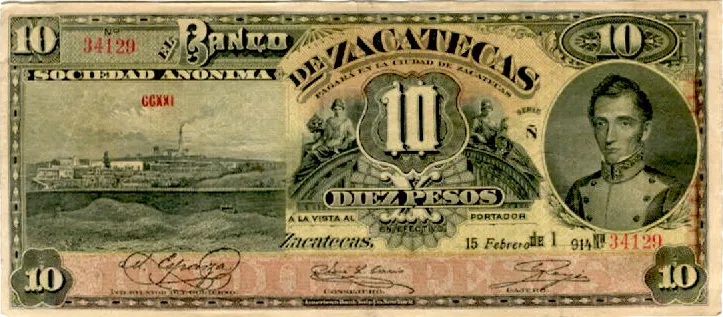
Obverse
Banco de Zacatecas
Engraved allegorical vignettes: a miner on the left, a female figure with goods in the center, and the profile portrait of a young man on the right
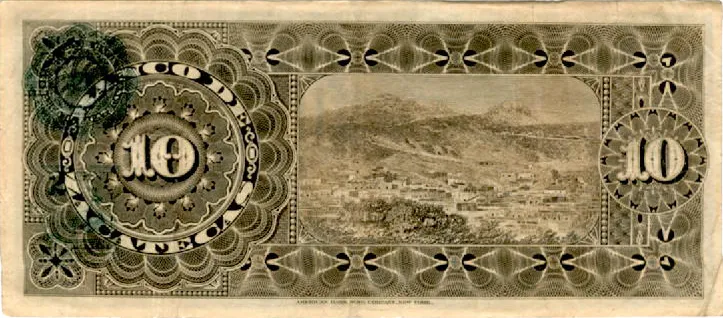
Reverse
Scenes of mining and labor, or a monument set against the mountainous landscape of Zacatecas
About this banknote
If you found a 10 pesos note from the Banco de Zacatecas dated around 1914, it is not legal tender and hasn't been for a century. Its worth is purely collector value: common examples trade for a few US dollars, while scarce signatures or crisp uncirculated notes can reach the low hundreds. Condition and the specific issuing bank decide everything.
This is not a Banco de México note. It predates Mexico's central bank entirely. In 2026, these state-bank notes are a real niche in world paper money collecting (notaphily), and prices swing widely depending on which bank issued the note and what shape it's in.
What it actually is
Before Mexico had a single central bank, each state licensed private banks that could print their own paper money, backed by silver. Zacatecas, one of the great silver-mining regions of the country, had its own Banco de Zacatecas. That's why the note's vignettes are all about mining: the ore was the collateral behind the paper.
This system of multiple issuing banks ended when the Banco de México was founded in 1925, which absorbed the note-issuing function nationwide. So any Banco de Zacatecas note is by definition a pre-1925 relic from Mexico's private-banking era, most of them tied to the Porfiriato (the long rule of Porfirio Díaz) and the Revolution that followed.
The design
- Front (obverse): engraved allegorical vignettes. A miner on the left, a female figure with goods at center, and a young man's portrait in profile on the right.
- Back (reverse): scenes of mining and labor, or a monument set against the mountainous Zacatecas landscape.
The imagery is deliberate. A mining state advertised mining on its money because silver ore was the guarantee.
What it's worth in 2026
Here is the honest picture. This is historic paper money, over a century old, so the value is entirely driven by condition and by how scarce the issuing bank is. State private-bank notes and Revolution-era scrip have their own market: some issues are common, others are genuinely rare, and many circulated so little (or were destroyed) that complete, intact examples are hard to find today.
| Note | Era | Condition | Typical value (USD) |
|---|---|---|---|
| Banco de Zacatecas 10 pesos | c. 1914, private state issue | Well-worn, folds, tears | a few to ~15 dollars |
| Banco de Zacatecas 10 pesos | c. 1914 | Crisp, uncirculated, common signature | ~40 to 150 dollars |
| Banco de Zacatecas 10 pesos | c. 1914 | Rare signature/variety, uncirculated | several hundred dollars |
Those are collector ranges, not guarantees. The exact figure depends on the specific signature combination, the plate, and whether the note is genuinely uncirculated versus "looks nice." A single hard fold or a piece of tape can cut the value in half.
What raises the value
- Grade. Uncirculated (no folds, sharp corners, full body) beats worn every time. Grading services like PMG certify world paper money and their holders add trust.
- Rarity of the signature/variety. Some issue-and-signature combinations are far scarcer than others. This is where a specialist catalog or the Pesoteca community matters.
- Printing errors. Genuine factory errors (misaligned cuts, ink smears, mismatched serials, off-center printing) turn a common note into a rarity worth several times face-level pricing. Note: ordinary wear or damage from handling is not a factory error.
- Serial numbers. Low serials and radar/palindrome serials attract collectors.
The myth to kill
"It's over 100 years old, so it must be worth a fortune." Age alone means very little in paper money. Millions of these notes were printed, and survival in poor condition is common. What's scarce is a clean, uncirculated example of a low-mintage bank. A tattered 10 pesos note is a historical curiosity worth a few dollars, not a retirement fund.
How to tell if yours is genuine
Modern security features (watermarks, security threads, polymer windows) do not apply to a 1914 note. For an issue this old, authentication is about the paper, printing method, and design details:
- Paper. Period notes use engraved intaglio printing on quality banknote paper. Reproductions tend to feel smooth and flat, with printed "texture" instead of real relief.
- Color and detail. Genuine engraving shows fine, crisp lines. Copies show dot patterns under a loupe and flat, muddy color.
- Signatures and plate details. Compare against reference images of the Banco de Zacatecas issues. Fantasy pieces and modern reprints get signatures, fonts, or plate letters wrong.
If anything looks off, post clear photos of both sides in the Pesoteca forum before you buy or sell.
Where to sell it
Don't dump it on social media to the first bidder. To sell a Banco de Zacatecas note safely:
- A verified dealer from the Pesoteca shop directory can appraise it on the spot.
- The buy-and-sell forum puts you in front of collectors who actually want state-bank issues.
- For a high-grade or rare-signature example, a graded auction (PMG-certified) reaches the world-money bidding audience where these notes get their real prices.
Photograph both faces in good light, and check for a low serial, a radar serial, or an error before you settle on a price. Any of those pushes the value up.
Got a Banco de Zacatecas or other Porfiriato-era note in a drawer? Post the front and back in the Pesoteca forum and let collectors tell you what you're really holding.
Historical context
The year 1914 marked the end of note issuance by the Banco de Zacatecas, which since 1891 had printed backed paper money for the state and its area of influence. It was a critical moment for Mexican banking: the Revolution altered the economy and the reforms begun the previous year were already aimed at abolishing the private banks' right of issue.
This 10-peso note of 1914 is among the last the institution managed to put into circulation. It keeps the usual iconography: a miner on the left, emblem of Zacatecan silver, a female figure with goods in the center, and a young man in profile on the right, with mining scenes on the reverse. Engraved by the American Bank Note Company of New York, it closes a cycle of more than two decades of regional bank paper. A few years later, in 1925, the Banco de México would take over exclusive authority to issue currency, putting an end to the era of the private banks of issue.
Frequently asked questions
How much is the 1914 Banco de Zacatecas 10 pesos note worth?
It is not legal tender, so its value is purely collector-driven. A worn, folded example trades for a few US dollars up to around 15. A crisp uncirculated note runs roughly 40 to 150 dollars, and rare signature varieties in top condition can reach several hundred. Condition and the specific issue decide the number.
Is this note rare?
It depends on the exact signature combination and the condition. Some issues from the Banco de Zacatecas are fairly common in worn grades, while high-grade uncirculated examples and certain scarce signature varieties are genuinely hard to find. Age alone does not make it rare, condition and survival do.
Where can I sell my 1914 Zacatecas note?
Use a verified dealer from the [Pesoteca shop directory](/tiendas) for an on-the-spot appraisal, or the [buy-and-sell forum](/foro/compra-venta) to reach collectors of state-bank issues. For a rare or high-grade note, a PMG-graded auction reaches the world-money market. Photograph both sides and check for a low or radar serial before pricing.
How do I know if my Zacatecas note is genuine?
Modern security features don't apply to a 1914 note. Check the paper (genuine engraved intaglio printing has real relief, reprints feel smooth and flat), the fineness of the lines under a loupe (copies show dot patterns), and compare signatures and plate details against reference images. If in doubt, post clear photos of both sides in the [Pesoteca forum](/foro).
Características Banxico
CCXXI
Familia PRIV
This banknote belongs to the BIL-PRIV family within the Sistema PSM . Explore all the banknotes that share origin, era and design with this piece.
Ver todos los billetes de la familia PRIV →