
Banco Yucateco 10 Pesos Note (Porfiriato Era)
Familia PRIV · algodón
Period: Bancos privados de emisión
Design
Banxico
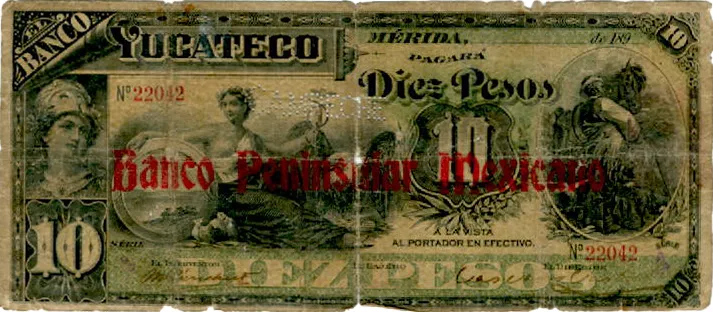
Obverse
Banco Yucateco
Seated female allegories making a toast and the figure of a young man, with a locomotive vignette
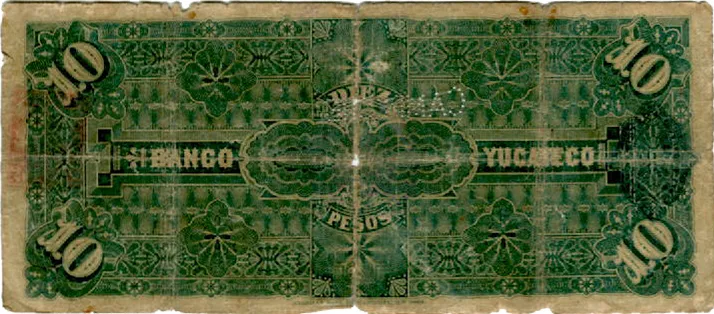
Reverse
Engraved ornamental design with the denomination and the name of the bank
About this banknote
Most old Mexican bank notes are worth a few dollars to a few hundred, not a fortune. The Banco Yucateco 10 pesos note is a genuine piece of history from Mexico's private-bank era, and a clean example can bring real money from world paper money collectors. Here is what actually drives its value in 2026, and how to check yours.
What this note is
The Banco Yucateco was a private bank of issue based in Mérida, Yucatán, during the Porfiriato (the long rule of Porfirio Díaz, roughly 1876 to 1911). In that period, before the Banco de México existed, Mexican states allowed private banks to print and issue their own currency. This 10 pesos note is one of those state private-bank issues.
The bank operated during the henequén boom, when Yucatán grew rich on the fiber crop known as "green gold." That prosperity is stamped right into the design. The front shows seated female allegorical figures raising a toast, the figure of a young man, and a vignette of a locomotive. The train was not decoration: it stood for the railway progress that carried henequén to port. The back carries an engraved ornamental design with the denomination and the bank's name.
Many surviving examples carry a red overprint reading "Banco Peninsular Mexicano." That overprint comes from the 1908 merger with the Banco Mercantil de Yucatán. Whether your note has that overprint or not affects both its identification and, in some cases, its value.
How much is it worth in 2026
This is historic paper money more than a century old, so it has no face value in circulation. Its worth is purely collector value, and that value swings widely based on two things: condition and the rarity of the issuing bank.
Private-bank notes from the Porfiriato and the paper scrip of the Mexican Revolution have their own active market among world banknote collectors (notaphily). Some issues are common and trade cheaply. Others are genuinely scarce, and many circulated so little, or survived so poorly, that finding a complete, intact example today is difficult.
As an honest range: a heavily worn, torn, or repaired example may bring only a few dollars to perhaps 20 or 30 USD. A clean, problem-free note with strong color and full margins can reach the low hundreds of USD, and truly rare varieties or top-grade certified examples go higher. Without a firm auction record for your exact variety and grade, treat any single online "price" with suspicion.
| Feature | What it means for value |
|---|---|
| Denomination | 10 pesos, Banco Yucateco, Mérida |
| Era | Porfiriato private-bank issue (pre-1913) |
| Common overprint | Red "Banco Peninsular Mexicano" (1908 merger) |
| Value driver #1 | Condition (crisp and uncreased vs. worn/torn) |
| Value driver #2 | Scarcity of the specific variety |
| Typical range | A few dollars to low hundreds USD by grade |
What actually drives the price
Age alone does not make a note valuable. Buyers pay for a combination of things:
- Condition. A crisp, uncreased note with full margins and bright ink is worth many times a soft, folded, stained one. Collectors use grades from Poor up to Uncirculated. Tears, pinholes, tape, and trimming all cut value hard.
- The variety. Notes with the "Banco Peninsular Mexicano" overprint, specimen or proof examples, and unissued remainders can trade differently from ordinary issued notes.
- Serial number. Low serial numbers and palindromic (radar) numbers draw extra interest.
- Certification. A note graded by a recognized service (such as PMG) sells for more and faster, because the buyer trusts the grade and authenticity.
The myth: "it's over 100 years old, it must be worth a fortune"
The most common mistake. Being pre-1913 does not guarantee value. Some Porfiriato bank notes were printed in large numbers or survive in quantity, so a worn example is worth only a few dollars regardless of its date. What commands real money is scarcity plus condition, not the calendar.
How to check what yours is worth
- Grade it honestly. Look for folds, tears, pinholes, stains, and trimmed edges. Do not flatten, tape, or "clean" it; that destroys value.
- Identify the exact variety. Note whether the red "Banco Peninsular Mexicano" overprint is present, and record the serial number.
- Photograph both sides in good, even light, flat and in focus.
- Verify authenticity by comparing the design, paper, and signatures against reference images of Banco Yucateco issues. Reproductions and reprints usually show smooth modern paper, flat colors, and no genuine engraved texture. When in doubt, get a second opinion before you buy or sell.
- Get a real appraisal. A serious numismatic dealer or a certified paper-money specialist will value it in person. For certified pieces, a grading service settles both grade and authenticity.
Where to sell it
Sell where informed buyers compete, not to the first person who makes an offer on social media. Reputable options include a verified numismatic dealer, a paper-money auction that handles world banknotes, and collector-to-collector marketplaces. Always disclose the serial number, the exact variety, and clear photos of front and back before agreeing on a price.
Have a Banco Yucateco note, or another Porfiriato private-bank issue, and want a straight read on it? Post clear photos of both sides in the Pesoteca forum and let collectors who know this series weigh in before you sell.
Historical context
The Banco Yucateco operated from 1890 as one of the major issuing banks of the peninsula, sustained by the wealth of henequen and by the trading house of Olegario Molina. This 10-peso note, with no date visible in the catalog, belongs to its mid-circulation series, the ones that truly moved through the daily commerce of Mérida.
Its obverse gathers the usual elements: female allegories toasting, the figure of a young man, and a locomotive vignette. The railway was no mere ornament: it was the infrastructure that made it possible to bring the fiber out from the haciendas to the port of Progreso and, with it, the fortune of the hacienda owners.
As with all of the bank's output, the piece was engraved by the American Bank Note Company. The Banco Yucateco would lose its autonomy in 1905, when it merged with the Banco Mercantil de Yucatán to form the Banco Peninsular Mexicano.
Frequently asked questions
How much is a Banco Yucateco 10 pesos note worth?
It is historic collector paper with no circulating value. A worn or damaged example may bring only a few dollars to around 20 or 30 USD, while a crisp, problem-free note or a scarce certified variety can reach the low hundreds of USD or more. Condition and the rarity of the specific issue decide the price.
Is the Banco Yucateco 10 pesos note rare?
Some Porfiriato private-bank issues are common, and others are genuinely scarce. Many of these notes circulated little or survived poorly, so a complete, intact, high-grade example can be hard to find. Notes with the red "Banco Peninsular Mexicano" overprint and any specimen or proof examples are separate varieties worth identifying precisely.
How can I tell if my Banco Yucateco note is genuine?
Compare the design, paper, signatures, and engraved texture against reference images of Banco Yucateco issues. Genuine notes have engraved detail and period paper; reproductions typically show smooth modern paper and flat, printed color with no real relief. For certainty, submit it to a paper-money grading service or ask experienced collectors in the Pesoteca forum before buying or selling.
Where can I sell a Banco Yucateco 10 pesos note?
Use buyers who know world paper money: a reputable numismatic dealer, a banknote auction that handles Mexican issues, or a collector marketplace. Photograph both sides in good light, note the serial number and whether the "Banco Peninsular Mexicano" overprint is present, and get more than one opinion. Avoid dumping it to the first offer on social media.
Características Banxico
Banco Peninsular Mexicano, CAMPECHE
Familia PRIV
This banknote belongs to the BIL-PRIV family within the Sistema PSM . Explore all the banknotes that share origin, era and design with this piece.
Ver todos los billetes de la familia PRIV →