
Banco Yucateco 10 Pesos (1898)
Familia PRIV · algodón
Period: Bancos privados de emisión
Design
Banxico
Obverse
Banco Yucateco
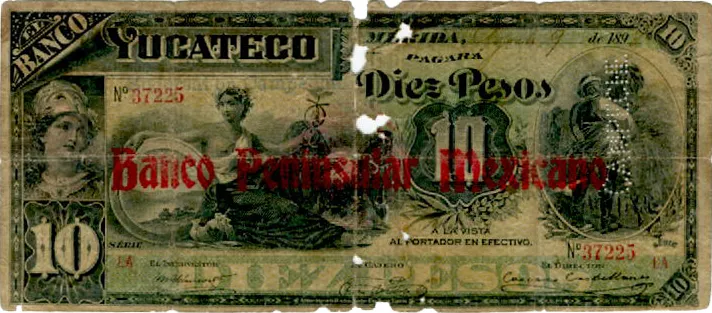
Seated female allegories making a toast and the figure of a young man, with a locomotive vignette
Reverse
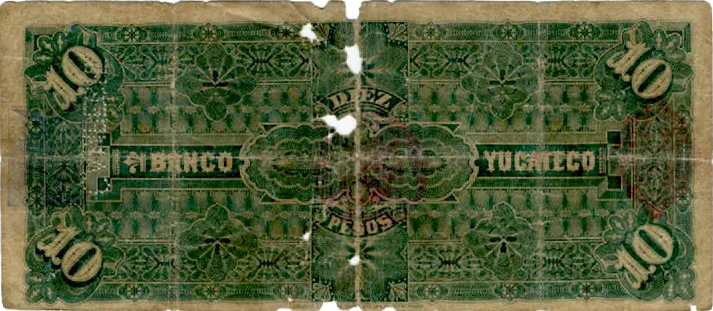
Engraved ornamental design with the denomination and the name of the bank
About this banknote
Most old Mexican paper money is worth a few dollars. The 1898 Banco Yucateco 10 pesos note is different: it comes from Mexico's private bank-note era, and depending on condition and the red overprint it can carry, well-preserved examples trade in the tens to low hundreds of US dollars among world paper money collectors. Here is what yours is actually worth in 2026, and how to check.
What this note is
This is a 10 pesos note issued by the Banco Yucateco of Mérida, in the state of Yucatán. During the Porfiriato (the long presidency of Porfirio Díaz, roughly 1876 to 1911), Mexico had no single national bank of issue. Instead, dozens of private state banks printed their own currency. The Banco Yucateco was one of them, and this note is a survivor from that system.
The bank operated during the henequén boom, when Yucatán grew wealthy on the fiber crop locals called "green gold." The locomotive engraved into the note's vignette is not decoration for its own sake: it advertised the railroads hauling henequén to port, the engine of the regional economy at the time.
The face (anverso) shows seated female allegorical figures raising a toast alongside the figure of a young man, with the locomotive vignette. The back (reverso) carries an ornamental engraved design with the denomination and the bank's name.
The red overprint that changes the value
Many surviving Banco Yucateco notes carry a red overprint reading "Banco Peninsular Mexicano." That stamp is the result of the 1908 merger between the Banco Yucateco and the Banco Mercantil de Yucatán, which combined into the Banco Peninsular Mexicano. Whether your note is a clean Banco Yucateco issue or an overprinted Banco Peninsular Mexicano piece matters to collectors, because the two are catalogued and priced separately. Check yours carefully before assuming which one you have.
How much is it worth in 2026
This is historical paper money, more than a century old, so its value is purely collectible. There is no face value to redeem; the pesos it once represented are long gone. What drives the price is condition, the specific bank issue, and how many examples survived.
Private-bank notes from the Porfiriato and the paper scrip of the Mexican Revolution have their own active market. Some issues are common and bring only a few dollars. Others are genuinely scarce, and many circulated so hard that finding a complete, uncut, undamaged example today is difficult. Condition is decisive: a crisp, uncirculated note can be worth several times a worn, folded, or torn one of the same type.
| Note | Year | Typical collector range (USD) | Notes |
|---|---|---|---|
| Banco Yucateco 10 pesos, circulated | 1898 | 25 to 80 | Folds, soiling, edge wear |
| Banco Yucateco 10 pesos, high grade | 1898 | 100 to 400+ | Crisp, bright, minimal handling |
| With "Banco Peninsular Mexicano" red overprint | post-1908 | Varies | Catalogued separately; compare before pricing |
These are collector ranges for privately issued notes of the era, not guaranteed figures. A specimen note (a printer's sample, often marked "Muestra" or with punched cancellation) or a note in a certified holder from PMG can sit well above these ranges. Treat any single online listing with caution, since sellers often over-ask.
What makes one worth more
Three things move a note like this up in value:
- Condition. No folds, no tears, no staining, bright paper. Grading services describe this as Uncirculated. A creased, limp note is worth a fraction of a crisp one.
- Scarcity of the exact issue. Some series letters and signature combinations are far rarer than others. This is where a catalog reference matters.
- Special features. Low serial numbers, printing errors, and specimen or proof status all add a premium.
Normal wear from age and handling is not an error and does not add value. Only genuine factory anomalies do.
The myth to ignore
Age alone does not make a note valuable. A 125-year-old bank note that was printed in large numbers and survives in quantity can still be worth 20 or 30 US dollars. "It's over a century old" is not a price. Rarity and condition are. Do not trust a headline that puts a private-bank note in the thousands without a matching auction record behind it.
How to check what yours is worth
- Photograph both sides in good, even light. Capture the full note, all four corners, and any red overprint.
- Identify the exact issue. Look for the bank name, the city (Mérida), the date, and any overprint. Match it against a world paper money catalog or an official reference.
- Assess condition honestly. Hold it to the light to check for pinholes, thin spots, and repairs. Repaired or trimmed notes lose value.
- Get a second opinion before you sell. Post clear images in the Pesoteca forum so other collectors can help identify and grade it.
Where to sell it
For a note like this, sell where informed buyers gather. A verified numismatic dealer from the Pesoteca directory can value it in person, and the Pesoteca buy-and-sell forum connects you directly with collectors of Mexican paper money. Always show clear photos of both sides and disclose condition truthfully. Avoid dumping it to the first bidder on a general marketplace, where private-bank notes are routinely underpriced by buyers who know what they are.
Have a Banco Yucateco note, or another Porfiriato private-bank issue you can't identify? Post it in the Pesoteca forum and let the community help you pin down the issue, grade, and a fair value.
Historical context
Toward the end of the 1890s, the Banco Yucateco was living its finest hour: its capital had grown to 1,250,000 pesos in 1898, a direct reflection of the henequen boom that enriched Mérida. This 10-peso note of 1898 circulated right in that period of expansion.
Its obverse keeps the bank's hallmark: female allegories toasting, the figure of a young man, and the locomotive vignette, emblem of the railway that structured the henequen economy. The reverse featured the usual engraved ornamental design with the denomination and the name of the institution.
Like the rest of its issues, this piece was engraved by the American Bank Note Company. The 10 pesos was among the denominations in common use, the ones that truly circulated in the commerce of a city that at the time boasted of being one of the most prosperous in the country.
Frequently asked questions
How much is the 1898 Banco Yucateco 10 pesos note worth?
As historical collectible paper money, not spendable currency. Circulated examples typically bring 25 to 80 US dollars, while crisp, high-grade notes can reach 100 to 400 USD or more. Condition and the exact issue drive the price. Post photos of both sides in the [Pesoteca forum](/foro) for a firm read before selling.
Is the Banco Yucateco 10 pesos note rare?
It depends on the exact issue. This comes from the Porfiriato private-bank era, when dozens of state banks printed their own currency. Some issues are common; others are genuinely scarce, and many circulated so hard that clean, complete examples are hard to find today. Notes with the red "Banco Peninsular Mexicano" overprint are catalogued separately.
Where can I sell the 1898 Banco Yucateco 10 pesos note?
Sell to informed buyers. A [verified dealer in the Pesoteca directory](/tiendas) can value it in person, or use the [Pesoteca buy-and-sell forum](/foro/compra-venta) to reach collectors of Mexican paper money. Photograph both sides in good light and disclose condition honestly. Avoid selling to the first bidder on a general marketplace, where these notes are usually underpriced.
How can I tell if the 1898 Banco Yucateco note is genuine?
Compare the paper, engraving, colors, and signatures against official Banco de México and world paper money references. Genuine notes of this era use engraved detail and textured paper; reproductions tend to have smooth paper and flat, printed-looking color. Check for the locomotive vignette and any red overprint. When in doubt, post clear images in the [Pesoteca forum](/foro).
Características Banxico
Banco Peninsular MexicanoBanco Peninsular Mexicano
Familia PRIV
This banknote belongs to the BIL-PRIV family within the Sistema PSM . Explore all the banknotes that share origin, era and design with this piece.
Ver todos los billetes de la familia PRIV →