
Banco Yucateco 10 Pesos (1899): Value & Rarity
Familia PRIV · algodón
Period: Bancos privados de emisión
Design
Banxico
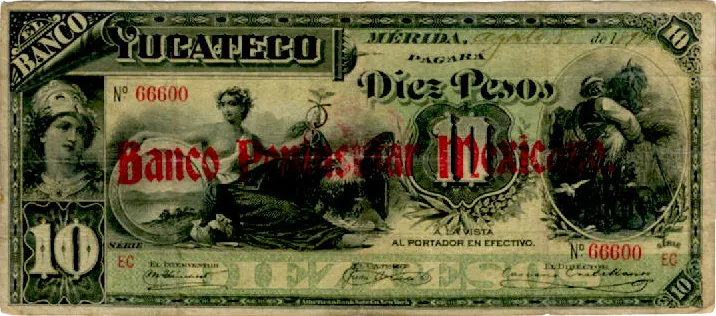
Obverse
Banco Yucateco
Seated female allegories making a toast and the figure of a young man, with a locomotive vignette
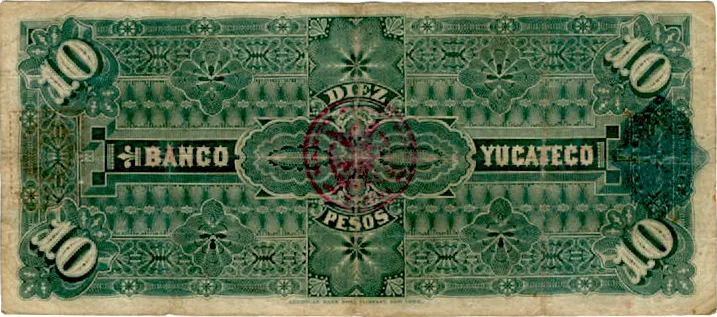
Reverse
Engraved ornamental design with the denomination and the name of the bank
About this banknote
Most people who inherit an old Mexican banknote assume it's worth a fortune. Usually not. An 1899 Banco Yucateco 10 pesos note in worn, damaged condition sells for a few dollars. But a crisp uncirculated example, or one with the scarce red overstamp, can bring several hundred dollars from collectors. Condition and rarity decide everything.
This is not a Banco de México note. It was issued by the Banco Yucateco of Mérida, one of dozens of private state banks that printed their own currency during the Porfiriato (the 1876-1911 rule of President Porfirio Díaz, when Mexican states allowed licensed private banks to issue paper money). These are collected internationally as world paper money, or notaphily.
What it is
The Banco Yucateco operated during the henequen boom, when Yucatán earned real fortunes exporting sisal fiber, locally called "green gold." The note reflects that world. The front (obverse) shows seated female allegorical figures toasting, a young man's portrait, and a locomotive vignette that advertised the railroad progress carrying henequen to port. The back (reverse) carries an engraved ornamental design with the denomination and the bank's name.
Many surviving examples carry a red overstamp reading "Banco Peninsular Mexicano." That stamp comes from the 1908 merger of the Banco Yucateco with the Banco Mercantil de Yucatán. Whether your note has that overstamp affects which catalog listing it falls under and, sometimes, its value.
What it's worth in 2026
This is historical paper money more than a century old, so it has no legal tender value. Its worth is purely to collectors, and it swings widely with condition and how scarce the specific issuer and variety are.
Private-bank notes from the Porfiriato behave differently from later Revolution-era emergency scrip. Some Banco Yucateco issues are relatively available; others are genuinely scarce, and many circulated so briefly that complete, undamaged survivors are hard to find. As a working guide for the 10 pesos:
| Condition | Typical collector range (USD) |
|---|---|
| Heavily worn, holes, tape, tears | 3 to 15 |
| Circulated, intact, some folds | 20 to 75 |
| Crisp, clean, minimal handling | 100 to 250 |
| Uncirculated / with scarce overstamp variety | 250 to 500+ |
These are ballpark figures from the world paper money market, not a guaranteed offer. A single note can fall anywhere in that spread depending on paper quality, ink, and eye appeal. Do not trust the first price you see online. Prices for private-bank notes are set by condition and by how many examples of that exact variety are known, not by age alone.
What raises the value
Four things move a Banco Yucateco note above the common range:
- Condition. A note with no folds, no pinholes, and strong color is worth many times a soft, torn one. Collectors grade paper money on a scale from Poor up to Uncirculated (UNC), and the jump from a folded note to a crisp one is the single biggest value driver.
- The overstamp variety. Whether your note has, or lacks, the red "Banco Peninsular Mexicano" overprint changes which catalog entry it matches. One variety can be materially scarcer than the other.
- Serial number. Low numbers (like 00001) or radar/palindrome serials draw extra demand.
- Genuine printing errors. Misaligned cuts, ink smears, or factory folds turn a common note into a rarity. Normal wear and use damage is not an error.
The myth to ignore
"It's from 1899, so it must be worth thousands." Age alone means almost nothing in paper money. Millions of notes survive from that era, and condition is brutal on paper. A holed, taped, century-old note is a decorative curiosity worth a few dollars. The value lives in scarcity and preservation, not the printed date.
How to tell if yours is genuine
With Porfiriato private-bank notes, watch for modern reproductions and reprints. Compare the paper, the engraving detail, and the signatures against reference images of authentic Banco Yucateco issues. Genuine notes use engraved intaglio printing with fine, sharp line work you can sometimes feel; reproductions tend to have smooth, flat paper and dull, printed-looking color. Fake overstamps also exist, so the red stamp should be examined closely against known genuine examples. If you are unsure, post clear photos of both sides in the Pesoteca forum and let the community weigh in before you buy or sell.
Where to sell it
Sell to people who actually collect this material, not to a general reseller. Your best options:
- A verified numismatic dealer from the Pesoteca directory, who can grade and value it in person.
- The Pesoteca buy-and-sell forum, where collectors of Mexican and world paper money trade directly.
- Established world paper money auction houses and specialist sales, if the note grades high or is a scarce variety.
Photograph both sides in good, even light before you list. Note the serial number, the exact condition, and whether the red overstamp is present. Avoid dumping it to the first Facebook buyer, and be wary of dealers who lowball based on "it's just old."
If you have an 1899 Banco Yucateco note in your hands right now, what does the front look like, and does it carry the red Banco Peninsular overstamp? Post it in the Pesoteca forum and the community will help you place it.
Historical context
By the turn of the century, the Banco Yucateco was one of the two major banks that Yucatán could support thanks to the wealth of henequen (sisal). This 10-peso note of 1899 closes out the 1890s with the bank in full expansion, having raised its capital in step with the henequen boom.
The obverse repeats the house iconography: female allegories toasting, the figure of a young man, and a locomotive vignette, a symbol of the railway that carried the fiber from the haciendas to the port of Progreso. The reverse, with its engraved ornamentation, finished off a mid-circulation note.
Engraved by the American Bank Note Company of New York, this 10-peso note represented a practical denomination for commerce in Mérida. Six years later, the 1905 merger with the Banco Mercantil would give rise to the Banco Peninsular Mexicano.
Frequently asked questions
How much is the 1899 Banco Yucateco 10 pesos note worth?
It has no face value today, only collector value. A worn or damaged example sells for roughly 3 to 15 USD. An intact circulated note runs about 20 to 75 USD, and a crisp, clean example or a scarce variety can reach 250 to 500 USD or more. Condition and rarity decide the price, not age.
Is the Banco Yucateco 10 pesos note rare?
Some Banco Yucateco issues are fairly available, but others are genuinely scarce, especially in high grade. Many circulated so little that complete, undamaged survivors are hard to find. Notes with the red 'Banco Peninsular Mexicano' overstamp, low serial numbers, or genuine printing errors are the ones collectors chase.
How can I tell if my Banco Yucateco note is genuine?
Compare the paper, engraving detail, and signatures against reference images of authentic notes. Genuine issues use sharp intaglio (engraved) printing; reproductions have flat, smooth paper and dull color. Fake red overstamps also exist, so examine that stamp closely. When in doubt, post clear photos of both sides in the Pesoteca forum before buying or selling.
Where can I sell the 1899 Banco Yucateco 10 pesos note?
Sell to collectors of world paper money, not general resellers. A verified dealer from the Pesoteca directory can value it in person, and the Pesoteca buy-and-sell forum connects you with specialist collectors. For high-grade or scarce varieties, established world paper money auctions are worth considering. Photograph both sides in good light and note the serial and any overstamp first.
Características Banxico
Banco Peninsular Mexicano
Familia PRIV
This banknote belongs to the BIL-PRIV family within the Sistema PSM . Explore all the banknotes that share origin, era and design with this piece.
Ver todos los billetes de la familia PRIV →