
Banco Yucateco 10 Pesos (1901): Value & Rarity
Familia PRIV · algodón
Period: Bancos privados de emisión
Design
Banxico
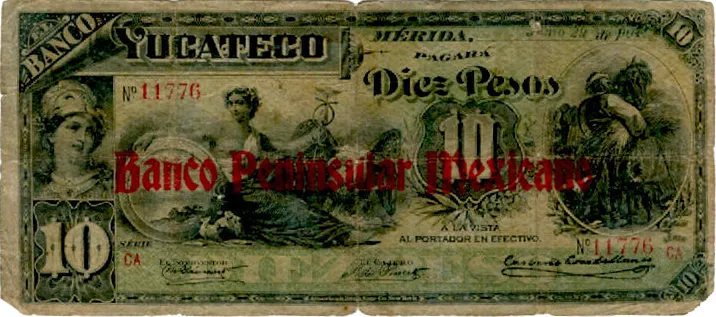
Obverse
Banco Yucateco
Seated female allegories making a toast and the figure of a young man, with a locomotive vignette
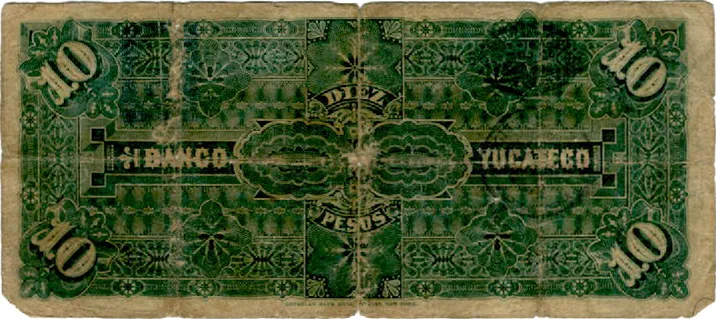
Reverse
Engraved ornamental design with the denomination and the name of the bank
About this banknote
Most Porfiriato-era Mexican bank notes sell for a few dollars to a few hundred USD, not thousands. The Banco Yucateco 10 pesos of 1901 is a genuine collectible piece of Mexican banking history, but its price is driven by condition and rarity, not just age. Here is what yours is actually worth and how to check.
What this note is
The Banco Yucateco was a private bank of issue based in Mérida during the presidency of Porfirio Díaz, a period Mexicans call the Porfiriato (roughly 1876 to 1911). Back then, before the Banco de México existed, individual state banks printed their own currency. This 10 pesos note dates to 1901, near the height of the henequén boom, when Yucatán's fiber industry (called "green gold") made the region one of the wealthiest in Mexico.
The design tells that story. The face shows seated female allegories raising a toast, the figure of a young man, and a vignette of a steam locomotive, a nod to the railway progress that carried henequén to port. The back carries an engraved ornamental design with the denomination and the bank's name.
Many surviving examples carry a red overstamp reading "Banco Peninsular Mexicano." That mark comes from the 1908 merger of the Banco Yucateco with the Banco Mercantil de Yucatán. Whether your note is unstamped or overstamped affects which collectors want it, and sometimes the price.
What it's worth in USD
This is historic paper money, more than a century old, so its value is purely collectible. It has no face value you can spend. Price comes down to two things: condition and how rare the specific note is.
For Mexican private-bank notes of this era, the realistic range runs from roughly a few dollars for a heavily worn, damaged example to several hundred USD for a crisp, problem-free note. Unissued or specimen notes, and rare signature or overstamp combinations, can climb higher. The very common issues stay modest no matter their age, so "it's from 1901" alone does not make it valuable.
| Note | Year | Typical range (USD) | What drives the top price |
|---|---|---|---|
| Banco Yucateco 10 pesos (worn) | 1901 | 5 to 40 | Complete, no tears |
| Banco Yucateco 10 pesos (mid grade) | 1901 | 40 to 150 | Full margins, light handling |
| Banco Yucateco 10 pesos (high grade / uncirculated) | 1901 | 150 to 600+ | Crisp paper, sharp color, scarce variety |
| Specimen or unissued remainder | 1901 | Varies, often higher | Pristine, no cancellation damage |
These are collector ranges, not guaranteed prices. A graded note (see below) at the top end of preservation can beat them; a soiled or repaired one falls to the bottom.
The myth to drop
A lot of people assume any Mexican note over 100 years old is worth a fortune. It rarely is. Age is common; condition and rarity are not. A tattered Banco Yucateco note that has been folded, taped, or trimmed is worth a fraction of a clean one. What actually pushes value up is a note that survived with strong paper, bright ink, full margins, and no repairs, plus a variety collectors are hunting for.
How to check what yours is worth
- Grade it honestly. Flatten the note and look for folds, tears, pinholes, stains, and tape. Notaphily grading runs from Poor up to Uncirculated. The difference between a folded example and a crisp one can be 10x in price.
- Check the variety. Note whether it carries the red "Banco Peninsular Mexicano" overstamp, and read the signatures and serial number. Low serial numbers can add a premium.
- Get it authenticated. Third-party grading services like PMG (Paper Money Guaranty) will certify authenticity and assign a grade, which makes selling to international collectors far easier.
- Compare real sales. Look at completed auction results from Heritage Auctions and Stack's Bowers, which handle Mexican paper money, rather than optimistic asking prices on general marketplaces.
How to spot a genuine note
Compare the paper, the engraving, and the signatures against verified images. Genuine notes of this period were engraved with fine line work you can feel and see under magnification. Reproductions and printed "replica" pieces tend to have flat, smooth paper and solid, dead color instead of the detailed intaglio lines. If a note looks too clean and too even, treat it with suspicion. When in doubt, post clear photos of both sides in the Pesoteca forum for a second opinion, or send it to PMG.
Where to sell
For a note like this, your best options are a verified numismatic dealer, a specialist auction house that handles world paper money (Heritage and Stack's Bowers both do), or a collector-to-collector marketplace. Photograph both sides in good, even light, note any overstamp or low serial number, and get an authentication before you set a price. Avoid dumping it to the first bidder on a general social-media group, where scarce notes routinely sell for well under their real value.
Have a Banco Yucateco note, or another Porfiriato-era bank issue you can't identify? Post photos of both faces in the Pesoteca forum and let the community help you pin down the variety and a fair value.
Historical context
In 1901, the Banco Yucateco was still a central piece of the financial machinery of the henequen boom. This 10-peso note from that year circulated when Mérida was experiencing one of the peaks of its prosperity, with hacienda owners exporting the fiber to the United States and Europe and exchanging their gold for the bank's paper.
The obverse preserves the house's motifs: female allegories making a toast, the figure of a young man, and the locomotive vignette, a reminder that the railroad was the backbone of the Yucatecan henequen economy. The reverse bore the usual engraved ornamental design.
Printed by the American Bank Note Company, this 10-peso note belonged to the denominations of everyday circulation. The bank would maintain its independent issue until the 1905 merger with the Banco Mercantil de Yucatán, origin of the Banco Peninsular Mexicano.
Frequently asked questions
How much is a Banco Yucateco 10 pesos (1901) note worth?
It's a collector item with no spendable face value. Realistic prices run from about 5 to 40 USD for a worn, complete example up to several hundred USD for a crisp, high-grade note. Rare varieties, specimens, and low serial numbers can go higher. Condition and rarity drive the price, not age alone.
Is the Banco Yucateco 10 pesos note rare?
Some Porfiriato private-bank notes are common and others are genuinely scarce. Many circulated so little, or survived in such poor shape, that clean, complete examples are hard to find. Whether yours carries the red 'Banco Peninsular Mexicano' overstamp and its condition both affect how sought-after it is.
How can I tell if my Banco Yucateco note is genuine?
Compare the paper, engraving, and signatures to verified images. Real notes have fine intaglio line work you can feel; replicas usually have smooth paper and flat color. For certainty, send it to PMG (Paper Money Guaranty) for authentication and grading, or post clear photos of both sides in the Pesoteca forum for review.
Where can I sell a Banco Yucateco 10 pesos (1901) note?
Use a verified numismatic dealer, a specialist auction house that handles world paper money such as Heritage Auctions or Stack's Bowers, or a collector-to-collector marketplace like the Pesoteca forum. Get it authenticated first, photograph both sides in good light, and note any overstamp or low serial number before setting a price.
Características Banxico
Banco Peninsular Mexicano
Familia PRIV
This banknote belongs to the BIL-PRIV family within the Sistema PSM . Explore all the banknotes that share origin, era and design with this piece.
Ver todos los billetes de la familia PRIV →