
Mexico 10 Pesos (1915) Carranza Note: Value & Rarity
Familia REV · algodón
Period: Revolución Mexicana
Design
Banxico
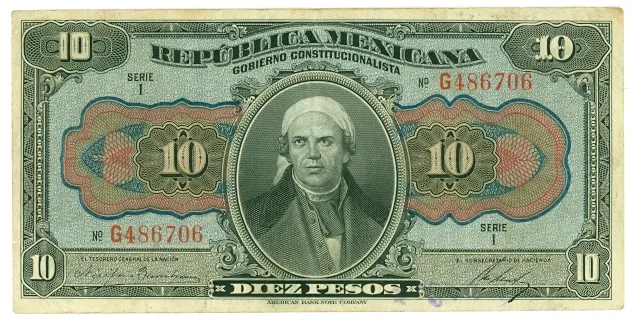
Obverse
Gobierno Constitucionalista
An engraved historical portrait in the center with the legend República Mexicana
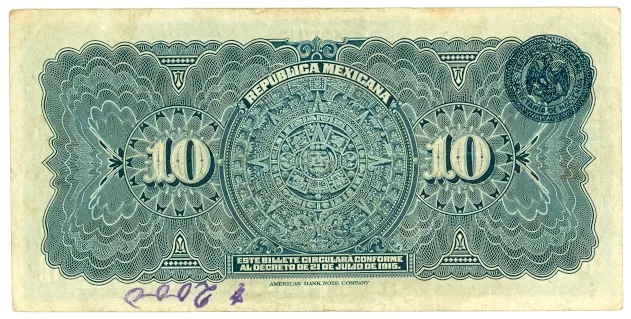
Reverse
The Sun Stone or Aztec Calendar
About this banknote
Most 1915 Mexican 10 pesos notes are worth a few dollars, not a fortune. But condition, the issuing office, and printing errors can push a single note into the hundreds of dollars. Here is what actually drives the price, and how to check yours in 2026.
This is not modern currency you can spend. It is a Revolution-era note from the Gobierno Constitucionalista de Carranza (the Constitutionalist Government led by Venustiano Carranza), issued under an official decree of 1915. Its worth today is purely collector value, measured in the world paper money market that English-speaking notaphilists (paper money collectors) actively trade in.
What a 1915 Mexico 10 Pesos Note Is
During the Mexican Revolution, the Carranza faction printed its own paper money to fund the war against Victoriano Huerta and to impose order on the chaos of competing revolutionary issues. Rival forces under Pancho Villa and Emiliano Zapata printed their own notes too, so the country was flooded with paper. The Constitutionalist notes carried national imagery to signal that Carranza's side was the legitimate government.
On the face (obverse) is an engraved historical portrait at center with the legend "REPUBLICA MEXICANA." The back (reverse) shows the Piedra del Sol, the Aztec Sun Stone commonly called the Aztec calendar. These design elements, along with the paper, the printed signatures, and the serial numbering, are what you compare against reference images to confirm you have a genuine 1915 issue and not a later reproduction.
What It's Worth Today
This is more than a century old, and value depends heavily on three things: condition, how scarce the specific issue is, and whether the note has any collectible quirk (a printing error, a low serial number, or a repeating serial).
Revolution-era paper is a category of its own. Some issues are common and trade for only a few dollars. Others are genuinely scarce because they circulated so little, or so hard, that few survive intact. A creased, soiled, torn note sits at the bottom of the range. A crisp, uncirculated example with strong color and full corners can be worth many times that.
Honest ranges for notes from this Revolution period, depending on the exact issue and grade:
| Condition (grade) | Typical value range (USD) |
|---|---|
| Well-circulated (folds, wear, soiling) | 3 to 15 dollars |
| Lightly circulated (Fine to Very Fine) | 15 to 60 dollars |
| About Uncirculated to Uncirculated | 60 to 300+ dollars |
| Scarce office/variety or notable error | can exceed several hundred dollars |
These are guide ranges, not fixed prices. The specific state, bank, or military office that issued a Revolution note matters enormously, so two notes of the same denomination and year can be worth very different amounts. Do not trust the first price you see online. Confirm the exact issue before you buy or sell.
The Myth: "It's a Hundred Years Old, So It Must Be Worth a Fortune"
Age alone does not make a note valuable. Millions of Revolution notes were printed, and many survive. What creates value is scarcity plus demand plus condition. A common 1915 issue in worn condition is worth pocket change to a collector. The record prices you sometimes read about apply to specific rare offices, error notes, or pristine uncirculated examples, not to the average note in a shoebox.
What Makes One Worth More
Check these before you assume yours is ordinary:
- Condition. No folds, no tears, no soiling. Crisp uncirculated paper commands a large premium. Never flatten, tape, or "clean" a note; that destroys value.
- Serial number. A very low number (like 0000012) or a palindrome/repeating serial (a radar note, such as 1234321) draws extra demand.
- Printing errors. Misaligned cuts, ink smears, factory folds, or off-center printing turn a common note into a rarity worth several times face value. Ordinary wear and use damage is not a factory error.
- Scarce issuing office. Some Constitutionalist issues are far scarcer than others. This is where an expert eye pays off.
How to Tell If It's Genuine
Compare your note against official Banco de México and reference-catalog images of the 1915 Constitutionalist issue. Look at the paper texture, the sharpness of the engraving, the color, and the printed signatures. Genuine period notes have real engraved detail and paper that shows its age. Reproductions and souvenir copies tend to have smooth, uniform paper and flat, printed-looking color with no engraving depth. If anything looks off, post clear photos of both sides in the Pesoteca forum and let the community weigh in.
Where to Sell It
To sell a 1915 10 pesos Carranza note safely:
- Get it in front of collectors who know Revolution paper. The Pesoteca buy-and-sell forum connects you directly with them.
- Use a verified dealer from the Pesoteca shop directory for an in-person appraisal without a middleman markup.
- Photograph both sides in good, even light before listing. Note the serial number, any error, and the exact condition.
- Do not dump it to the first buyer on social media. A scarce office or a low serial can multiply the value, and a snap sale leaves that money on the table.
Got a 1915 Carranza note (or a whole stack of Revolution paper) and not sure which issues you're holding? Post front-and-back photos in the Pesoteca forum and we'll help you sort the common from the scarce.
Historical context
A 10-peso note from 1915 issued by the Mexican Republic, Constitutionalist Government, the movement led by Venustiano Carranza during the most turbulent stage of the Revolution. With the country fractured into factions and official money in crisis, the constitutionalists resorted to printing their own paper to finance the war and the administration.
The design repeats the formula meant to inspire confidence: a historical portrait engraved at the center and the legend República Mexicana, seeking to have the note perceived as money of the entire country. On the reverse, the Sun Stone, one of the most recognizable emblems of Mexican identity, reinforces that aspiration to national legitimacy.
The great problem was the overabundance of issues. Villistas, Zapatistas, state governments, and Carrancistas produced paper simultaneously, which triggered distrust and inflation; metal coinage disappeared from circulation because people hoarded it. Thus, 1915 was marked as the year of monetary chaos, and these 10-peso notes are a faithful portrait of that war economy.
Frequently asked questions
How much is a 1915 Mexico 10 pesos note worth?
It depends on condition and the exact issue. A worn, folded example is worth roughly 3 to 15 US dollars. A crisp uncirculated note can bring 60 to 300 dollars or more, and a scarce issuing office or a genuine printing error can push it well past several hundred. This is collector value only; the note cannot be spent.
Is the 1915 10 pesos Carranza note rare?
Some issues are common and easy to find; others are genuinely scarce because they circulated hard and few survive intact. Rarity depends on the specific issuing office, not just the year. Condition, a low or repeating serial number, and printing errors all make a note more sought after by collectors.
Where can I sell a 1915 Mexican 10 pesos note?
The safest routes are the [Pesoteca buy-and-sell forum](/foro/compra-venta), where you reach collectors of Revolution-era paper, or a verified dealer from the [Pesoteca shop directory](/tiendas) for an in-person appraisal. Photograph both sides in good light and check for a low serial or error before selling. Avoid dumping it to the first social-media offer.
How can I tell if my 1915 10 pesos note is genuine?
Compare the paper, engraving sharpness, color, and printed signatures against official Banco de México and catalog reference images of the 1915 Constitutionalist issue. Genuine notes show real engraved detail and aged paper; reproductions have smooth paper and flat, printed-looking color. When in doubt, post clear photos of both sides in the [Pesoteca forum](/foro).
Familia REV
This banknote belongs to the BIL-REV family within the Sistema PSM . Explore all the banknotes that share origin, era and design with this piece.
Ver todos los billetes de la familia REV →