
Mexico 100 Pesos of 1866: Value & How to Sell
Familia ANT · algodón
Period: Antecedentes del papel moneda
Design
Banxico
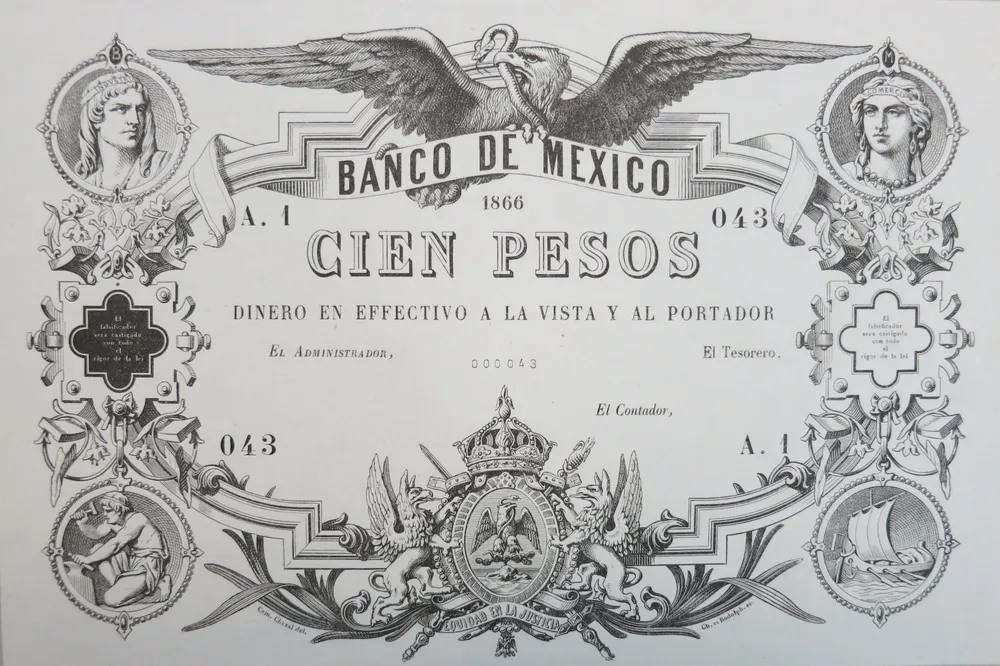
Obverse
Banco de México (1866)
Female allegories, a crowned eagle, and the imperial coat of arms
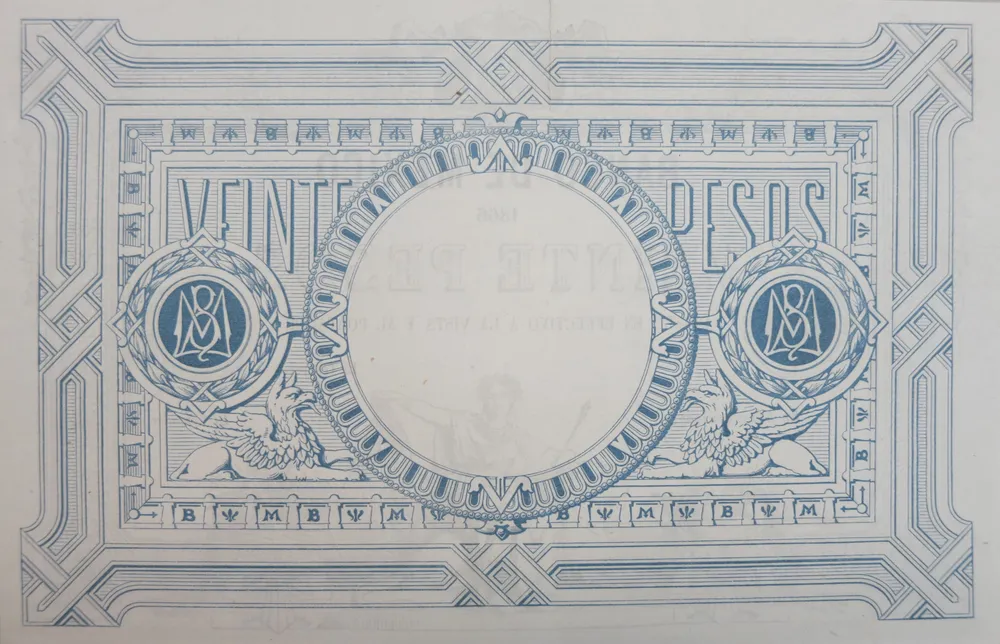
Reverse
Nineteenth-century ornamental design
About this banknote
Most old paper money is worth pocket change, but the 1866 Mexican 100 pesos is a different animal. This is a mid-19th-century note tied to Mexico's Second Empire, and the few known examples are scarce enough that value is set at specialist auction, not at a coin shop counter. If you actually have a genuine one, you are holding a note that can bring hundreds to several thousand dollars depending on type and condition.
What the 1866 100 pesos is
This note dates to 1866, during the reign of Maximilian I and the Second Mexican Empire. The design reflects that era: the face carries female allegorical figures, a crowned eagle, and the imperial coat of arms. The back shows ornamental 19th-century engraving typical of banknotes from that period.
A critical point for collectors: many surviving examples of very early Mexican notes are proofs or specimens rather than issued, circulated notes. A proof is a test printing used before production. A specimen is a sample copy, often marked or perforated, kept for reference and never spent. These behave very differently in the market than a note that actually circulated, and telling them apart is where value is won or lost.
How much is it worth in 2026
There is no single sticker price for this note, and any site quoting you one exact figure is guessing. Value depends on four things:
- Type: issued note vs. proof vs. specimen. Each is priced separately.
- Grade: a note graded by PMG (Paper Money Guaranty) sells for a premium over an ungraded, uncertified one.
- Condition: creases, tears, stains, and trimming all pull the price down hard.
- Where it sells: a specialist auction of Mexican paper money will realize far more than a general online listing.
Because of that spread, treat any figure as a range, not a promise. Notes of this age and origin move through specialist sales, so the smart first step is an appraisal from someone who handles Mexican notaphily, not a quick sale to the first buyer.
| Note | Year | Type | Realistic value range (USD) |
|---|---|---|---|
| Mexico 100 pesos | 1866 | Issued (circulated) | Several hundred to several thousand, condition dependent |
| Mexico 100 pesos | 1866 | Proof / specimen | Priced individually at specialist auction |
If you want a firm number for your specific note, post clear photos of both sides in the Pesoteca forum or take it to a verified dealer. Nobody can price this note accurately from a description alone.
The myth to avoid
Age alone does not make a note valuable, and "1866" is not a magic date that guarantees a windfall. What matters is real scarcity, correct identification of type, and grade. Just as important: notes this old and this desirable are targets for reproductions and outright fakes. A convincing-looking piece with flat colors and smooth modern paper is almost certainly not a genuine Second Empire note.
How to tell if yours is genuine
Compare your note against reference images from the Banco de México and specialist catalogs. On period notes, check:
- Paper: genuine 19th-century notes have a distinctive stock. Reproductions feel smooth and modern.
- Printing: original engraving shows crisp, layered detail. Reprints look flat with even, printed color.
- Signatures and design elements: these should match documented examples exactly.
- Specimen/proof markings: perforations, overprints, or reference notations point to a non-issued piece, which changes value but does not make it fake.
For a note in this class, the safest move is professional authentication and grading through a service like PMG before you buy or sell anything.
Where to sell it
Do not dump a note like this into a fast Facebook sale to the first offer. For a piece of this rarity, your best options are:
- A verified numismatic dealer from the Pesoteca shop directory, who can assess it in hand.
- The collector buy/sell forum at Pesoteca, among people who actually know Mexican paper money.
- For a confirmed genuine issued note or a proof/specimen, a specialist paper-money auction is often where the strongest prices are realized.
Always photograph both sides in good light, note any special markings, and get an authentication opinion before agreeing to a price.
Have a note you think might be an 1866 100 pesos, or an older Mexican note you can't identify? Post both sides in the Pesoteca forum and let collectors help you figure out what you actually have.
Historical context
A 100-peso note of 1866, part of the precursors of paper money in Mexico, associated with the issues bearing the name Banco de México that arose during Maximilian's Second Empire, with no connection to the central institute we know today, created in 1925.
The obverse brings together female allegories, a crowned eagle, and the imperial coat of arms, iconography that betrays its origin in the brief government of Maximilian of Habsburg, when the project of issuing voluntarily accepted paper money was taken up again under new conditions.
This kind of high denomination was printed abroad, first with Perkins Bacon and Company and later with the American Bank Note Company. The piece is a testament to a monetary experiment that, despite the Empire's brevity, left the country one of its first successful experiences with bank notes.
Frequently asked questions
How much is the 1866 Mexican 100 pesos note worth?
It depends heavily on type and condition. A genuine issued note can range from several hundred to several thousand dollars, while proofs and specimens are priced individually at specialist auction. There is no single fixed price, so get it appraised rather than trusting one quoted figure.
Is the 1866 100 pesos note rare?
Yes. It is a mid-19th-century note tied to Mexico's Second Empire, and many surviving examples are proofs or bank specimens rather than issued, circulated notes. That scarcity is exactly why it needs professional identification and grading to value correctly.
How do I tell if my 1866 100 pesos note is genuine?
Compare the paper, engraving, signatures, and design against Banco de México references. Genuine period notes have distinctive paper and crisp, layered printing; reproductions feel smooth and modern with flat color. For a note this valuable, professional authentication and grading through a service like PMG is the safest path.
Where can I sell an 1866 Mexican 100 pesos note?
Use a verified dealer from the [Pesoteca shop directory](/tiendas) or the collector [buy/sell forum](/foro/compra-venta). For a confirmed genuine issued note, proof, or specimen, a specialist paper-money auction often realizes the strongest prices. Photograph both sides, get it authenticated, and avoid selling fast to the first online buyer.
Características Banxico
Prueba del anverso. Unifaz, Cam. Chazal del./Ch. et Rodolph. sc.
Familia ANT
This banknote belongs to the BIL-ANT family within the Sistema PSM . Explore all the banknotes that share origin, era and design with this piece.
Ver todos los billetes de la familia ANT →