
Banco de Zacatecas 100 Pesos (1900): Value & Rarity
Familia PRIV · algodón
Period: Bancos privados de emisión
Design
Banxico
Obverse
Banco de Zacatecas
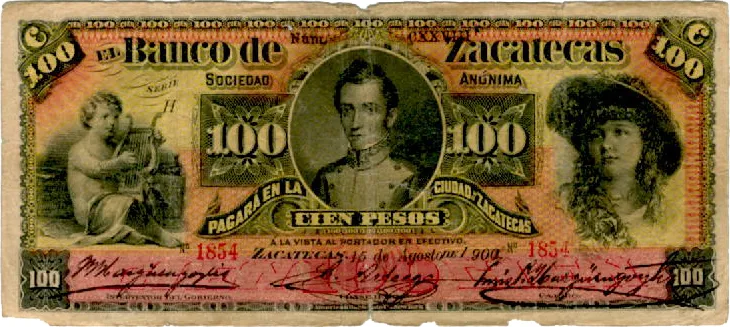
Engraved allegorical vignettes: a miner on the left, a female figure with goods in the center, and the profile portrait of a young man on the right
Reverse
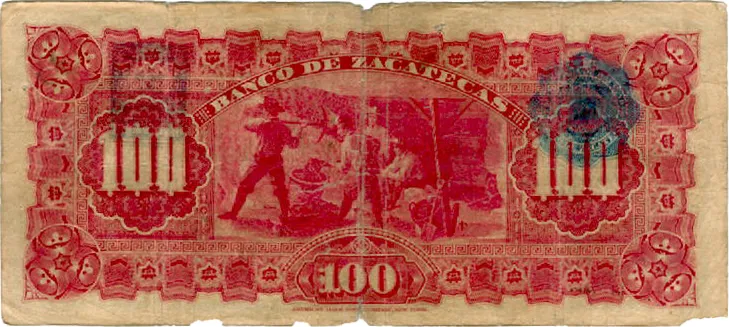
Scenes of mining and labor, or a monument set against the mountainous landscape of Zacatecas
About this banknote
If you inherited a large, ornate 100 pesos note that says Banco de Zacatecas and dates to around 1900, you own a private mining-bank note from Mexico's Porfiriato era, not a Banco de México bill. Most surviving examples sell for a few dollars to a few hundred USD depending on condition and whether the note was ever redeemed. A crisp, uncanceled, high-grade example can command more. In 2026, world paper money (notaphily) collectors treat these private-bank issues as a distinct and active niche.
What you actually have
Before Mexico had a single central bank, individual states licensed private banks to print their own paper money, each note backed by silver held in reserve. Zacatecas was one of the great silver-mining states, so its bank issued notes whose engraved vignettes celebrate mining: the ore in the ground was the literal guarantee behind the paper.
This system of multiple issuing banks ("banca de emisión múltiple") ended when the Banco de México was founded in 1925 and became the sole note issuer. That makes any genuine Banco de Zacatecas note pre-1925, and this design dates to roughly 1900.
Front (anverso): engraved allegorical vignettes, a miner on the left, a female figure with goods at center, and a young man's portrait in profile on the right.
Back (reverso): scenes of mining and labor, or a monument set against the mountainous Zacatecas landscape.
How much is it worth
This is historical paper money more than a century old, so the value is purely collector value. There is no "face value" you can spend. Two things drive the price: condition and the rarity of the issuing bank.
Private-bank notes from the Porfiriato split into two very different groups:
- Common issues that survived in quantity (often because they were remainders never put into circulation, or redeemed and stored). These trade in the low tens of USD.
- Scarce issues from banks that produced small quantities, or high denominations like the 100 pesos that few people held. These are genuinely hard to find intact.
Many of these notes circulated so little, or were destroyed on redemption, that a complete, undamaged example is the exception. That scarcity is what a serious buyer pays for.
| Note | Bank / State | Era | Typical collector range (USD) |
|---|---|---|---|
| 100 pesos | Banco de Zacatecas | c. 1900 | ~50 to several hundred, grade-dependent |
| Lower denominations (1, 5, 10 pesos) | Banco de Zacatecas | Porfiriato | ~10 to 80 |
| High-grade uncirculated 100 pesos | Banco de Zacatecas | c. 1900 | can exceed the ranges above |
The 100 pesos was a large denomination for the period, so genuine circulated examples are less common than the small change notes. But condition still decides everything: a folded, stained, or torn example is worth a fraction of a crisp one.
The myth to avoid
Old does not mean valuable. A century-old note that is common, damaged, or was printed in the thousands is still worth only what a collector will pay, often a modest amount. Age adds interest, not automatic money. Do not trust the first inflated price you see on a social-media listing.
Is it a remainder or a genuinely issued note?
One detail matters a lot with private-bank money: whether the note was issued (signed, serial-numbered, sometimes cut-canceled or hole-punched when redeemed) or a remainder (unsigned, unissued, never put into circulation). Remainders often survive in bright, uncirculated shape because they never left the bank, which can make them common. A genuinely issued and redeemed note tells a fuller story but may show wear or cancellation marks. Collectors value both, but for different reasons, so identify which one you have.
How to check what yours is worth
- Grade it honestly. Look for folds, tears, stains, pinholes, and missing corners. Crisp and flat is worth far more than soft and creased. Professional grading services (PMG is the standard for paper money) can slab and certify high-value notes.
- Read the serial number and signatures. Confirm the bank name, denomination, and date. Note whether it is hand-signed and serial-numbered (issued) or blank (remainder).
- Check for genuineness. Genuine period notes use engraved intaglio printing with fine, raised line detail, quality banknote paper, and correct signatures. Reproductions and fantasy prints tend to have flat, screen-printed color, smooth modern paper, and fuzzy detail. Compare against reference images of Banco de Zacatecas issues.
- Compare to sold results, not asking prices. Heritage Auctions and Stack's Bowers both handle Mexican private-bank and revolutionary paper money, and their archives show real hammer prices.
Where to sell
For a note like this, sell where knowledgeable buyers actually are. Options that work for a US or international collector:
- A specialist world-paper-money dealer who handles Mexican and Latin American notes.
- Auction houses such as Heritage or Stack's Bowers for higher-grade or scarcer examples, where competing bidders set a fair price.
- Collector forums and marketplaces focused on notaphily, where you can post clear photos of both sides and ask before you sell.
Photograph the front and back in good, even light, note any serial number, signatures, or cancellation marks, and get a second opinion before accepting an offer. Avoid dumping it to the first buyer on a general marketplace.
Not sure what your Banco de Zacatecas note really is, remainder or issued, common or scarce? Post clear photos of both sides in the Pesoteca forum and let collectors who handle these weigh in before you set a price.
Historical context
At the turn of the century, the Banco de Zacatecas was already an established institution within the system of private banks of issue that characterized Porfirian Mexico. This 100-peso note dated 1900 marks that start of the 20th century, when the bank combined issuance, deposit, discount, and mortgage operations for the benefit of regional commerce and mining.
Its allegorical vignettes sustain the usual narrative: the miner as a symbol of Zacatecan silver, the female figure with goods as an emblem of prosperous commerce, and the young man in profile who tops off the composition. On the reverse, scenes of labor and the mountainous landscape anchored the piece in the territory that gave it its name.
Printed by the American Bank Note Company, this high-denomination note was not pocket money but an instrument for large payments in an economy still dominated by silver specie.
Frequently asked questions
How much is a Banco de Zacatecas 100 pesos note worth?
It is worth collector value only, not face value, because these private-bank notes were retired long ago. Common or worn examples sell for tens of USD, while a crisp, uncirculated, genuinely issued 100 pesos can reach several hundred USD. Condition and whether it is a remainder or an issued note drive the price.
Is the Banco de Zacatecas 100 pesos note rare?
It depends on the exact note. Lower denominations that survived as unissued remainders are fairly common. The 100 pesos was a high denomination that few people held, so genuinely issued, complete examples in good condition are scarcer and harder to find intact than the small change notes.
Where can I sell a Banco de Zacatecas note?
Sell through a specialist world-paper-money dealer, an auction house such as Heritage or Stack's Bowers for higher-grade examples, or a notaphily collector marketplace. Photograph both sides in good light, note any serial number or cancellation marks, and get a second opinion before accepting an offer. You can post it in the [Pesoteca forum](/foro) for feedback first.
How do I tell if my Banco de Zacatecas note is genuine?
Genuine period notes use engraved intaglio printing with fine, slightly raised line detail, quality banknote paper, and correct signatures. Reproductions and fantasy prints usually show flat, screen-printed color, smooth modern paper, and fuzzy detail. Compare your note against reference images of Banco de Zacatecas issues, and ask in the [Pesoteca forum](/foro) if you are unsure.
Características Banxico
Firmas autógrafas, CXXVI
Familia PRIV
This banknote belongs to the BIL-PRIV family within the Sistema PSM . Explore all the banknotes that share origin, era and design with this piece.
Ver todos los billetes de la familia PRIV →