
100 Pesos Banknote (1903), Banco de Zacatecas
Familia PRIV · algodón
Period: Bancos privados de emisión
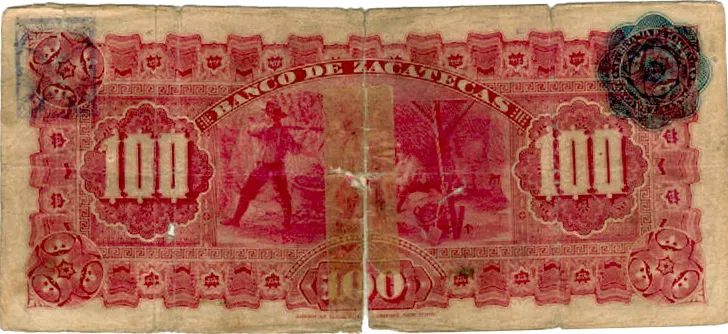
Design
Banxico
Obverse
Banco de Zacatecas
Engraved allegorical vignettes: a miner on the left, a female figure with goods in the center, and the profile portrait of a young man on the right
Reverse
Scenes of mining and labor, or a monument set against the mountainous landscape of Zacatecas
About this banknote
Most people who inherit a stack of old Mexican paper money expect one big payday. The truth is more nuanced: a worn 1903 Banco de Zacatecas 100 pesos note might bring 20 to 50 US dollars, while a crisp, well-preserved example from a scarce private bank can climb into the hundreds. Condition and the issuing bank decide everything.
This is a piece of pre-central-bank Mexican history. If you have one, here is what actually drives its value, how to tell if yours is real, and where to sell it without getting shortchanged.
What it is
The 1903 Banco de Zacatecas 100 pesos note comes from the era before Mexico had a single central bank. During the Porfiriato (the long rule of president Porfirio Díaz, roughly 1876 to 1911), individual states licensed private banks to print their own paper money, each note backed by silver held in reserve.
Zacatecas was one of the great silver-mining states, so its bank existed on the strength of the metal coming out of its mines. That is why the artwork on the note leans on mining themes: the ore in the ground was the guarantee behind the paper. This system of multiple issuing banks ended when the Banco de México was founded in 1925, which is why notes like this one no longer have any legal-tender function at all. They are collector items, full stop.
Design and description
Front (obverse): engraved allegorical vignettes. A miner stands on the left, a female figure surrounded by goods sits at the center, and a young man is shown in profile portrait on the right. The bank name, denomination (100 pesos), and issue details appear across the note.
Back (reverse): scenes of mining and labor, or a monument set against the mountainous Zacatecas landscape, depending on the printing.
What it's worth in 2026
Because this note is more than a century old and no longer legal tender, its value is entirely collector-driven. Two things move the price: condition and the rarity of the issuing bank.
Private-bank notes from the Porfiriato, along with the emergency scrip printed during the Mexican Revolution, form their own active corner of world paper money collecting (notaphily). Some of these notes are common and trade for pocket change; others are genuinely scarce because so few survived. Many circulated so briefly, or were redeemed and destroyed, that a complete, undamaged example is hard to find today.
For the Banco de Zacatecas 100 pesos, expect a broad range:
| Condition | Typical value (USD) |
|---|---|
| Heavily worn, tears, missing corners | 15 to 40 |
| Circulated but complete, moderate folds | 40 to 120 |
| Crisp, minimal handling (about uncirculated) | 150 to 400 |
| Uncirculated, exceptional eye appeal | 400 and up |
These are guide ranges, not fixed quotes. Auction results for Mexican private-bank notes vary widely by specific bank, and a lower denomination in top grade can outperform a battered high denomination. A canceled or specimen note (marked SPECIMEN or with cancellation punches) is priced separately from an issued, circulating example, and can be worth more or less depending on demand.
What makes one worth more
- Condition first. A note with no folds, no tears, and bright original color can be worth several times a worn one. Collectors grade paper money on a scale from Poor up to Gem Uncirculated. Never flatten, tape, or trim a note to "improve" it; that destroys value.
- Low or fancy serial numbers. A very low serial (like 00000001) or a palindrome serial (reads the same both ways) attracts a premium.
- Printing errors. Genuine factory errors, misaligned cuts, ink smears, missing color, or double serials, turn a common note into a rarity. Ordinary wear and use damage is not an error.
How to tell if yours is genuine
On a note this old you are comparing it against verified references rather than checking modern security threads. Look at:
- Paper. Period banknote paper has texture and often a subtle tone. Reproductions and prints tend to feel smooth and flat.
- Engraving quality. Real vignettes were steel-engraved, so lines are sharp and slightly raised to the touch. Reprints show flat, screen-like or pixelated color.
- Signatures and serial numbers. Compare against official Banco de Zacatecas references and known genuine examples. Serial numbers were typically hand-numbered or press-numbered, not printed as part of a flat scan.
When in doubt, post clear photos of both sides in the Pesoteca forum so the community can weigh in, and consider third-party authentication (PMG grades and encapsulates world paper money) before a high-value sale.
Where to sell it
Do not dump it on the first Facebook buyer. Your safest options:
- A verified numismatic dealer from the Pesoteca shop directory, which can appraise it in person.
- The Pesoteca buy-and-sell forum, where collectors who actually want this material set fair prices.
- For higher-grade or scarce examples, an auction house that handles world paper money reaches serious international bidders.
Before you sell, photograph both sides in good light, note the exact bank and denomination, and check the serial for anything low or palindromic. Those details can raise your price.
If you inherited a batch of old Mexican notes and are not sure which are common and which are the scarce ones, post the whole group in the Pesoteca forum. Someone there has almost certainly handled the same bank.
Historical context
The Banco de Zacatecas belonged to the generation of issuing banks that, during the Porfiriato, provided Mexico's mining and commercial regions with their own paper money. This 1903 100-peso note circulated in the bank's years of greatest stability, when its prestige rested as much on its metallic backing as on the quality of its printing.
The obverse composition maintains the house's iconographic program: the miner, a tribute to the silver-mining vocation that made Zacatecas famous; the female allegory of commerce; and the youthful portrait in profile. The reverse, with mining and mountains, reinforced that unmistakable regional identity.
The engravings came from the American Bank Note Company of New York, a guarantee against counterfeiting. Pieces of 100 pesos like this one moved mainly among commercial houses, landowners, and the banking circuit itself, not in everyday retail.
Frequently asked questions
How much is the 1903 Banco de Zacatecas 100 pesos note worth?
It has no legal-tender value, so it's worth what a collector will pay. A worn, complete example typically brings 15 to 40 US dollars, a nicer circulated note 40 to 120, and a crisp near-uncirculated piece 150 to 400 or more. Condition and the rarity of the issuing bank drive the price.
Is this banknote rare?
It's scarce rather than ultra-rare. Private-bank notes from the Porfiriato circulated briefly and many were redeemed and destroyed, so complete, well-preserved examples are hard to find. Value climbs sharply with condition, and a low or palindrome serial number or a genuine printing error can multiply it.
How can I tell if my 1903 note is genuine?
Check the paper (real period paper has texture, reprints feel smooth and flat), the engraving (genuine vignettes are sharp and slightly raised, fakes look flat or pixelated), and the signatures and serial numbers against verified references. For a valuable example, third-party grading such as PMG confirms authenticity. When unsure, post photos in the Pesoteca forum.
Where can I sell the 1903 Banco de Zacatecas 100 pesos note?
A verified dealer from the Pesoteca shop directory can appraise it in person, or list it in the Pesoteca buy-and-sell forum among collectors. For higher-grade or scarce notes, a world paper money auction house reaches international bidders. Photograph both sides in good light and note any low or palindrome serial before you sell.
Características Banxico
Firmas autógrafas, CXXXIX
Familia PRIV
This banknote belongs to the BIL-PRIV family within the Sistema PSM . Explore all the banknotes that share origin, era and design with this piece.
Ver todos los billetes de la familia PRIV →