
100 Pesos 1914 Banco de Zacatecas Note
Familia PRIV · algodón
Period: Bancos privados de emisión
Design
Banxico
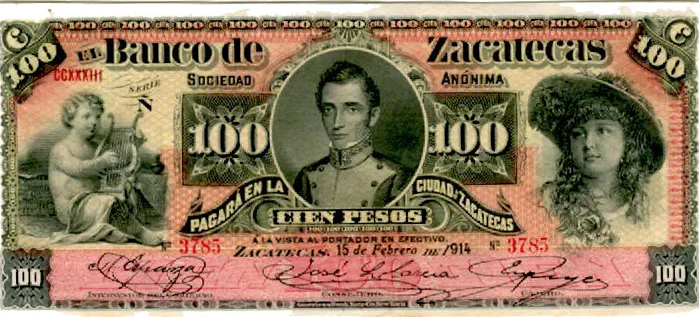
Obverse
Banco de Zacatecas
Engraved allegorical vignettes: a miner on the left, a female figure with goods in the center, and the profile portrait of a young man on the right
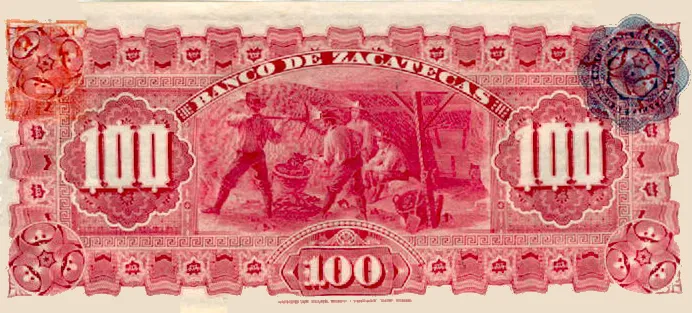
Reverse
Scenes of mining and labor, or a monument set against the mountainous landscape of Zacatecas
About this banknote
If you inherited a large, ornate 100 pesos note from the Banco de Zacatecas dated 1914, here is the honest answer first: most examples trade in the range of roughly 20 to 150 USD, and truly clean, uncirculated pieces can reach several hundred dollars. This is a private-bank note from Mexico's pre-central-bank era, not a rare treasure worth thousands unless the grade and specifics line up.
What you actually have
Before Mexico had a single central bank, individual states licensed private banks to print their own paper money, backed by silver. The Banco de Zacatecas was one of them. Zacatecas was mining country, so the vignettes on the note point straight to what backed it: the silver in the ground.
On the face (anverso) you get engraved allegorical vignettes: a miner on the left, a female figure with goods at the center, and a young man's portrait in profile on the right. The back (reverso) shows mining and labor scenes, or a monument set against the mountainous Zacatecas landscape.
This system of multiple issuing banks ended when the Banco de México was founded in 1925 and took over as the sole note-issuing authority. That makes your note a genuine artifact of the Porfiriato-era banking world.
How much is it worth in 2026
This is historic paper money, over a century old, so the value is entirely collector-driven. Two things move the price: condition and rarity of the issuing bank.
Mexican private-bank notes from this period fall into a wide spread. Common survivors from well-documented banks are worth modest money. Notes that circulated very little, or that come from short-lived banks, can be genuinely scarce and command real premiums.
| Condition | Typical value range (USD) |
|---|---|
| Well-worn, folded, small tears | 15 to 40 |
| Circulated but complete, decent color | 40 to 120 |
| Crisp, uncirculated, sharp corners | 150 to 500+ |
| Rare variety or exceptional grade | Several hundred to low thousands |
These are collector ranges, not guarantees. A note with heavy staining, missing corners, or tape repairs sits at the bottom no matter its age.
What raises the value
- Uncirculated condition. No folds, no soft corners, original crispness. Grade drives everything in world paper money.
- Low or repeated serial numbers. A low folio (serial) or a palindrome (radar) number appeals to specialists.
- Printing errors. Misaligned cuts, ink smears, factory folds, or off-center serials can turn a common note into a wanted rarity. Normal wear and damage from handling do not count as errors.
- Unsigned or specimen notes. Some of these notes exist as unissued remainders. Specifics matter here, so get a photo checked before you assume.
The myth to drop
"It's over 100 years old, so it must be worth a fortune." Age alone means little in notaphily. Millions of these state-bank notes were printed, and many survived because they were never fully circulated. Rarity comes from the specific bank and the grade, not the date on the paper.
How to tell if yours is genuine
Original Banco de Zacatecas notes were engraved, so the design has fine detail and a slight texture. Reproductions and reprints tend to have flat, printed-looking color, smooth modern paper, and fuzzy lines under magnification. Compare the vignettes, the paper feel, and the signatures against verified images before buying or selling. If anything looks off, post clear photos of both sides in the Pesoteca forum and let collectors weigh in.
Where to sell it
To sell a 100 pesos 1914 Banco de Zacatecas note, your safest options are a verified numismatic shop from the Pesoteca directory, where you get an on-the-spot appraisal, or the buy-and-sell forum among collectors who know this exact series. Photograph both faces in good light, note the serial number, and flag any low folio, radar number, or possible error, all of which lift the value. Do not dump it to the first buyer on social media.
For more context on Mexican paper money and how grading affects price, see our related guides in the Pesoteca banknote section and the general coin and note values directory.
Got one in a drawer or an inheritance box? Post front-and-back photos in the Pesoteca forum and we'll help you figure out whether yours is a common survivor or the scarce variety worth chasing.
Historical context
The year 1914 was the breaking point for the Banco de Zacatecas. This 100-peso note bears that critical date: it was the year when the capture of Zacatecas by Francisco Villa's División del Norte, one of the decisive battles of the Revolution, forced the bank to provisionally close its head office and move its operations to Mexico City.
The piece keeps the usual iconography (the miner of Zacatecan silver, the female figure of commerce, and the young man in profile, with mining scenes on the reverse), but it circulated in a country where the system of private banks of issue was collapsing under the weight of civil war.
Engraved by the American Bank Note Company, this note belongs to the twilight of an era. The bank would formally survive until 1931, when it passed to the Bank Liquidation Committee, in a Mexico where the Banco de México (created in 1925) already monopolized issuance.
Frequently asked questions
How much is the 100 pesos 1914 Banco de Zacatecas note worth?
As a collector item, most examples trade between roughly 15 and 150 USD depending on condition. Crisp uncirculated notes can reach several hundred dollars, and a genuine rare variety or printing error can push higher. Age alone doesn't make it valuable; grade and rarity do.
Is the 100 pesos 1914 note rare?
It's a private-bank note from Mexico's Porfiriato era, before the Banco de México existed. Common survivors are affordable, but notes that barely circulated, or that carry low serial numbers, palindrome (radar) serials, or genuine printing errors, are genuinely scarce and worth a premium.
Where can I sell my 100 pesos 1914 Banco de Zacatecas note?
The safest routes are a [verified numismatic shop in the Pesoteca directory](/tiendas), which appraises it on the spot, or the [Pesoteca buy-and-sell forum](/foro/compra-venta) among collectors. Photograph both sides in good light and note the serial number before agreeing to any price.
How can I tell if my 100 pesos 1914 note is genuine?
Originals were engraved, so the design shows fine detail and slight texture, with period paper. Reproductions usually have flat printed color, smooth modern paper, and fuzzy lines under magnification. Compare the vignettes and signatures to verified images, and if in doubt, post clear photos in the [Pesoteca forum](/foro).
Características Banxico
Firmas autógrafas, CCXXXIII
Familia PRIV
This banknote belongs to the BIL-PRIV family within the Sistema PSM . Explore all the banknotes that share origin, era and design with this piece.
Ver todos los billetes de la familia PRIV →