
Banco de Zacatecas 20 Pesos (1900): Value Guide
Familia PRIV · algodón
Period: Bancos privados de emisión
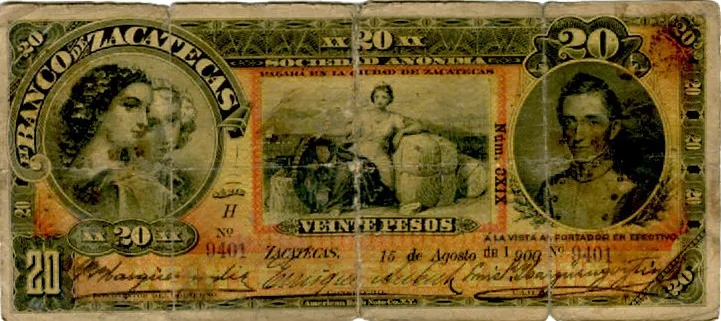
Design
Banxico
Obverse
Banco de Zacatecas
Engraved allegorical vignettes: a miner on the left, a female figure with goods in the center, and the profile portrait of a young man on the right
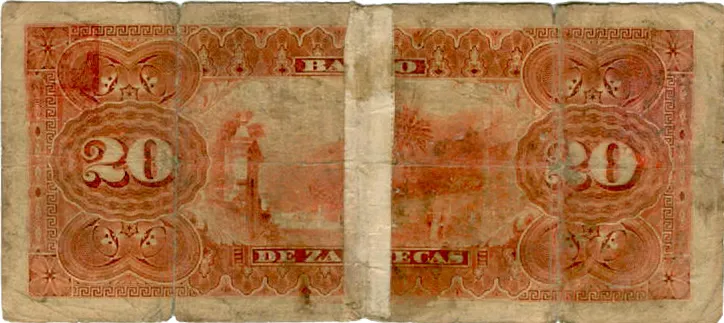
Reverse
Scenes of mining and labor, or a monument set against the mountainous landscape of Zacatecas
About this banknote
If you found a 20-peso note from the Banco de Zacatecas dated around 1900, you have a piece of pre-central-bank Mexican paper money. Most examples in worn condition sell for roughly 40 to 150 USD, but crisp, uncirculated notes and scarce signature varieties can bring several hundred dollars from world-paper-money collectors. The condition of the note drives almost everything.
This is not the modern circulating 20-peso banknote. It predates the Banco de México by a quarter century. In 2026, these Porfiriato-era private bank notes are one of the more collectible corners of Mexican notaphily (the study and collecting of paper money), and prices depend heavily on the issuing bank and how well the paper survived.
What it is
Before Mexico had a single central bank, individual states licensed private banks to print their own paper money, each note backed by silver held in reserve. The Banco de Zacatecas was one of these state issuing banks, operating during the rule of Porfirio Díaz (the Porfiriato, roughly 1876 to 1911).
Zacatecas was mining country, so the note's imagery leans on that theme: mining was literally the collateral behind the paper. The face shows engraved allegorical vignettes: a miner on the left, a female figure with goods at the center, and a young man's profile portrait on the right. The back carries mining and labor scenes, or a monument set against the mountainous Zacatecas landscape.
This system of multiple private issuing banks ended when the Banco de México was founded in 1925 and took over sole authority to print currency. That transition is a big part of why these older notes are collectible today: they represent a banking era that no longer exists.
What it's worth in 2026
Because this is historic paper money over a century old, it has no legal spending value. Its worth is purely as a collectible, and two things decide the number: condition and how scarce the issuing bank's notes are.
Private-bank notes from the Porfiriato behave very differently from one another at auction. Some banks issued heavily and their notes are common; others are genuinely rare, and many notes circulated so little (or were redeemed and destroyed) that complete, intact examples are hard to find. The Banco de Zacatecas sits in the middle to upper range for collector demand, helped by the strong mining imagery that appeals to thematic collectors.
| Condition | Typical range (USD) | Notes |
|---|---|---|
| Heavily worn, tears, missing pieces | 20 to 50 | Damage suppresses value fast |
| Circulated, folds, still complete | 50 to 150 | The most common state |
| Crisp, minimal handling (AU) | 150 to 350 | Sharp corners, strong color |
| Uncirculated, no folds | 350 to 700+ | Scarce; premium for eye appeal |
| Rare signature or serial variety | Can exceed the above | Depends on the specific issue |
Treat these as guide ranges, not fixed prices. Auction results for Mexican revolutionary and private-bank paper vary widely by grade, and a single fold or a stained corner can move a note down a full tier. If you have one, do not trust the first price you see on a marketplace listing. Ask in the Pesoteca forum or take it to a serious dealer before you sell.
What raises the value
A few things push a Banco de Zacatecas note above the common range:
- Uncirculated condition. No folds, sharp corners, and bright original color. This matters more than any other single factor.
- Low or fancy serial numbers. A very low serial, a repeating number, or a palindrome (radar) serial adds a premium.
- Genuine printing errors. Misaligned cuts, ink shifts, or off-center printing turn a common note into a rarity. Ordinary wear and use damage is not an error.
- Scarce signature or plate varieties. Some issues within the same bank are far harder to find than others.
The myth to avoid
A note being "over 100 years old" does not make it valuable on its own. Age is common; condition and scarcity are not. Plenty of century-old private-bank notes trade for under 50 USD because they survived in large numbers and in worn shape. The record prices in this field go to the scarce banks in top grades, not to every old note in a drawer.
How to tell if yours is genuine
Reproductions and outright fakes exist for Porfiriato paper money. Check these points:
- Paper feel. Genuine notes use period banknote paper with texture and often a subtle rag content. Reproductions tend to feel smooth, like modern printer stock.
- Print quality. Original engraving shows fine, crisp line detail. Fakes often look flat, with solid color blocks instead of engraved shading.
- Signatures and design. Compare the layout, signatures, and vignettes against known genuine examples and Banco de México reference archives.
- Overall consistency. Colors on originals are layered and slightly uneven from the printing process; flat, uniform color is a warning sign.
If you are unsure, post clear photos of both sides in the Pesoteca forum and let experienced collectors weigh in before you buy or sell.
Where to sell it
To sell a Banco de Zacatecas 20-peso note safely, your best options are a verified numismatic dealer from the Pesoteca shop directory, who can value it on the spot, or the Pesoteca buy-and-sell forum where collectors trade directly. Photograph both faces in good light, note the serial number, and flag any low serial, fancy number, or possible error, all of which raise the price. Avoid dumping it to the first offer on a general social-media marketplace, where these notes routinely sell for a fraction of their real collector value.
Got a Banco de Zacatecas note or another Porfiriato private-bank issue in your inheritance box? Share photos of the front and back in the forum and the community will help you identify the bank, the grade, and what it's realistically worth.
Historical context
As the 20th century began, the Banco de Zacatecas was already a consolidated institution, with nearly a decade of issuing backed notes. It belonged to the system of private banks unified by the General Law of Credit Institutions of 1897, which allowed each state to have its own issuer of paper money.
This 20-peso note of 1900 opens the new century with the bank in full expansion, supported by its branches in Aguascalientes and San Juan de los Lagos. The 20-peso denomination served the formal commerce of the region. On the obverse coexist the series' vignettes: a miner representing Zacatecan silver, a female allegory of commerce in the center, and the portrait of a young man in profile on the right, with mining scenes on the reverse. The printing was carried out by the American Bank Note Company of New York. This model of a plurality of issuers would disappear when the Banco de México was founded in 1925.
Frequently asked questions
How much is the 1900 Banco de Zacatecas 20-peso note worth?
As a collectible, most examples sell for roughly 50 to 150 USD in circulated but complete condition. Crisp uncirculated notes can reach 350 to 700 USD or more, and scarce signature varieties or notes with low or fancy serial numbers go higher. It has no legal spending value; worth is set entirely by condition and the scarcity of the issuing bank.
Is the Banco de Zacatecas 20-peso note rare?
It sits in the middle to upper range of Porfiriato private-bank notes for collector demand. Some issuing banks are common and others are genuinely scarce. Many of these notes circulated very little or were destroyed after redemption, so intact, high-grade examples are harder to find and command a premium.
Where can I sell my Banco de Zacatecas note?
The safest routes are a verified dealer from the [Pesoteca shop directory](/tiendas), who can appraise it in person, or the [Pesoteca buy-and-sell forum](/foro/compra-venta) among collectors. Photograph both sides in good light, record the serial number, and note any low serial, radar number, or printing error before you sell. Avoid taking the first offer on a general marketplace.
How do I tell if my Banco de Zacatecas note is genuine?
Check the paper, print quality, and design. Genuine notes use textured period banknote paper and show fine engraved line detail with layered, slightly uneven color. Reproductions usually feel smooth like modern paper and print with flat, uniform color. Compare the vignettes and signatures against known genuine examples, and post clear photos in the [forum](/foro) if you have any doubt.
Características Banxico
CXVII.
Familia PRIV
This banknote belongs to the BIL-PRIV family within the Sistema PSM . Explore all the banknotes that share origin, era and design with this piece.
Ver todos los billetes de la familia PRIV →