
20 Pesos 1908 Banknote (Banco de Zacatecas): Value & Guide
Familia PRIV · algodón
Period: Bancos privados de emisión
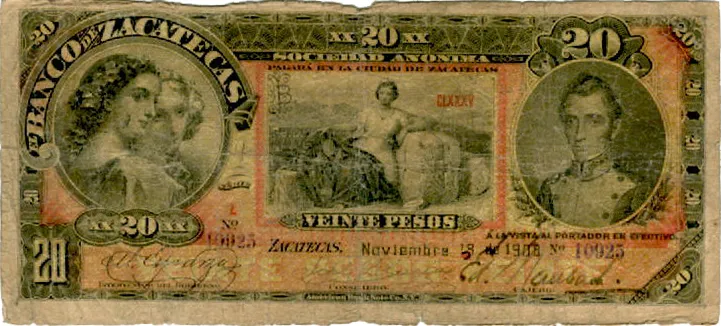
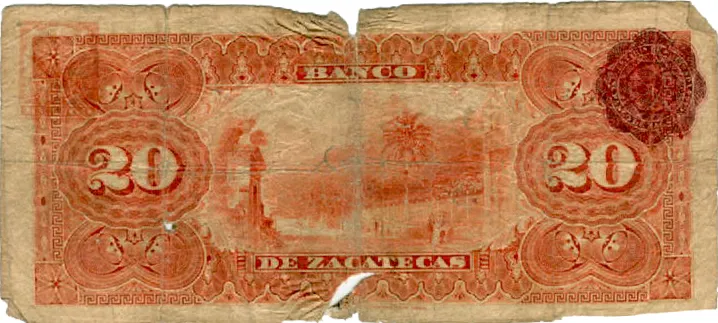
Design
Banxico
Obverse
Banco de Zacatecas
Engraved allegorical vignettes: a miner on the left, a female figure with goods in the center, and the profile portrait of a young man on the right
Reverse
Scenes of mining and labor, or a monument set against the mountainous landscape of Zacatecas
About this banknote
If you inherited an old Mexican 20 pesos note dated 1908 from the Banco de Zacatecas, here is the honest answer: most survivors sell in the range of roughly USD 40 to USD 300, and truly clean, high-grade examples can reach several hundred dollars or more. This is not a rare-billionaire note. It is a genuine piece of pre-central-bank Mexican paper money, and condition decides almost everything.
This is a private state bank note from the Porfiriato era, not a Banco de México issue. It has real collector value in the world paper money (notaphily) market, but the exact figure swings hard between a worn, taped example and a crisp uncirculated one.
What it actually is
Before Mexico had a single central bank, individual states licensed private banks to print their own paper money, backed by silver. Zacatecas, one of the great silver-mining regions on earth, had its own bank of issue. That is why the note's imagery is all about mining: the metal in the ground was the guarantee behind the paper.
This system of multiple issuing banks ended in 1925, when the Banco de México was founded and took over note issuance. That makes any surviving Banco de Zacatecas note more than a century old and, by definition, obsolete currency with collector-only value.
On the front (obverse): engraved allegorical vignettes. A miner on the left, a female figure with goods at the center, and the profile portrait of a young man on the right.
On the back (reverse): mining and labor scenes, or a monument set against the mountainous Zacatecas landscape.
How much is it worth in 2026
Because this is historic paper money, its value is purely collector-driven. Two things move the number more than anything: condition and rarity of the specific bank and denomination. Porfiriato-era private bank notes and later Revolution-era scrip form their own collecting field. Some are common, some are genuinely scarce, and many circulated so little (or were redeemed and destroyed) that clean complete examples are hard to find.
| Condition | What it looks like | Typical value (USD) |
|---|---|---|
| Well worn (Good/VG) | Soft, folds, small tears or stains | 30 to 80 |
| Circulated (Fine/VF) | Intact, moderate handling, still crisp corners | 80 to 180 |
| High grade (XF/AU) | Bright, minimal handling, strong color | 180 to 350 |
| Uncirculated (UNC) | No folds, no handling, original paper | 350 and up |
These are broad market ranges for Banco de Zacatecas notes of this era. A specific serial denomination, a rare signature combination, or a note that has been graded and encapsulated by PMG (Paper Money Guaranty, the main grading service for world banknotes) can sit at the top of the range or above it. A note that has been repaired, trimmed, or backed with tape drops toward the bottom regardless of how bright it looks.
What pushes the value up
- A truly uncirculated note. No folds, no soft corners, original body to the paper. This is the single biggest lever.
- A PMG grade. A third-party grade removes the guesswork and reassures buyers, which is exactly what an inherited note needs to sell well.
- Low or fancy serial numbers. A very low serial, a repeated pattern, or a palindrome (a number that reads the same forward and backward) draws extra bidders.
- Genuine printing errors. Misaligned cuts, ink smears, factory folds, or off-center printing turn a common note into a scarcity worth several times face. Normal wear from circulation is not an error.
The myths worth killing
"It's over 100 years old, so it must be worth a fortune." Age alone does almost nothing. Plenty of century-old paper trades for the price of a lunch. What creates value is scarcity plus demand plus condition, and this note is old but not automatically rare.
"It's the first thing that comes up online." Ignore the first eye-catching listing you find. Ask sellers to state the condition honestly and to show sharp photos of both sides before you believe any price.
How to check what yours is worth
- Grade the condition first. Lay it flat under good light. Count the folds. Check the corners and edges for tears. Look for stains, tape, or trimming. Condition is most of the value.
- Read the serial number. Low, repeated, or palindromic numbers add a premium.
- Look for errors. Any factory misprint is a plus. Everyday wear is not.
- Confirm it's genuine. Compare the design, paper, and signatures against reference images of Banco de Zacatecas issues. Period notes were printed on quality paper with fine engraving; modern reproductions tend to have smooth flat paper and dull, printed color instead of engraved depth. When in doubt, post clear photos of both faces in the Pesoteca forum for a second opinion.
- Get an expert read before you sell. A verified numismatic shop or an experienced collector can value it in person.
Where to sell it
To sell your 1908 Banco de Zacatecas 20 pesos note safely, your best options are a verified numismatic shop from the Pesoteca shop directory, which can value it on the spot, or the Pesoteca buy-and-sell forum among collectors who actually want this material. For higher-grade examples, having the note graded by PMG first will usually get you a stronger price. Photograph both sides in good light and note any low serial, palindrome, or error before you list it. Don't dump it to the first Facebook offer.
Think you have an uncirculated one, a low serial, or a possible printing error? Post both sides in the Pesoteca forum and let the community help you pin down what it's really worth.
Historical context
The Banco de Zacatecas maintained its 20-peso note issue over more than two decades, adapting it to the design changes of each period. Founded in 1891, it rested its prestige on the state's mining industry, one of Mexico's great suppliers of silver.
This 20-peso note of 1908 corresponds to the last stable years of the Porfiriato, before the Revolution altered the country's economic life. The denomination was useful for medium-scale commercial transactions. Its obverse shows the bank's usual iconography: a miner on the left, a female figure with goods in the center, and a young man in profile on the right, with mining motifs and mountainous landscape on the reverse. Engraved by the American Bank Note Company of New York, it is a good example of the maturity reached by the private banks of issue. That system would come to its end with the centralization of currency in the Banco de México in 1925.
Frequently asked questions
How much is the 1908 Banco de Zacatecas 20 pesos note worth?
Most surviving examples sell for roughly USD 40 to USD 300, driven almost entirely by condition. A worn note sits at the low end, while a crisp uncirculated example, especially one graded by PMG, can reach several hundred dollars or more. Age alone does not make it valuable; grade and rarity do.
Is the 1908 Mexico 20 pesos note rare?
It's a genuine Porfiriato-era private bank note from a defunct issuer, so it has real collector interest, but it is not automatically rare. Some Banco de Zacatecas denominations are scarce and others are relatively common. What makes any specific note stand out is high grade, a low or palindromic serial number, or a genuine printing error.
Where can I sell my 1908 Banco de Zacatecas banknote?
The safest routes are a verified shop from the [Pesoteca directory](/tiendas), which values it in person, or the [Pesoteca buy-and-sell forum](/foro/compra-venta) among collectors. For a higher-grade note, grading it with PMG first usually gets a better price. Photograph both sides clearly and avoid selling to the first random online offer.
How do I tell if the 1908 note is genuine?
Compare the design, paper, and signatures against reference images of Banco de Zacatecas issues. Authentic period notes used quality paper with fine engraved detail and depth; reproductions typically have smooth, flat paper and dull printed color. If you're unsure, post sharp photos of both faces in the [Pesoteca forum](/foro) for expert review.
Características Banxico
CLXXXV
Familia PRIV
This banknote belongs to the BIL-PRIV family within the Sistema PSM . Explore all the banknotes that share origin, era and design with this piece.
Ver todos los billetes de la familia PRIV →