
Banco Yucateco 20 Pesos Note (Mexico): Value & History
Familia PRIV · algodón
Period: Bancos privados de emisión
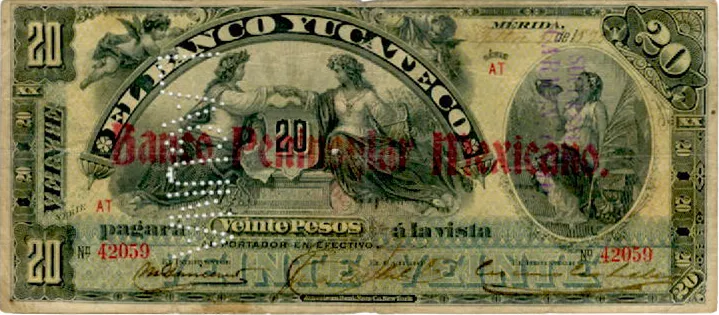
Design
Banxico
Obverse
Banco Yucateco
Seated female allegories making a toast and the figure of a young man, with a locomotive vignette
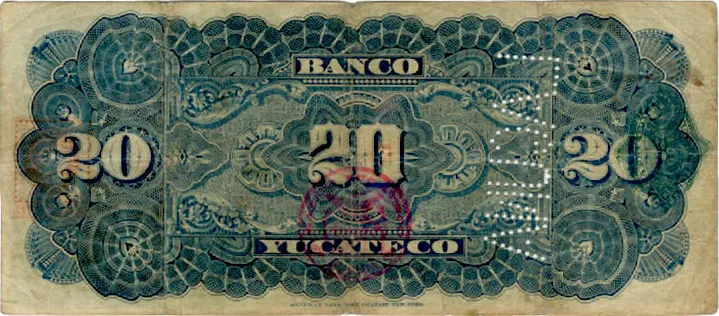
Reverse
Engraved ornamental design with the denomination and the name of the bank
About this banknote
Most old Mexican bank notes are worth a few dollars. But the private-bank issues of the Porfiriato, like the Banco Yucateco 20 pesos, sit in a real collector market where a clean example can run from around 30 to several hundred USD, and rare varieties climb higher. Here is what yours is actually worth and how to check.
This is not a modern circulating peso note. It is historic paper money, over a century old, issued by a private state bank during Mexico's era of regional bank-of-issue currency (roughly 1897 to the 1910s). That means its value is purely collector value: nothing here is legal tender, and condition and rarity drive the number, not age alone.
What it's worth today
As a general range, a genuine Banco Yucateco 20 pesos note runs from about 20 to 300 USD, with the ceiling depending on condition, whether it carries the sought-after overprint (see below), and whether it is a specimen or a fully issued, signed note. Well-preserved examples and remainders (unsigned, uncirculated stock that never entered circulation) trade at the higher end. Heavily worn, torn, or repaired notes fall to the low end or below.
A few things push the price up:
- The "Banco Peninsular Mexicano" red overprint. Many of these notes carry a red overstamp from the 1908 merger with the Banco Mercantil de Yucatán. Collectors treat the overprinted variety as a distinct, often scarcer, issue. Confirm whether yours has it, because it changes the catalog reference and the price.
- Grade. Notaphily (world paper money collecting) grades notes from Poor up to Uncirculated (UNC / Gem UNC). A crisp, unfolded note with sharp corners and full color can be worth several times a soft, circulated one.
- Specimen vs. issued. Printer's specimens (marked "SPECIMEN" or with punch cancels) and unsigned remainders are common enough that they anchor the affordable end. A fully issued note with real signatures and serial numbers, actually used in circulation, is often scarcer.
What the note looks like
The Banco Yucateco operated out of Mérida during the henequén boom, the era when Yucatán's "green gold" fiber made the region one of the wealthiest in Mexico. The imagery reflects that moment of prosperity and industry.
- Front (obverse): seated female allegorical figures raising a toast, alongside the figure of a young man, with a vignette of a steam locomotive. The train was no accident: it advertised the railway progress that carried henequén to port.
- Back (reverse): an engraved ornamental design showing the denomination and the bank's name.
- Overprint: many surviving notes bear the red "Banco Peninsular Mexicano" overstamp from the 1908 merger.
| Feature | Detail |
|---|---|
| Issuer | Banco Yucateco (Mérida, Yucatán) |
| Denomination | 20 pesos |
| Era | Porfiriato, private bank of issue (c. 1897 to 1910s) |
| Overprint variety | Red "Banco Peninsular Mexicano" (1908 merger) |
| Typical value range | 20 to 300 USD depending on grade and variety |
| Where sold | Heritage Auctions, Stack's Bowers, specialist notaphily dealers |
The myth: "it's over 100 years old, so it must be worth a fortune"
Age alone does not make paper money valuable. Plenty of Porfiriato and Revolution-era notes survive in quantity, especially specimens and unissued remainders that were saved in bank archives and never circulated. Those are affordable precisely because so many exist. The notes that command real money are the scarce banks, the scarce denominations, the genuinely issued and signed examples, and the top grades. A common remainder in a Facebook listing priced at hundreds of dollars is usually optimistic, not a windfall.
How to check what yours is worth
- Identify the exact variety. Note the denomination, whether it has the red Banco Peninsular Mexicano overprint, and whether it is signed and serial-numbered (issued) or blank (remainder/specimen). This determines the catalog reference.
- Grade it honestly. Look for folds, tears, pinholes, stains, and corner wear. A note with no folds and full crispness (UNC) is worth far more than one that has been through wallets. Do not press or "restore" it yourself; that can lower value.
- Compare recent sales. Check completed listings from specialist world-paper-money dealers and auction results (Heritage and Stack's Bowers both handle Mexican bank notes) rather than asking prices on general marketplaces.
- Get a second opinion before selling. Post clear photos of both sides in the Pesoteca forum so collectors can confirm the variety and grade.
How to tell if it's genuine
Genuine notes of this era were printed by professional bank-note engravers, so look for sharp, fine-line intaglio engraving, consistent paper texture, and crisp detail in the vignettes and lettering. Reproductions and reprints tend to have flat, printed-looking color, smooth modern paper, and fuzzy detail under magnification. Compare the design, signatures, and serial-number style against known genuine examples. If in doubt, ask in the forum before you buy or sell.
Where to sell it
For a note like this, your best options are a specialist world paper money dealer or a numismatic auction house (Heritage, Stack's Bowers) that regularly sells Mexican bank notes and can reach international collectors. Between collectors, the Pesoteca buy-and-sell forum is a solid route. Photograph both sides in good, even light, note the overprint and any special serial number, and avoid dumping it to the first bidder on social media, where these notes are routinely underpriced or overpriced.
Have a Banco Yucateco note, with or without the red overprint? Post front and back photos in the Pesoteca forum and let collectors help you pin down the variety and a fair value.
Historical context
The Banco Yucateco ranks among the most emblematic issuers of Yucatán's henequen boom. Opened in Mérida in 1890 and backed by the house of Olegario Molina, it provided financial services to the planters who exported the fiber that made the peninsula rich. This 20-peso note, with no visible date in the catalog, belongs to its mid-to-high value series.
The obverse brings together the bank's characteristic motifs: female allegories offering a toast, the figure of a young man, and a locomotive vignette, a direct allusion to the railway that connected the henequen estates to the port of Progreso. The reverse bore the usual engraved ornamental design.
Printed by the American Bank Note Company of New York, this note circulated until the bank lost its autonomy in 1905, when it merged with the Banco Mercantil de Yucatán to form the Banco Peninsular Mexicano, closing a singular chapter of Mexican regional banking.
Frequently asked questions
How much is a Banco Yucateco 20 pesos note worth?
As a collector item, a genuine Banco Yucateco 20 pesos note generally runs from about 20 to 300 USD. Condition drives the price: a crisp, uncirculated note is worth several times a folded, worn one. Notes with the red 'Banco Peninsular Mexicano' overprint, or fully issued and signed examples, tend to bring more than common unsigned remainders.
Is the Banco Yucateco 20 pesos note rare?
It depends on the type. Printer's specimens and unissued remainders survive in some quantity and are affordable. Fully issued, signed, and circulated notes, and certain overprint varieties, are scarcer and command higher prices. Age alone does not make it rare; the specific variety and grade do.
Where can I sell a Banco Yucateco 20 pesos note?
Your safest routes are a specialist world paper money dealer or a numismatic auction house such as Heritage or Stack's Bowers that regularly handles Mexican bank notes, or the collector-to-collector [Pesoteca buy-and-sell forum](/foro/compra-venta). Photograph both sides in good light, note any overprint or special serial number, and get a value check before selling.
How can I tell if my Banco Yucateco note is genuine?
Genuine notes show sharp intaglio (engraved) line work, consistent period paper, and crisp detail in the vignettes and lettering. Reproductions usually have flat printed color, smooth modern paper, and fuzzy detail under magnification. Compare the design, signatures, and serial-number style with known examples, and ask in the [Pesoteca forum](/foro) if you are unsure.
Características Banxico
BANCO PENINSULAR MEXICANO Firma y fecha autógrafa.
Familia PRIV
This banknote belongs to the BIL-PRIV family within the Sistema PSM . Explore all the banknotes that share origin, era and design with this piece.
Ver todos los billetes de la familia PRIV →