
20 Pesos 1901 Banco Yucateco Banknote: Value & Rarity
Familia PRIV · algodón
Period: Bancos privados de emisión
Design
Banxico
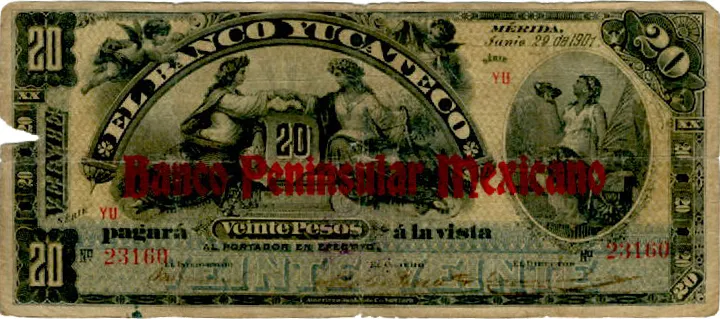
Obverse
Banco Yucateco
Seated female allegories making a toast and the figure of a young man, with a locomotive vignette
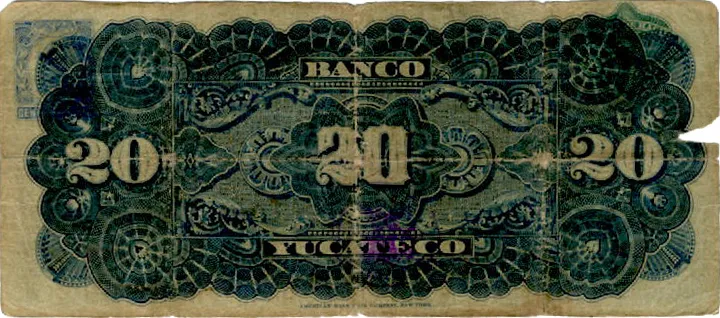
Reverse
Engraved ornamental design with the denomination and the name of the bank
About this banknote
If you inherited an old Mexican 20 pesos note dated 1901 that reads Banco Yucateco and shows a locomotive, you are holding a private bank note from the Porfiriato era, not modern currency. It has no face value today. What it is worth depends entirely on condition and how rare that specific bank issue is, and in 2026 clean examples of these Yucatán notes trade with a real collector market behind them.
What this note actually is
During the rule of Porfirio Díaz (the "Porfiriato," roughly 1876 to 1911), Mexico had no single central bank. Instead, dozens of private and state chartered banks were allowed to issue their own paper money. The Banco Yucateco of Mérida was one of them, operating during the henequen boom, when Yucatán got rich exporting sisal fiber (locals called it "green gold").
That history is printed right on the note. The locomotive vignette is not decoration: it referenced the railway progress that hauled henequen to the port. The face shows seated female allegories and the figure of a young man; the back carries an engraved ornamental design with the denomination and the bank's name.
Many surviving examples carry a red overprint reading "Banco Peninsular Mexicano." That stamp is not damage or a fake. It marks the 1908 merger of the Banco Yucateco with the Banco Mercantil de Yucatán, and it tells collectors exactly where the note sits in the bank's history.
How much is it worth
This is historic paper money over a century old, so its value is purely collector value. There is no melt floor like a silver coin, and it is not legal tender. Price comes down to two things: condition and how scarce that particular bank and denomination are.
Private bank notes from the Porfiriato and the emergency scrip of the Revolution have their own dedicated market. Some issues are common and sell for modest sums. Others are genuinely rare, because many circulated so little, or survived so poorly, that intact examples are hard to find today. A crisp, uncirculated note with strong color and full margins can be worth many times a worn, torn, or repaired one.
Because exact hammer prices for a specific serial and grade vary widely, be skeptical of any single figure you see online. The honest range for these regional bank issues runs from a few dollars for a heavily worn common note to several hundred dollars, and higher for scarce banks in top grade. Get yours looked at before you accept a price.
| Detail | Information |
|---|---|
| Issuer | Banco Yucateco, Mérida |
| Denomination | 20 pesos |
| Date | 1901 |
| Era | Porfiriato (private bank issue) |
| Common overprint | Red "Banco Peninsular Mexicano" (1908 merger) |
| Face vignette | Female allegories, young man, locomotive |
| Modern face value | None (not legal tender) |
| Value basis | Collector value: condition and rarity |
What raises the value
Three things push a note above the common range:
- Condition. Uncirculated, no folds, no pinholes, no tears or repairs. Grading services (PMG is the main one for world paper money) assign a numeric grade that buyers trust.
- The overprint status. Whether a note carries the red Banco Peninsular Mexicano stamp affects which collectors want it, since it reflects a specific point in the bank's timeline.
- Serial and printing quirks. Low serial numbers, and genuine factory printing errors (misaligned cuts, ink shifts, uncut portions) can lift value well above a standard note. Ordinary wear is not an error.
What it is NOT
Do not confuse this with a Banco de México note. The modern central bank did not exist until 1925. Anyone telling you a private Porfiriato note is worth a fortune "because it's old" is guessing. Age alone means little in paper money. A common note from 1901 can be worth less than a scarce note from the 1970s. Rarity and grade decide everything.
How to tell if yours is genuine
Compare the design, paper, and signatures against verified images of Banco Yucateco issues. Genuine notes of this period use engraved intaglio printing with fine, raised line work you can sometimes feel, along with period-correct paper. Reproductions and reprints tend to have flat, smooth paper and dull, uniform color with no engraving relief. If a red overprint is present, look at whether it sits correctly over the design. When in doubt, post clear photos of both sides in the Pesoteca forum for a second opinion, or send it to PMG for professional authentication and grading.
Where to sell it
To sell a note like the 1901 Banco Yucateco 20 pesos, the safest routes are a verified numismatic dealer from the Pesoteca shop directory, who can appraise it in person, or the collector buy and sell forum where world paper money collectors trade directly. Photograph both faces in good, even light, note the serial number and any overprint, and get more than one opinion before you accept an offer. Avoid dumping it on a general marketplace to the first buyer, where these regional bank notes are routinely undersold.
Have one in hand and want to know what it's really worth? Post the serial, the overprint, and clear photos of both sides in the Pesoteca forum and let collectors who know the Yucatán issues weigh in.
Historical context
By 1901, the Banco Yucateco was one of the two major banks that the wealth of henequen allowed Yucatán to sustain, an uncommon case in the Mexico of the time. This 20-peso note from that year circulated at the very height of the Mérida henequen boom.
The obverse preserves the characteristic motifs: female allegories toasting, the figure of a young man, and the locomotive vignette, a symbol of the railway that carried the fiber from the haciendas to Progreso. The reverse finished off with its engraved ornamentation and the name of the bank.
Engraved by the American Bank Note Company, this 20-peso note was a denomination of some value, used in commercial transactions in the prosperous Yucatecan capital. The bank would keep its own issue until the 1905 merger that gave rise to the Banco Peninsular Mexicano.
Frequently asked questions
How much is the 1901 Banco Yucateco 20 pesos note worth?
It has no face value today, since it is a private Porfiriato-era bank note, not modern currency. Collector value depends on condition and rarity. Heavily worn common examples may bring only a few dollars, while a crisp uncirculated note, or a scarce issue, can reach several hundred dollars or more. Get it graded or appraised before selling.
Is the 1901 Banco Yucateco note rare?
Some Porfiriato private bank issues are common and others are genuinely scarce. Many of these Yucatán notes circulated briefly or survived poorly, so intact, clean examples can be hard to find. The red 'Banco Peninsular Mexicano' overprint (from the 1908 merger), a low serial number, or a factory printing error all make a note more sought after.
Where can I sell my Banco Yucateco 20 pesos note?
The safest options are a verified dealer from the [Pesoteca shop directory](/tiendas), who can appraise it on the spot, or the collector [buy and sell forum](/foro/compra-venta). Photograph both sides in good light, record the serial number and any overprint, and get more than one opinion before accepting an offer.
How do I know if my 1901 note is genuine?
Compare the design, paper, and signatures to verified Banco Yucateco images. Genuine notes use engraved intaglio printing with fine, sometimes raised line work on period-correct paper. Reproductions usually have smooth paper and flat, uniform color. When unsure, post clear photos of both sides in the [Pesoteca forum](/foro) or send it to PMG for authentication.
Características Banxico
BANCO PENINSULAR MEXICANO Firma y fecha autógrafa.
Familia PRIV
This banknote belongs to the BIL-PRIV family within the Sistema PSM . Explore all the banknotes that share origin, era and design with this piece.
Ver todos los billetes de la familia PRIV →