
Banco Yucateco 20 Pesos (1910): Value & How to Sell
Familia PRIV · algodón
Period: Bancos privados de emisión
Design
Banxico
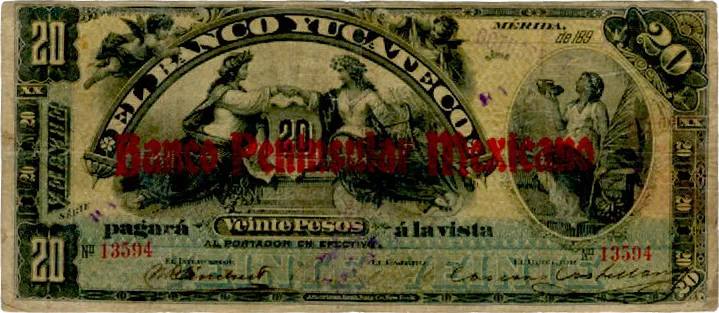
Obverse
Banco Yucateco
Seated female allegories making a toast and the figure of a young man, with a locomotive vignette
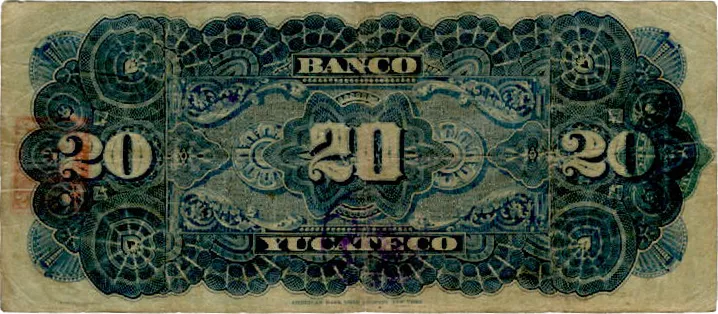
Reverse
Engraved ornamental design with the denomination and the name of the bank
About this banknote
If you inherited a 1910 Banco Yucateco 20 pesos note, here is the honest answer: this is a private-bank note from Mexico's Porfiriato era, and its value is purely collector value, not face value. Depending on condition and how scarce the issuing bank's notes are, expect anywhere from a few dollars for a worn, common example to several hundred USD for a crisp, high-grade or rare variety.
This is not Mexican government currency. In 2026, notes like this belong to the world paper money (notaphily) market, where private state-bank issues from the early 1900s trade among specialist collectors, not at a bank teller.
What this note actually is
The Banco Yucateco was a private bank of issue based in Mérida, Yucatán. During the Porfiriato (the long rule of Porfirio Díaz, roughly 1876 to 1911), individual Mexican states had banks that printed their own paper money. This was normal before Mexico centralized note issuing under the Banco de México in 1925.
The Banco Yucateco operated during the henequén boom, when Yucatán's fiber plantations, called the "green gold" era, made the region briefly one of the wealthiest in Mexico. That prosperity is why the note exists and why its design leans on imagery of progress.
Design details to check
- Obverse (front): seated female allegorical figures raising a toast, the figure of a young man, and a vignette of a locomotive. The train was not decoration. It referenced the railroads that hauled henequén to port, the engine of the local economy.
- Reverse (back): engraved ornamental design carrying the denomination and the bank's name.
The red overprint that matters
Many surviving Banco Yucateco notes carry a red overprint reading "Banco Peninsular Mexicano." This came from the 1908 merger of the Banco Yucateco with the Banco Mercantil de Yucatán, which created the new Banco Peninsular Mexicano.
Whether your note has that overprint changes which variety you own, and collectors track these differences closely. Note both the presence of the overprint and its exact wording when you photograph or list the piece.
What it's worth in 2026
| Note | Era | Condition | Typical range (USD) |
|---|---|---|---|
| Banco Yucateco 20 pesos | c. 1910 | Heavily circulated, tears, stains | a few dollars to ~25 |
| Banco Yucateco 20 pesos | c. 1910 | Solid circulated, complete | ~30 to 100 |
| Banco Yucateco 20 pesos | c. 1910 | High grade / crisp / scarce variety | ~150 to several hundred |
These are collector ranges, not guarantees. Private-bank and revolutionary-era Mexican paper money has a real but specialized market. Some issues are common; others are genuinely rare because so few notes survived intact after more than a century. A cancelled or "remainder" note (one never issued, sometimes with punch holes or no serial signatures) usually trades lower than an issued, signed example.
Because values swing so much on condition and variety, do not trust the first price you see online. A single listing does not set the market.
What drives the value
- Condition (grade). Creases, folds, tears, pinholes, and stains all cut value hard. A flat, bright note can be worth many times a limp, folded one.
- The overprint and variety. The "Banco Peninsular Mexicano" red overprint, serial ranges, and signature combinations distinguish varieties. Some are much scarcer than others.
- Completeness. Missing corners or trimmed edges reduce value sharply.
- Authenticity. Genuine issued notes with real signatures and serial numbers outrank remainders and, obviously, reproductions.
How to tell if yours is genuine
Compare your note against reference images of Banco Yucateco issues from paper money catalogs and collector references. Real examples show:
- Engraved intaglio printing with fine, sharp line detail you can sometimes feel.
- Period paper that is thin and slightly textured, not the smooth, bright stock of a modern print.
- Serial numbers, signatures, and (where present) the red overprint consistent with documented varieties.
Reproductions and souvenir prints tend to have flat color, uniform ink, and glossy modern paper. If anything looks too clean or the paper feels wrong, get a second opinion before you buy or sell. You can post clear photos of both sides in the Pesoteca forum for a read from collectors who handle these.
Where to sell it
For a note this old and this specialized, the safest routes are:
- A verified numismatic dealer from the Pesoteca shop directory, who can grade and value it in person.
- The Pesoteca buy-and-sell forum, where world paper money collectors trade directly.
Specialist auction houses that handle Mexican and Latin American paper money are also an option for a high-grade or rare example. Wherever you go, photograph both faces in good light, note the serial number, any overprint, and any damage. Avoid dumping it to the first buyer on a general marketplace who has no idea what a Porfiriato private-bank note is.
If you also have coins or notes from the Revolution era, they share the same specialist market and the same rule: condition and scarcity decide everything.
Got a Banco Yucateco note, or a stack of old Mexican paper money you can't identify? Post photos of the front and back in the Pesoteca forum and let the community tell you what you actually have.
Historical context
This 20-peso note of 1910 illustrates the long life of the Banco Yucateco design, whose plates continued in service even after the institution lost its autonomy. By 1910, following the 1905 merger, that stock had already passed into the orbit of the Banco Peninsular Mexicano, heir to Yucatán's henequen prestige.
The piece keeps the classic look of the original bank: female allegories toasting, the figure of a young man, and the locomotive vignette, emblem of the railway that was the backbone of the henequen economy. The reverse retained its engraved ornamental design.
Engraved by the American Bank Note Company, the notes of this family circulated in a Yucatán that, on the eve of the Revolution, still lived off the export of the fiber. The 20 pesos represented an intermediate-to-high denomination in peninsular commerce.
Frequently asked questions
How much is the 1910 Banco Yucateco 20 pesos note worth?
It has no face value today; it's collector-only. A heavily circulated example may bring just a few dollars up to about 25 USD, a solid complete note roughly 30 to 100 USD, and a crisp high-grade or scarce variety can reach several hundred USD. Condition and variety decide the price.
Is the Banco Yucateco 20 pesos note rare?
It depends on the variety. This is a private state-bank note from the Porfiriato era, and survival rates vary a lot. Some issues are relatively common; others are genuinely scarce because few notes survived intact after more than a century. The red 'Banco Peninsular Mexicano' overprint and the serial and signature combinations distinguish which variety you have.
Where can I sell a 1910 Banco Yucateco note?
The safest options are a verified dealer from the [Pesoteca shop directory](/tiendas), who can value it on the spot, or the [Pesoteca buy-and-sell forum](/foro/compra-venta) among collectors. Specialist paper money auction houses suit high-grade or rare examples. Photograph both sides, note the serial number and any overprint, and don't sell to the first casual buyer.
How do I know if my Banco Yucateco note is genuine?
Look for engraved intaglio printing with sharp fine lines, thin period paper with slight texture, and serial numbers, signatures, and any red overprint consistent with documented varieties. Reproductions usually have flat color and glossy modern paper. Compare against catalog images and, if unsure, post clear photos of both sides in the [Pesoteca forum](/foro).
Características Banxico
BANCO PENINSULAR MEXICANO Firma y fecha autógrafa.
Familia PRIV
This banknote belongs to the BIL-PRIV family within the Sistema PSM . Explore all the banknotes that share origin, era and design with this piece.
Ver todos los billetes de la familia PRIV →