
20 Pesos 1915 Carranza Banknote: Value & Guide
Familia REV · algodón
Period: Revolución Mexicana
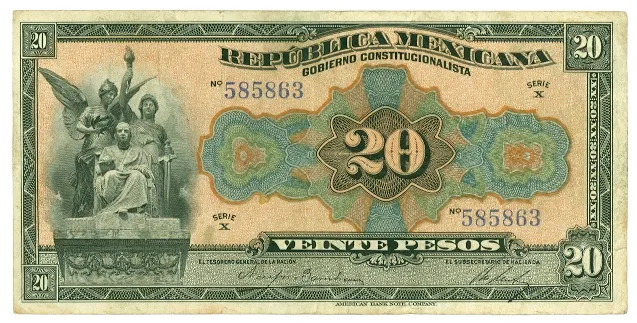
Design
Banxico
Obverse
Gobierno Constitucionalista
An engraved historical portrait in the center with the legend República Mexicana
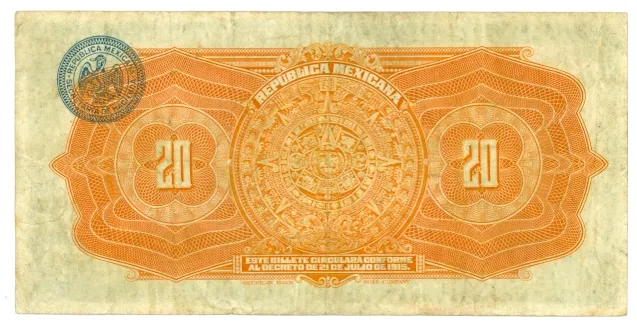
Reverse
The Sun Stone or Aztec Calendar
About this banknote
Most 1915 Mexican 20 pesos notes are worth from about 10 to 60 USD, not a fortune. A crisp uncirculated example, a scarce issuing branch, or a printing error can push that into the low hundreds. This is a Revolution-era note from Carranza's Constitutionalist government, and value depends almost entirely on condition and which issuer printed it.
If you inherited or found one, here is what it actually is, what drives the price, and how to check yours in 2026.
What this note is
The 20 pesos of 1915 was issued by the Gobierno Constitucionalista (Constitutionalist Government) led by Venustiano Carranza, under a 1915 decree. During the Mexican Revolution, competing factions printed their own paper money to fund the war. Carranza's side issued notes carrying the image of the Mexican Republic and national iconography to present itself as the legitimate government against Pancho Villa and Emiliano Zapata.
The front (obverse) shows an engraved historical portrait at the center with the legend República Mexicana. The back (reverse) displays the Piedra del Sol, the Aztec Sun Stone (often called the Aztec calendar).
These are more than a century old. Everything about their value is collector value, so-called notaphily, the collecting of paper money. There is no face value to redeem; the note is long demonetized.
What it's worth in 2026
Revolution-era Mexican paper falls into two very different buckets. Common issues are affordable and easy to find. Scarce issuing branches, or notes that barely circulated and survived intact, sell for real money.
| Condition / variety | Typical value (USD) |
|---|---|
| Circulated, common issuer, folds and wear | 8 to 25 |
| Clean, minor handling, common issuer | 25 to 60 |
| Crisp uncirculated (no folds) | 60 to 150 |
| Scarce issuing branch or printing error | 150 to 500+ |
These ranges reflect the broad Constitutionalist issue. Because so many varieties and issuing offices exist, a specific note can land anywhere in this spread. The number in the corner (the issuing branch and series) matters as much as the date. Do not trust the first price you see online; a common note listed at a high asking price is not the same as one that actually sold.
What drives the price
Three things separate a 10-dollar note from a 300-dollar note:
1. Condition. Paper money is graded much more harshly than coins. A note with no folds, full corners, and original crispness (what collectors call uncirculated, or grades like 65 EPQ on a PMG holder) is worth several times a worn, soft, taped example. Folds, tears, stains, and pinholes each pull the price down.
2. Rarity of the issuer. Not all 1915 20-peso notes came from the same office. Some issuing branches printed limited quantities or saw their notes destroyed, and those are genuinely scarce today. This is the single biggest swing factor and the one most casual sellers overlook.
3. Serial numbers and errors. A low serial number (like 000012), a palindrome serial (a radar note, reading the same forwards and backwards), or a genuine factory printing error (misaligned cut, ink smear, missing print) turns a common note into something collectors chase. Normal wear from use is not an error.
How to tell if yours is genuine
Reproductions and outright forgeries of Revolution notes exist, though the low value of common issues means fakes are less common than for gold coins. Check:
- Paper feel. Original notes are printed on distinctive rag paper with texture. Modern reproductions often use smooth, flat paper with flat, printer-like colors.
- Engraving detail. Genuine notes show fine engraved lines in the portrait and the Sun Stone. Copies look fuzzy or dot-patterned under magnification.
- Design match. Compare your note against reference images and catalog listings for the exact issuer and series. Wrong fonts, wrong signatures, or off proportions are red flags.
If you are unsure, post clear photos of both sides in the Pesoteca forum and the community can weigh in before you buy or sell.
Where to sell it
For the best result, get more than one opinion:
- A verified numismatic dealer from the Pesoteca shop directory can appraise it in person and quote you on the spot.
- The Pesoteca buy-and-sell forum puts you in front of collectors who actually want Revolution-era paper.
- For a high-grade or scarce piece, a graded holder from PMG or PCGS Banknote adds confidence and usually a premium.
Photograph both sides in good, even light before you list. Note the serial number, the issuing branch, and any error. Avoid dumping it to the first buyer on social media, which is where good notes get sold for a fraction of their value.
For more on Revolution and early-20th-century Mexican paper, see our related guides in the Pesoteca banknote section, and if you want a second set of eyes on your note, drop it in the forum. Got a low serial or a printing quirk on yours? Show us, that detail could be worth more than the note itself.
Historical context
20-peso note of 1915 issued by the República Mexicana, Constitutionalist Government, the faction of Venustiano Carranza during the Revolution. With official money in crisis and the war consuming resources, the Constitutionalists printed their own paper to pay the army and sustain the administration in the regions under their control.
The design follows the pattern of these issues: a historical portrait engraved at the center and the legend República Mexicana to convey authority, with the Sun Stone on the reverse as a symbol of national identity. Everything was aimed at getting the public to read the note as legitimate money of the country, and not as paper of a warring faction.
The reality was harsher. With so many different issues circulating at once (Carrancista, Villista, state governments), distrust grew, the paper depreciated, and metal coinage practically vanished from people's hands as they hoarded it. Thus 1915 went down in history as the year of Mexican monetary chaos, and these 20-peso notes are among its most representative testimonies.
Frequently asked questions
How much is the 1915 Mexican 20 pesos note worth?
Most circulated examples sell for about 8 to 25 USD, and a clean note with light handling brings 25 to 60 USD. A crisp uncirculated note, a scarce issuing branch, or a genuine printing error can reach 150 to 500 USD or more. Condition and issuer decide the price.
Is the 1915 20 pesos Carranza note rare?
Common issues are affordable and not hard to find. But the Constitutionalist government issued this denomination through many offices, and some issuing branches are genuinely scarce. A high-grade uncirculated note, a low serial number, or a radar (palindrome) serial makes any example more sought after.
Where can I sell a 1915 Mexican 20 pesos note?
Use a verified dealer from the [Pesoteca shop directory](/tiendas) for an in-person appraisal, or the [buy-and-sell forum](/foro/compra-venta) to reach collectors directly. For a high-grade or scarce note, professional grading from PMG or PCGS Banknote adds value. Photograph both sides and record the serial number and issuing branch before selling.
How do I tell if my 1915 20 pesos note is genuine?
Check the paper (genuine notes use textured rag paper, not smooth flat stock), look for fine engraved lines in the portrait and Aztec Sun Stone, and compare the design, fonts, and signatures against reference images for the exact issuer. Reproductions usually show flat colors and a dot pattern under magnification. When in doubt, post photos in the [Pesoteca forum](/foro).
Familia REV
This banknote belongs to the BIL-REV family within the Sistema PSM . Explore all the banknotes that share origin, era and design with this piece.
Ver todos los billetes de la familia REV →