
Mexico 5 Pesos Banknote (1906), Banco de Zacatecas
Familia PRIV · algodón
Period: Bancos privados de emisión
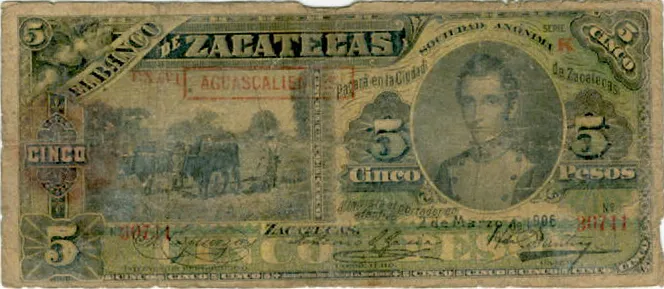
Design
Banxico
Obverse
Banco de Zacatecas
Engraved allegorical vignettes: a miner on the left, a female figure with goods in the center, and the profile portrait of a young man on the right
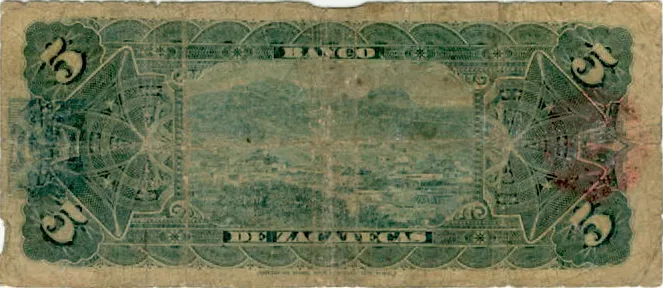
Reverse
Scenes of mining and labor, or a monument set against the mountainous landscape of Zacatecas
About this banknote
If you inherited a 5 pesos note dated 1906 from the Banco de Zacatecas, its value has nothing to do with 5 pesos today. This is a piece of pre-central-bank Mexican paper money, and depending on condition and rarity it can be worth from a few dollars to a few hundred USD. Common examples in worn condition trade in the 15 to 40 USD range; crisp, well-preserved notes and scarcer signature or series varieties can reach 150 to 400 USD or more at auction.
This is a private state bank note, not a government bill. Before Mexico had a single central bank, individual states licensed private banks to print their own paper money, each note backed by silver held in reserve. Zacatecas was one of the great silver-mining states, so the Banco de Zacatecas printed its own currency, and the vignettes on the note point straight to the source of that backing: mining. This system of multiple issuing banks ended when the Banco de México was founded in 1925.
What the note looks like
The face (anverso) carries engraved allegorical vignettes: a miner on the left, a female figure with goods at the center, and the profile portrait of a young man on the right. The back (reverso) shows scenes of mining and labor, or a monument set against the mountainous Zacatecas landscape. The imagery is deliberate, since the silver coming out of Zacatecas mines was literally the guarantee behind the paper.
What it's actually worth in 2026
This is historical paper money more than a century old, so its value is entirely collector value (notaphily), driven by three things: condition, the issuing bank, and any special feature like a low serial number or printing error.
Porfiriato-era private bank notes and Revolution-era scrip form their own active market among world-paper-money collectors. Some issues are common, others genuinely scarce, and many circulated so little (or were redeemed and destroyed) that complete, intact examples are hard to find today. The Banco de Zacatecas issues are collectible but not among the rarest state banks, which keeps most examples in the affordable range.
| Condition | What it means | Typical value (USD) |
|---|---|---|
| Well-worn (VG-Fine) | Folds, soiling, soft corners | 15 to 45 |
| Very Fine to Extra Fine | Light handling, strong color | 60 to 150 |
| About Uncirculated / Crisp | Minimal handling, sharp edges | 150 to 400+ |
| Special serial or error | Low number, printing flaw | Several times the above |
Grading in USD depends on how you sell and to whom. A dealer buying to resell pays less than the retail figures above. For accurate figures on this specific type, check what similar Banco de Zacatecas 5 pesos notes have brought at recent Heritage or Stack's Bowers world-paper-money sales, since documented hammer prices beat any single internet listing.
What makes one worth more than another
Check three things on your note:
- Condition. A crisp, unfolded example can be worth several times a worn one. Do not flatten, tape, or trim it, since that destroys value.
- Serial number. A low serial number or a palindrome (a number that reads the same both ways) draws extra demand.
- Printing errors. Misaligned cuts, ink smears, factory folds, or off-center serials turn a common note into a scarce one. Note that normal wear and use damage is not a factory error.
The myth to ignore
Age alone does not make a banknote valuable. A hundred-plus years old sounds impressive, but plenty of these private bank notes survive in quantity and trade for the price of a lunch. What moves the number is rarity of the issuing bank and grade, not the date on the paper. If a listing tells you an ordinary worn 1906 note is worth thousands, treat it as clickbait and check real sale records instead.
How to tell if yours is genuine
Original notes from this era were engraved and printed on quality banknote paper. Compare the design, paper texture, and signatures against known genuine examples. Reproductions and souvenir copies usually show flat, printed color instead of engraved detail, smooth modern paper, and fuzzy lettering under magnification. Feel the paper and look at the engraving lines closely. If you are unsure, post clear photos of both sides in the Pesoteca forum so collectors can weigh in.
Where to sell it
For a note like this, your safest options are a verified numismatic dealer or the collector market, not a quick sale to the first buyer online. Photograph both sides in good light, note the serial number, and get more than one opinion. World-paper-money specialists at auction houses (Heritage, Stack's Bowers) handle Mexican private bank issues regularly, and collector forums connect you directly with buyers who know what a Banco de Zacatecas note is actually worth. Read our related guides on most valuable Mexican coins, Mexican silver content, and the Pesoteca dealer directory before you decide.
Got a 1906 Banco de Zacatecas 5 pesos note in a drawer? Post the serial number and photos of both sides in the Pesoteca forum and let collectors tell you what it's really worth.
Historical context
The Banco de Zacatecas, in operation since 1891, had mining as its reason for being: the city and the state had for centuries been one of the world's great suppliers of silver, and it is no coincidence that the figure of the miner presides over its notes. The institution was part of the system of private issuing banks that the Law of 1897 unified under a single legal framework, with issuance backed and limited to each state.
This 1906 5-peso note corresponds to the Porfiriato's period of greatest stability, before the Revolution. On the obverse coexist the three allegorical vignettes of the series: the miner on one side, a female figure with goods at the center, and a young man in profile at the other end, while the reverse depicts scenes of labor and the mountainous Zacatecan landscape. Printed by the American Bank Note Company of New York, it is a good example of how regional paper money combined economic backing with visual propaganda of local wealth. Private issuance would come to an end with the founding of the Banco de México in 1925.
Frequently asked questions
How much is the 1906 Mexico 5 pesos banknote worth?
It's collector value only, since 5 pesos face is meaningless today. A worn Banco de Zacatecas note typically brings 15 to 45 USD, while crisp, well-preserved examples reach 150 to 400 USD or more. A low serial number or a printing error can push it several times higher.
Is the 1906 Banco de Zacatecas 5 pesos note rare?
It's collectible but not among the rarest Mexican private bank notes. Zacatecas issued a fair number, so worn examples are affordable. Value climbs with condition, and genuinely scarce signature varieties, low serials, or errors are what command premium prices.
Where can I sell my 1906 Mexico 5 pesos banknote?
Use a verified numismatic dealer that appraises it in person, or the collector market through world-paper-money auction houses like Heritage and Stack's Bowers. Photograph both sides in good light and check the serial number first. Avoid dumping it on a general marketplace to the first bidder.
How can I tell if my 1906 5 pesos note is genuine?
Original notes show engraved detail, quality banknote paper, and crisp lettering. Reproductions have flat printed color, smooth modern paper, and fuzzy text under magnification. Compare the design and signatures to known genuine examples, and post photos in the Pesoteca forum if you're unsure.
Características Banxico
CXLVI Aguascalientes
Familia PRIV
This banknote belongs to the BIL-PRIV family within the Sistema PSM . Explore all the banknotes that share origin, era and design with this piece.
Ver todos los billetes de la familia PRIV →