
Banco de Zacatecas 5 Pesos (1909) Banknote Value
Familia PRIV · algodón
Period: Bancos privados de emisión
Design
Banxico
Obverse
Banco de Zacatecas
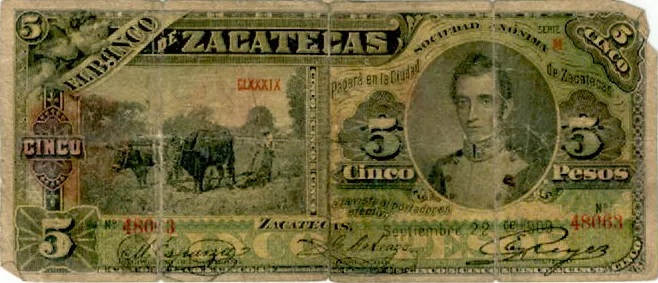
Engraved allegorical vignettes: a miner on the left, a female figure with goods in the center, and the profile portrait of a young man on the right
Reverse
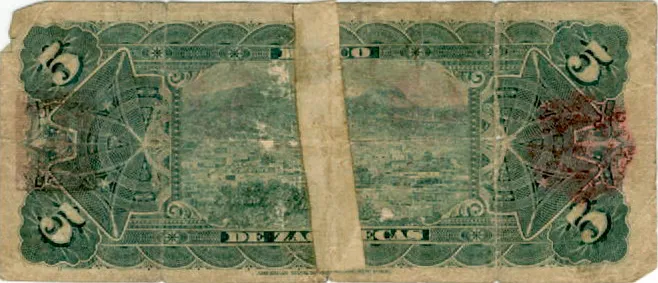
Scenes of mining and labor, or a monument set against the mountainous landscape of Zacatecas
About this banknote
Most old Mexican banknotes sell for a few dollars to a few hundred, not a fortune. The 1909 Banco de Zacatecas 5 pesos note is a genuine historical piece from Mexico's private-bank era, and depending on condition and how many survive, a nice example can bring anywhere from about 20 USD to several hundred. Here is what actually drives that number in 2026.
What this note actually is
This is a 5 pesos note issued by the Banco de Zacatecas, one of the state-chartered private banks that printed money during the Porfiriato (the long rule of President Porfirio Díaz, roughly 1876 to 1911).
Before Mexico had a single central bank, each state licensed its own private banks to issue paper money backed by silver. Zacatecas was mining country, so the note's engravings lean on mining imagery: the metal in the ground was the collateral behind the paper. This system of multiple issuing banks ended when the Banco de México was founded in 1925, which makes these earlier private-bank notes a distinct and collectible category in world paper money (notaphily).
Design. The face carries allegorical engraved vignettes: a miner on the left, a female figure with goods at center, and the profile portrait of a young man on the right. The back shows mining and labor scenes, or a monument set against the mountainous Zacatecas landscape. Denomination reads CINCO PESOS (5 pesos).
How much is it worth in 2026
This is historical paper money, well over a century old, so the value is purely collector value. It has nothing to do with the old 5-peso face amount, which is meaningless today. What matters is condition and how rare the issuing bank's notes are.
Private-bank notes from the Porfiriato do not follow one flat price. Some banks printed heavily and their notes are common; others are genuinely scarce. Banco de Zacatecas notes sit in the middle: available, but not as plentiful as the big central-region banks. As a rough guide for what these bring on the world-note market:
| Condition (grade) | Typical value range (USD) |
|---|---|
| Heavily circulated, tears, stains, pieces missing | 5 to 20 |
| Circulated but complete, folds, no major damage | 20 to 75 |
| Lightly circulated, crisp, minor handling | 75 to 200 |
| About uncirculated to uncirculated (rare survivor) | 200 to 600+ |
These are collector ranges, not a guaranteed offer. Two forces push a specific note above them: exceptional preservation (crisp paper, bright color, no folds) and specimen or proof examples, which some private banks distributed and which trade higher than issued notes. A low serial number, an unusual signature combination, or a printing error can also lift the price.
The myth: "it's a hundred years old, so it's worth thousands"
Age alone does not make paper money valuable. Millions of notes survive from this era, and a worn, torn example is worth a few dollars no matter how old it is. Condition and true scarcity drive value, not the date on the paper. A common note in poor shape stays cheap; a scarce note in top grade is where the real money sits. Do not trust the first inflated price you see online.
How to check what yours is worth
- Grade it honestly. Lay it flat and look for folds, tears, pinholes, stains, and missing corners. Crisp and complete beats worn and repaired every time. Never trim, tape, or "clean" a note; that destroys value.
- Check the serial number. A low number, a repeating pattern, or a palindrome (reads the same both ways) makes a note more desirable.
- Look for errors. Genuine factory errors (misaligned cuts, ink smears, missing print) can multiply value. Ordinary wear is not an error.
- Compare against references. Match the design, paper, and signatures to cataloged images of Banco de Zacatecas issues before assuming yours is standard.
Is it genuine?
For notes this old, authentication is about paper, printing, and signatures rather than modern security threads. Genuine period notes use banknote paper with real fiber and engraved (intaglio) printing you can sometimes feel. Reproductions and reprints tend to have smooth modern paper, flat colors, and photocopied detail. Signatures on private-bank notes were often hand-applied or lithographed in a specific way; compare yours to documented examples. If anything looks off, post clear photos of both sides in the Pesoteca forum and let the community weigh in before you buy or sell.
Where to sell it
To sell a Banco de Zacatecas 5 pesos note, your safest routes are a verified numismatic dealer from the Pesoteca directory, who can appraise it in person, or the Pesoteca buy-and-sell forum among collectors. For higher-grade or scarce examples, a specialist world-paper-money auction can reach the collectors who pay the most. Photograph both sides in good light, note the serial number and any error, and avoid dumping it on a general marketplace to the first buyer.
Have one of these in a family box and not sure what grade it is? Post front-and-back photos in the Pesoteca forum and we'll help you place it.
Historical context
Founded in 1891 with capital of 600,000 pesos, the Banco de Zacatecas operated under the private bank of issue scheme that governed Mexico until the mid-1920s. Each state could have its bank authorized to release its own notes; the one in Zacatecas even extended its reach with offices in Aguascalientes and San Juan de los Lagos.
This 5-peso note of 1909 belongs to the final stretch of the Porfiriato, when the circulation of regional bank paper was already common in commerce. Like the entire series, it shows on the obverse the miner, emblem of Zacatecan silver, alongside a female figure with goods and the portrait of a young man in profile; on the reverse, scenes of mining and labor against a mountainous background. The printing was carried out by the American Bank Note Company of New York. Beginning in 1913, banking reforms started to curtail the private right of issue, a process that culminated with the Banco de México's monopoly in 1925.
Frequently asked questions
How much is the 1909 Banco de Zacatecas 5 pesos note worth?
As a collector piece, a heavily worn example runs about 5 to 20 USD, a clean circulated note 20 to 75 USD, and a crisp near-uncirculated survivor can reach 200 to 600 USD or more. The old 5-peso face value is meaningless today; condition and scarcity set the price.
Is the 1909 Banco de Zacatecas 5 pesos note rare?
It's uncommon but not extremely rare. Banco de Zacatecas was one of several private state banks that issued notes during the Porfiriato. Well-preserved, uncirculated examples and specimen or proof notes are the scarce and valuable ones; worn issued notes are far more common.
How can I tell if my Banco de Zacatecas note is genuine?
Check the paper and printing. Genuine period notes use real banknote paper with engraved (intaglio) detail you can sometimes feel, plus period-correct signatures. Reproductions have smooth modern paper, flat colors, and photocopied detail. Compare against cataloged images, and if in doubt post photos in the Pesoteca forum.
Where can I sell the 1909 Banco de Zacatecas 5 pesos note?
Safest options are a verified dealer from the Pesoteca directory, who appraises it on the spot, or the Pesoteca buy-and-sell forum among collectors. For scarce or high-grade notes, a specialist world-paper-money auction reaches the buyers who pay the most. Photograph both sides and note the serial number before selling.
Características Banxico
CLXXXVI.
Familia PRIV
This banknote belongs to the BIL-PRIV family within the Sistema PSM . Explore all the banknotes that share origin, era and design with this piece.
Ver todos los billetes de la familia PRIV →