
5 Pesos Note (1914), Banco de Zacatecas: Value & Prices
Familia PRIV · algodón
Period: Bancos privados de emisión
Design
Banxico
Obverse
Banco de Zacatecas
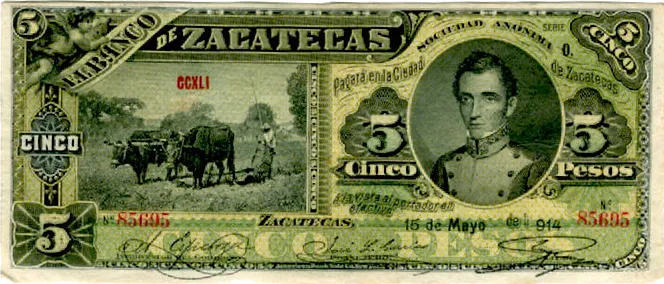
Engraved allegorical vignettes: a miner on the left, a female figure with goods in the center, and the profile portrait of a young man on the right
Reverse
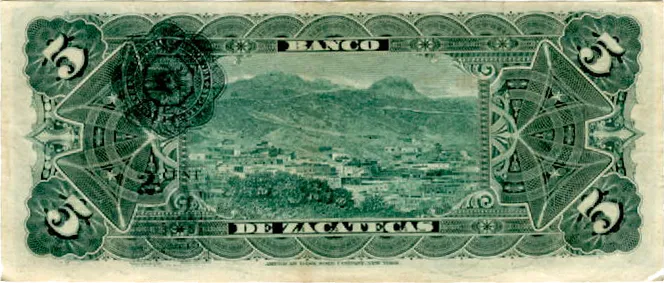
Scenes of mining and labor, or a monument set against the mountainous landscape of Zacatecas
About this banknote
Most 1914-era Mexican notes are worth from a few dollars to around 50 USD, but the Banco de Zacatecas 5 pesos can climb past 100 USD in crisp uncirculated condition or with a rare signature combination. Value here is driven by the issuing bank, the grade, and how many survived, not just the age.
This is not a Banco de México note. It comes from an earlier era, when Mexico had no single central bank and individual states ran private banks licensed to print their own paper money, each backed by silver. The Banco de Zacatecas was one of them. Zacatecas built its wealth on mining, which is why the vignettes on this note point straight at silver and ore: the metal was the guarantee behind the paper. This whole system of multiple issuing banks ended in 1925, when the Banco de México was founded and took over note issue.
What it looks like
The face carries engraved allegorical vignettes: a miner on the left, a female figure with goods at the center, and the profile portrait of a young man on the right. The back shows mining and labor scenes, or a monument set against the mountainous Zacatecas landscape. These are classic "bank note" designs of the period, printed by commercial engravers, with detailed line work that is hard to fake.
What it's worth in 2026
This is historic paper money, over a century old, so its value is purely collectible. It has no face value you can spend. What you can actually get depends on three things:
- Grade (condition). Notaphily grading runs from heavily worn (Good, VG) up to Uncirculated (UNC). A note with folds, tears, or stains sits at the bottom of the range. A crisp, uncirculated example with sharp corners can be worth several times more.
- Rarity of the issuing bank. Private-bank notes from the Porfiriato and vouchers from the Revolution have their own market. Some banks flooded the region with paper; others issued little and are genuinely scarce today. Many circulated so briefly that complete, undamaged examples are hard to find now.
- Whether it was actually issued. Some of these notes survive as "remainders," printed but never put into circulation, often without serial numbers or signatures. Issued, signed, serial-numbered notes usually carry a premium over blank remainders, though pristine remainders still sell well because they look mint.
As a working range, expect a well-worn example to bring a modest sum in the tens of dollars, while a high-grade or scarce-variety Banco de Zacatecas 5 pesos can reach into the low hundreds of dollars. Because these state-bank notes trade thinly, prices swing with condition and with how many are on the market at once. Check a completed-sales record or ask before you set a price.
| Note | Year | Issuer | Typical value (USD) |
|---|---|---|---|
| 5 Pesos | 1914 | Banco de Zacatecas | Worn: tens of dollars; UNC/scarce variety: low hundreds |
What actually drives the price
Age alone means very little here. A century-old note in poor shape is still a poor-shape note. What raises value:
- Uncirculated condition: no folds, no soft corners, full body to the paper.
- Low or unusual serial numbers: very low serials or radar (palindrome) numbers draw extra demand.
- Printing errors: genuine factory errors like miscuts, ink smears, or misalignments can multiply the value. Ordinary wear and handling damage is not an error.
- Documented rarity: if the specific denomination and signature combination is known to be scarce among Zacatecas issues, that matters more than the design.
How to tell if yours is genuine
For notes this old, forgery usually means a modern reproduction or a photocopy sold as real. Check the paper first: originals are printed on banknote stock with a distinct feel and often show fine engraved intaglio lines you can sometimes sense under angled light. Reproductions tend to have smooth, flat paper and dull, even color with no crisp line detail. Compare the vignettes, typefaces, and any signatures against reference images of Banco de Zacatecas issues. If the note has serial numbers and signatures, they should look printed and applied to the era, not laser-flat. When in doubt, post clear photos of the front and back in our forum for a second opinion before you buy or sell.
Where to sell it
To sell the 1914 Banco de Zacatecas 5 pesos safely, your best options are a verified dealer from the Pesoteca shop directory, who can appraise it on the spot, or the collector buy-and-sell forum, where world paper-money collectors are actively looking for Mexican state-bank issues. World paper money (notaphily) is a strong English-language market, so international collectors are real buyers here. Photograph both sides in good light, note the serial number and any signature, and flag anything unusual (low serial, radar number, error). Don't dump it to the first bidder on a social-media group.
Have a 1914 Banco de Zacatecas note in hand? Post the serial number and photos of both faces in the Pesoteca forum and let collectors help you pin down the variety and a fair figure.
Historical context
The Banco de Zacatecas carried its note issues into 1914, the year when the Revolution reached its most intense point and the Mexican banking system entered into crisis. Founded in 1891, it had been for more than two decades a central pillar of the regional economy, sustained by the city's centuries-old mining vocation.
This 5-peso note of 1914 is among the last the bank managed to put into circulation before revolutionary reforms began dismantling private issue. It preserves the characteristic iconography: the miner on the left as an emblem of Zacatecan silver, the female figure of commerce in the center, and the portrait of a young man in profile on the right, with mining scenes on the reverse. Printed by the American Bank Note Company of New York, it represents the close of a cycle: a few years later, in 1925, the newborn Banco de México would take over exclusive authority to issue paper money in the country.
Frequently asked questions
How much is the 1914 Banco de Zacatecas 5 pesos note worth?
Value is purely collectible, since it has no spendable face value. A worn example brings from a few dollars up to the tens of dollars. A crisp uncirculated note, or a scarce signature and serial variety, can reach into the low hundreds of dollars. Grade and rarity of the issuing bank set the price.
Is the 1914 Banco de Zacatecas 5 pesos note rare?
It depends on the exact variety. Some private-bank notes from this era were issued in quantity, while others are genuinely scarce. Many circulated briefly, so complete, undamaged examples are hard to find. Issued, signed, serial-numbered notes usually carry a premium over blank printed remainders.
Where can I sell my 1914 Banco de Zacatecas note?
Use a verified dealer from the [Pesoteca shop directory](/tiendas) for an on-the-spot appraisal, or the [buy-and-sell forum](/foro/compra-venta) among collectors. World paper money is an active international market. Photograph both sides in good light and note the serial number, any signature, and any printing error before you set a price.
How do I tell if the note is genuine?
Check the paper: originals use banknote stock with fine engraved (intaglio) line detail, while reproductions feel smooth and print in flat, dull color. Compare the vignettes, typefaces, and signatures against reference images of Banco de Zacatecas issues. When unsure, post clear photos of both faces in the [forum](/foro) for a second opinion.
Características Banxico
CCXL
Familia PRIV
This banknote belongs to the BIL-PRIV family within the Sistema PSM . Explore all the banknotes that share origin, era and design with this piece.
Ver todos los billetes de la familia PRIV →