
5 Pesos Banco Yucateco Banknote: Value & Guide
Familia PRIV · algodón
Period: Bancos privados de emisión
Design
Banxico
Obverse
Banco Yucateco
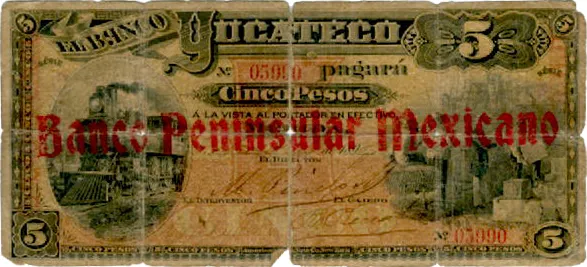
Seated female allegories making a toast and the figure of a young man, with a locomotive vignette
Reverse
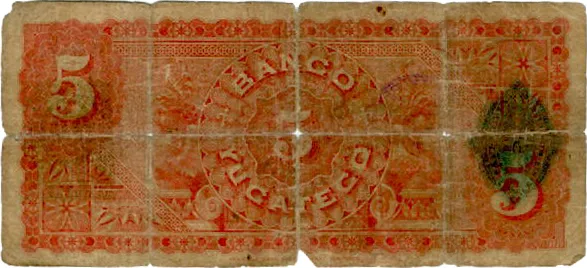
Engraved ornamental design with the denomination and the name of the bank
About this banknote
If you have a 5 pesos note from the Banco Yucateco de Mérida, you own a piece of Mexican private-bank paper money from the Porfiriato era, roughly the 1890s to 1910s. These are collector items, not spending money, and most sell in the range of 20 to a few hundred US dollars depending on condition and the specific issue. A pristine example or a scarce variety can go higher.
The common belief is that any 100-year-old banknote is a windfall. It usually is not. Value on world paper money is driven by four things: how many survive, condition (collectors call it grade), the reputation of the issuing bank, and eye appeal. This note scores well on history and design, which is why there is a real English-language market for it among notaphily collectors.
What the Banco Yucateco note is
The Banco Yucateco was a state note-issuing bank in Mérida, Yucatán, one of many private banks allowed to print their own currency during the Porfiriato (the long rule of Porfirio Díaz). It operated at the height of the henequén boom, when Yucatán's sisal-fiber exports made the region briefly one of the wealthiest in Mexico. Locals called henequén "green gold."
The design tells that story. The face shows seated female allegories toasting and the figure of a young man, with a vignette of a steam locomotive. The railroad was not decoration: it moved the henequén to port for export. The back carries an engraved ornamental design with the denomination and the bank's name.
The red overprint that matters
Many Banco Yucateco notes carry a red overprint reading "Banco Peninsular Mexicano." This came from the 1908 merger with the Banco Mercantil de Yucatán, which created the Banco Peninsular Mexicano. That overprint is a key detail:
- A note without the overprint is an original Banco Yucateco issue.
- A note with the red "Banco Peninsular Mexicano" stamp is a post-1908 revalidated piece.
Collectors track both, and the overprint variety can be scarcer or more common than the plain one depending on the exact type. Note which one you have before you shop it around.
How much is it worth in 2026
This is historic paper money, over a century old, so its value is purely collectible. Private-bank notes of the Porfiriato and the emergency scrip of the Revolution have their own market. Some issues are common, others extremely scarce, and many circulated so little (or were destroyed) that a complete, undamaged example is genuinely hard to find.
| Item | Era | Typical collector range (USD) | Notes |
|---|---|---|---|
| Banco Yucateco 5 pesos, well-worn | c. 1890s to 1910s | 20 to 60 | Folds, soiling, edge wear |
| Banco Yucateco 5 pesos, mid-grade | c. 1890s to 1910s | 60 to 150 | Bright, minor handling |
| Banco Yucateco 5 pesos, high grade | c. 1890s to 1910s | 150 to 400+ | Crisp, strong color, scarce issue |
| With red "Banco Peninsular" overprint | post-1908 | Varies by scarcity | Confirm which type before valuing |
These are ballpark figures for the general market. Certified notes graded by PMG (Paper Money Guaranty) can bring more, because grading removes the guesswork on authenticity and condition. Specialized auction houses that handle Mexican banks, such as Heritage Auctions and Stack's Bowers, are the right place to check realized prices for a specific type and signature combination.
What drives the price up
- Condition. A crisp, uncirculated note with full color and no folds can be worth several times a worn one. Notaphily collectors are demanding about this.
- Scarcity of the exact issue. Some Yucateco types survive in decent numbers; others are rare. The catalog reference and signatures on your note tell an expert which one you have.
- The overprint variety. Original versus "Banco Peninsular Mexicano" overprint can matter to a specialist.
- Full, undamaged paper. Tears, missing corners, tape, and heavy staining cut value hard.
The ones people overrate
A century-old date alone does not make a note valuable. Porfiriato private-bank notes were printed by the thousands, and a heavily circulated, damaged example of a common type is a 20-dollar item, not a fortune. Ignore "worth millions" claims floating around social media for old Mexican paper money. Genuine four- and five-figure prices exist, but they attach to specific rare types in top grade, verified by an auction record, not to any random old note in a drawer.
How to tell if yours is genuine
- Compare the paper, design, signatures, and colors with reference images of authentic Banco Yucateco notes. Genuine period notes were engraved: the printing has fine detail and slight relief. Reproductions tend to have flat, smooth paper and dull, flat color.
- Check the red overprint if present. It should look like an applied stamp, not part of the base printing.
- Look for engraving detail in the allegorical figures and the locomotive vignette. Blurry, pixelated lines suggest a scan-and-print fake.
- When in doubt, post clear, well-lit photos of both sides in the Pesoteca forum and let the community weigh in, or send it to PMG for certification.
Where to sell it
To sell a Banco Yucateco 5 pesos note, your safest routes are a verified numismatic dealer from the Pesoteca directory, which can appraise it in person, or the Pesoteca buy-and-sell forum, where collectors who actually want these notes are watching. Photograph both faces in good light, note whether it carries the overprint, and record the condition honestly. For a high-grade or rare type, a specialized world-paper-money auction gives you the widest pool of serious bidders. Avoid dumping it to the first offer on a general marketplace.
Do you have a Banco Yucateco note, with or without the red overprint? Post photos of both sides in the Pesoteca forum and let collectors help you pin down the exact type and what it is worth today.
Historical context
The Banco Yucateco, active in Mérida from 1890, embodies like few others the relationship between banking and henequen in Porfirian Yucatán. The fiber turned the peninsula into a thriving export economy, and banks like this one provided liquidity to the hacienda owners who sold "green gold" on international markets.
This 5-peso note, with no date visible in the catalog, belongs to the bank's low-denomination series, the ones most widely used in daily commerce. The obverse gathers female allegories toasting, the figure of a young man, and the characteristic locomotive vignette, a symbol of the railway that linked the henequen haciendas with the port of Progreso.
Engraved by the American Bank Note Company, the notes of the Banco Yucateco enjoyed prestige until, in 1905, the merger with the Banco Mercantil de Yucatán gave rise to the Banco Peninsular Mexicano. Its 5-peso issues continued to circulate even overstamped under the new name.
Frequently asked questions
How much is the Banco Yucateco 5 pesos note worth?
As a collector item, most examples sell from about 20 to 60 US dollars if well-worn, and 150 to 400 or more if crisp and high grade. Scarce issues and certified notes can bring more. Condition and the exact type drive the price, not just its age.
Is the Banco Yucateco 5 pesos note rare?
It depends on the exact issue. Some Porfiriato private-bank notes survive in decent numbers, while others are genuinely scarce, especially in high grade. Notes with the red 'Banco Peninsular Mexicano' overprint from the 1908 merger are tracked separately by collectors.
Where can I sell a Banco Yucateco banknote?
The safest options are a verified dealer from the [Pesoteca directory](/tiendas), who can appraise it on the spot, or the [Pesoteca buy-and-sell forum](/foro/compra-venta) among collectors. For a rare or high-grade note, a specialized world-paper-money auction such as Heritage or Stack's Bowers reaches serious bidders. Photograph both sides and note the condition.
How can I tell if my Banco Yucateco note is genuine?
Compare the paper, engraving, signatures, and colors with authentic reference images. Real period notes were engraved, with fine detail and slight relief, while fakes tend to have flat, smooth paper and dull color. Check the red overprint if present. When unsure, post clear photos in the [Pesoteca forum](/foro) or have it certified by PMG.
Familia PRIV
This banknote belongs to the BIL-PRIV family within the Sistema PSM . Explore all the banknotes that share origin, era and design with this piece.
Ver todos los billetes de la familia PRIV →