
5 Pesos Banco Yucateco (1901): Value & Where to Sell
Familia PRIV · algodón
Period: Bancos privados de emisión
Design
Banxico
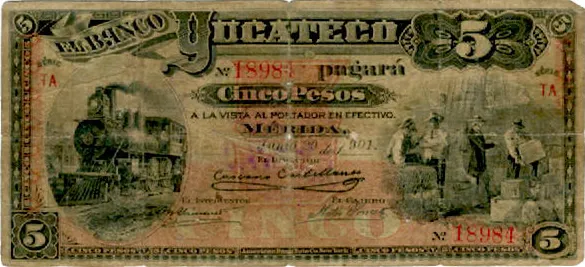
Obverse
Banco Yucateco
Seated female allegories making a toast and the figure of a young man, with a locomotive vignette
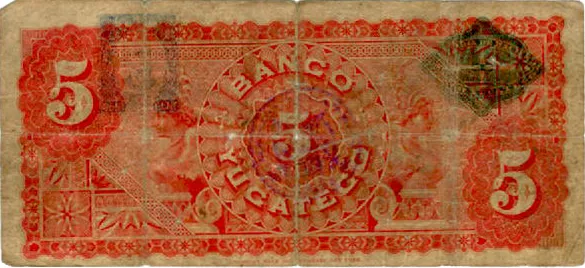
Reverse
Engraved ornamental design with the denomination and the name of the bank
About this banknote
Most inherited Mexican banknotes are worth a few dollars. The Banco Yucateco 5 pesos note from 1901 is different: it is genuine historic paper money from Mexico's era of private state banks, and depending on condition and one specific red overprint, examples change hands from around 20 USD to well over 150 USD among collectors of world paper money.
If you found one in a family album or an old box, here is what actually drives the price, and how to tell a common example from a scarce one.
What this note actually is
The Banco Yucateco was a private bank based in Mérida, in the Yucatán peninsula, and it issued its own currency during the Porfiriato, the long rule of president Porfirio Díaz (roughly 1876 to 1911). In that era Mexico had no single national issuer. Dozens of private state banks printed their own notes backed by their own reserves. This is why a note from 1901 says "Banco Yucateco" and not "Banco de México," which did not exist yet (it was founded in 1925).
The bank operated during the henequén boom, when Yucatán grew rich exporting the sisal fiber known locally as "green gold." The engraved locomotive vignette on the note is deliberate: it advertised the railway progress that carried henequén to the port for export.
Design. The face shows seated female allegorical figures raising a toast and the figure of a young man, alongside the locomotive vignette. The back carries an engraved ornamental design with the denomination and the bank's name. These were printed by professional security printers of the period, so the engraving is fine and detailed, not flat.
The detail that changes the value: the red overprint
Many surviving Banco Yucateco notes carry a red overprint reading "Banco Peninsular Mexicano." This came from the 1908 merger of the Banco Yucateco with the Banco Mercantil de Yucatán, which created the new Banco Peninsular Mexicano. Notes were overprinted rather than reprinted.
For a collector this matters:
- A clean Banco Yucateco note with no overprint is one collecting target.
- A note with the red "Banco Peninsular Mexicano" overprint is a different, separately catalogued item and is sought by specialists tracking the merger.
Check your note for that red stamp before you value it. It is not damage or a defacement; it is part of the history and, for the right buyer, part of the appeal.
What it's worth in 2026
This is historic paper money more than a century old, so its value is purely collectible. There is no "face value" to spend. Price depends almost entirely on two things: condition and how scarce that specific bank and type are.
Private-bank notes of the Porfiriato and the paper scrip of the later Mexican Revolution form their own active market inside world paper money (notaphily). Some issues are common, others are extremely scarce, and many circulated so briefly that intact examples are hard to find today.
| Type | Condition | Typical collector range (USD) |
|---|---|---|
| Banco Yucateco 5 pesos, no overprint | Well-circulated (folds, wear) | 15 to 45 |
| Banco Yucateco 5 pesos, no overprint | Crisp, clean, few defects | 60 to 150+ |
| With red "Banco Peninsular Mexicano" overprint | Depends on state | Priced separately; ask a specialist |
| Specimen or proof (if genuine) | High grade | Significantly higher, individually assessed |
These are collector-market ranges, not fixed prices. A note graded and encapsulated by PMG (Paper Money Guaranty, the main third-party grading service for banknotes) in a high grade can sell above the ranges above. A torn, stained, or repaired example sells well below.
Treat any exact figure you see on a single online listing with caution. A "buy it now" price is what a seller hopes to get, not what the note is worth. Confirm against recent sold results and, when the amount is meaningful, get a specialist opinion.
The myth to drop
Age alone does not make a banknote valuable. "It's from 1901" is not a selling point by itself; plenty of century-old notes trade for the price of a coffee. What moves the price is real scarcity of that specific bank and type, condition, the presence of the overprint, and buyer demand. A common note in poor condition stays cheap no matter how old it is.
How to check what yours is worth
- Grade the condition honestly. Crisp and flat with strong color and full corners is worth many times more than soft, folded, and stained. Never flatten, tape, trim, or "clean" an old note; that destroys value.
- Look for the red overprint. Confirm whether it says "Banco Peninsular Mexicano." That determines which catalog type you actually have.
- Photograph both sides in good, even light, flat, filling the frame. Serious buyers need clear images of face and back before they quote.
- Verify authenticity (see below) before assuming a value.
- Compare against sold prices, not asking prices, and post it to a knowledgeable community for a second read.
Where to sell it
For Mexican historic banknotes, the safest routes are a verified numismatic dealer from the Pesoteca shop directory, who can appraise the note in person, or the collector-to-collector Pesoteca buy-and-sell forum. Both put your note in front of people who actually understand Porfiriato private-bank issues.
For higher-value or graded examples, an established world-paper-money auction house reaches specialist bidders worldwide. Avoid dumping the note to the first offer on a general social-media marketplace, where buyers rarely know the overprint distinction and often lowball.
Want a second opinion on your note before you sell? Post clear photos of both sides in the Pesoteca forum and tell us whether yours carries the red overprint.
Historical context
The Banco Yucateco was, alongside the Banco Mercantil, one of the great financial pillars of the henequen boom that enriched Yucatán at the end of the nineteenth century. Backed by the house of Olegario Molina, it had expanded its capital from an initial 700,000 pesos to more than a million by the end of the 1890s, a sign of the prosperity Mérida was experiencing.
This 1901 5-peso note circulated at the height of the bank's peak. Its obverse combines female allegories offering a toast, the figure of a young man, and a locomotive vignette, a nod to the railway that structured the henequen economy. The reverse, with its engraved ornamental design, crowned a piece of everyday circulation.
The notes came off the plates of the American Bank Note Company. A few years later, in 1905, the Banco Yucateco would merge with the Banco Mercantil de Yucatán to form the Banco Peninsular Mexicano, closing its chapter as an independent issuer.
Frequently asked questions
How much is the Banco Yucateco 5 pesos note (1901) worth?
As a collector item, a well-circulated example typically runs from about 15 to 45 USD, while a crisp, clean note can reach 60 to 150 USD or more. Notes with the red 'Banco Peninsular Mexicano' overprint, or those graded high by PMG, are valued separately and can sell higher. Condition and scarcity decide the price, not the 1901 date alone.
Is the Banco Yucateco 5 pesos note rare?
It depends on the exact type and condition. This was a private state bank from the Porfiriato, and its notes are genuinely historic and no longer common, especially in crisp condition. Many circulated so little or wore out so heavily that intact examples are scarce today. The red 'Banco Peninsular Mexicano' overprint version is tracked as a distinct type by specialists.
Where can I sell my 1901 Banco Yucateco banknote?
The safest options are a verified dealer from the [Pesoteca shop directory](/tiendas), who can appraise it in person, or the [Pesoteca buy-and-sell forum](/foro/compra-venta) among collectors who know these issues. For higher-value or PMG-graded notes, an established world-paper-money auction house reaches specialist bidders. Photograph both sides clearly and note any red overprint before selling.
How can I tell if the Banco Yucateco 5 pesos note is genuine?
Examine the engraving: authentic period notes have fine, detailed line work and textured paper, while reproductions show flat colors and smooth, modern-feeling paper. Compare the design, signatures, and any red overprint against reference images of catalogued examples. If you are unsure, post clear photos of both sides in the [Pesoteca forum](/foro) for the community to review.
Familia PRIV
This banknote belongs to the BIL-PRIV family within the Sistema PSM . Explore all the banknotes that share origin, era and design with this piece.
Ver todos los billetes de la familia PRIV →