
Mexico 50 Pesos Note: José María Morelos (Series F, Polymer)
Familia F · polímero
Period: México Contemporáneo
Design
Banxico
Obverse
José María Morelos y Pavón
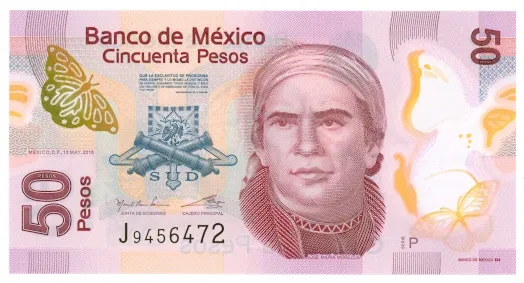
Portrait of José María Morelos with two opposing cannons, the standard of his forces, and a bow with an arrow and the word SUD
Reverse
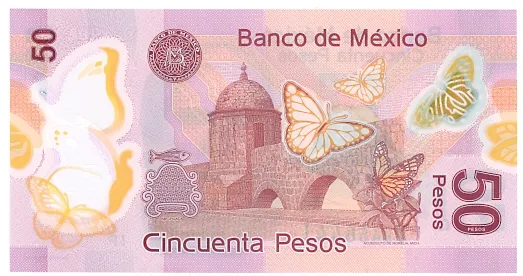
The aqueduct of Morelia and a monarch butterfly
About this banknote
Most circulated Mexican 50 peso notes with José María Morelos are worth exactly their face value, which is roughly 2.50 to 3 USD at current exchange rates. The pieces that sell for more are the uncirculated ones, the low serial numbers, and the printing errors. Here is what your note actually is and how to tell if yours is one of the few worth more than pocket change.
What this note is
This is the pink 50 peso note from the Banco de México Series F (familia F), printed on polymer with a transparent window that became its signature feature. The front (anverso) shows José María Morelos y Pavón, the insurgent priest who convened the Congress of Chilpancingo in 1813 during Mexico's War of Independence.
The back (reverso) shows the aqueduct of Morelia in the state of Michoacán, an 18th-century structure, along with three monarch butterflies, which migrate to Michoacán's forests every winter. Collectors pay close attention to that butterfly detail, since the size of the butterfly varies between print runs. The Banco de México has been withdrawing this design from circulation, which is exactly when collectors start hunting for clean, unused examples.
What it's worth in 2026
If your note still circulates and shows normal wear, it is worth its face value of 50 pesos, about 2.50 to 3 USD. There is no premium for a used Series F note, no matter how old it looks. Age alone does not make a banknote valuable.
Three things move the price above face value:
- Uncirculated condition. A crisp note with no folds, creases, or stains, ideally still in its original bank wrapper (blister), carries a modest premium as the design leaves circulation.
- Special serial numbers. A low serial (like A0000123), a radar/palindrome number (reads the same forward and backward), or a repeated/solid number is what specialist collectors chase.
- Genuine printing errors. Misaligned cuts, ink smears, factory folds, missing print, or off-center serials turn a common note into a rarity worth several times face value.
For an ordinary note, that is the whole picture. Everyday wear and handling damage is not an error and adds nothing.
| Feature | What it means | Effect on value |
|---|---|---|
| Circulated, normal wear | Standard note | Face value (~3 USD) |
| Uncirculated / in wrapper | Crisp, no folds | Small premium |
| Low or radar serial | Special folio | Higher, collector demand |
| Genuine printing error | Factory defect | Several times face value |
The ones people think are worth a fortune but aren't
A circulated Morelos note that happens to be a few years old is not rare. Millions were printed. The "my old note must be worth thousands" idea does not apply to a modern Series F polymer note. Value here comes from condition and serial number, not from the date on it.
How to check what yours is worth
Start with three checks. Is it truly uncirculated, with no folds or soft corners? Does the serial number stand out (low, repeating, or a palindrome)? Is there a real printing error, not just wear? Any one of those makes it worth showing to collectors.
To confirm it's genuine, inspect the security features: the watermark visible against the light, the security thread, microprinting, raised intaglio you can feel with your fingers, and, on polymer notes, the transparent window. A counterfeit usually feels smooth with no raised texture, and its watermark looks printed on rather than built into the substrate.
To sell, a verified numismatic shop from the Pesoteca directory will appraise it on the spot, or you can list it in the Pesoteca buy-and-sell forum among collectors. Photograph both sides in good light before agreeing to any price.
For context, read why the 20 peso note is leaving circulation and the most counterfeited banknotes in Mexico.
Think your Morelos note has an odd serial or a genuine misprint? Post clear photos of both sides in the forum and the community will tell you what you're holding.
Historical context
This 50-peso note of 2015 belongs to the polymer variant of Family F and preserves on the obverse the effigy of José María Morelos y Pavón, the priest and insurgent leader who took up the banner of the struggle after Hidalgo's death. Morelos convened the Congress of Chilpancingo in 1813 and gave the nation the Sentimientos de la Nación, a document that abolished slavery and proclaimed popular sovereignty.
The reverse pays tribute to Michoacán, Morelos's native land, with the Morelia aqueduct as the main motif, accompanied by monarch butterflies and a stylization of the state's pre-Hispanic symbol.
The shift from cotton paper to polymer in this denomination responded to the search for notes that were more durable and harder to counterfeit. Thus, this piece represents a hinge moment in the technological transition of the Mexican note during the second decade of the twenty-first century.
Frequently asked questions
How much is the Mexican 50 peso Morelos note worth?
If it still circulates with normal wear, it's worth its face value, roughly 2.50 to 3 USD at current exchange rates. As a collectible, an uncirculated note, one with a special serial number, or one with a genuine printing error can sell for several times face value. Condition and rarity are what matter.
Is the 50 peso Morelos note rare?
No, the standard Series F polymer note was printed in the millions and is not rare. What's scarce and sought-after are uncirculated examples in their original wrapper, low or palindrome serial numbers, and factory printing errors. Age by itself adds no value.
Where can I sell my 50 peso Morelos note?
The safest options are a verified numismatic shop from the [Pesoteca directory](/tiendas), which appraises it in person, or the collector [buy-and-sell forum](/foro/compra-venta). Photograph both sides in good light and check for a low or radar serial or any error before agreeing on a price. Avoid dumping it to the first bidder on social media.
How can I tell if my 50 peso Morelos note is genuine?
Check the security features: the watermark visible against the light, the security thread, microprinting, the raised intaglio you can feel by touch, and the transparent window on the polymer version. A fake usually feels smooth with no raised texture and has a watermark that looks printed on rather than built into the note. If in doubt, ask in the [forum](/foro).
Familia F
This banknote belongs to the BIL-F family within the Sistema PSM . Explore all the banknotes that share origin, era and design with this piece.
Ver todos los billetes de la familia F →