
50 Pesos Banknote (1891), Banco de Zacatecas
Familia PRIV · algodón
Period: Bancos privados de emisión
Design
Banxico
Obverse
Banco de Zacatecas
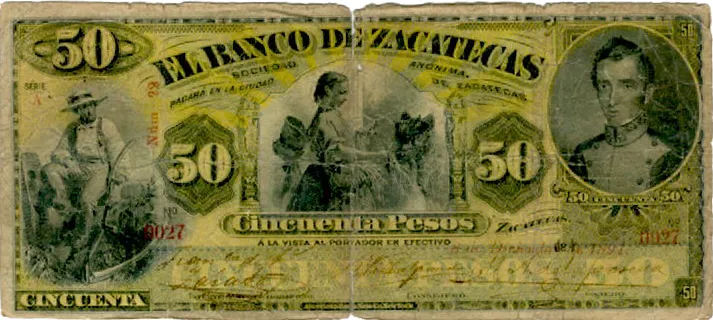
Engraved allegorical vignettes: a miner on the left, a female figure with goods in the center, and the profile portrait of a young man on the right
Reverse
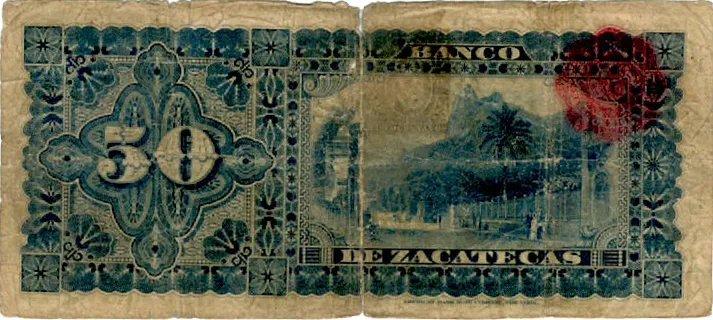
Scenes of mining and labor, or a monument set against the mountainous landscape of Zacatecas
About this banknote
Most 19th-century Mexican banknotes are worth a few dollars, but a genuine, well-preserved 50 pesos note from the Banco de Zacatecas (1891) can bring anywhere from about 50 USD in worn condition to several hundred USD for a crisp, problem-free example. This is not modern currency you can spend. It is a private-bank note from Mexico's Porfiriato era, and its entire value is as a collectible.
What you actually have
Before Mexico had a single central bank, individual states hosted private banks licensed to print their own paper money, each note backed by silver. Zacatecas, one of the great silver-mining regions of the country, ran the Banco de Zacatecas. That mining wealth is why the note's engravings show miners and mineral scenes: the silver in the ground was the guarantee behind the paper.
This whole system of multiple issuing banks ended when the Banco de México was founded in 1925, which is why these older private-bank notes are now a distinct collecting field in world paper money (a hobby collectors call notaphily).
Design details
The face (anverso) carries engraved allegorical vignettes: a miner on the left, a female figure with goods at the center, and the profile portrait of a young man on the right. The back (reverso) shows scenes of mining and labor, or a monument set against the mountainous Zacatecas landscape. Denomination is 50 pesos, dated 1891.
How much is it worth in 2026?
This is historic paper money more than a century old, so its value is purely collector-driven. Two things decide the price: condition (grade) and how rare the issuing bank's notes are. Some Porfiriato private-bank notes are relatively common; others are extremely scarce because so few survived intact. Notes that circulated heavily are often found torn, stained, or fragmentary, and that crushes value.
Here is a realistic value framework for a genuine example. These are indicative ranges for the collector market, not fixed quotes, because condition swings the number hard.
| Condition | What it looks like | Approx. value (USD) |
|---|---|---|
| Well-worn / damaged | Tears, stains, missing corners, tape | 15 to 50 |
| Circulated, intact | Folds and softness, no major damage | 50 to 150 |
| About uncirculated | Minimal handling, strong color, crisp | 150 to 350 |
| Choice uncirculated | No folds, sharp corners, original paper | 350 to 800+ |
Specimen notes (marked "Especimen" or "Muestra" and printed for reference, never issued) and remainders (unsigned, unissued stock) trade on their own scale and can sit at either end depending on scarcity. If your note is one of those, get it looked at specifically, because generic price guides will mislead you.
What raises the value
- Grade above everything. A crisp, uncirculated note can be worth five to ten times a folded, tired one of the exact same type.
- Low or repeating serial numbers. A very low serial number or a palindrome (radar) note draws extra collector demand.
- Genuine printing errors. Misaligned cuts, ink smears, factory folds, or off-center serials can multiply the value. Normal wear and use damage is not an error.
- Rarity of the specific bank issue. Some Banco de Zacatecas denominations survive in tiny numbers.
Is it rare?
Rarer than a modern note, but not automatically valuable. "Old" does not mean "fortune," and any site telling you a common private-bank note is worth thousands by default is selling clicks. What makes a specific example rare is a combination of high grade plus a scarce issue plus a desirable serial or error. A worn, common 50 pesos type in poor shape is worth its floor and little more.
How to tell if yours is genuine
Reproductions and reprints of attractive Porfiriato notes exist. Check these:
- Paper. Period notes use textured, aged paper. Modern reprints often feel smooth and look too flat.
- Printing quality. Genuine engraving shows fine, sharp line detail. Reproductions tend to have soft, screened, or pixelated lines under a loupe.
- Color. Original inks have depth; copies often print flat, even color.
- Signatures and serials. Compare against reference images of authentic Banco de Zacatecas notes. Watch for printed "signatures" that should be hand-applied.
When in doubt, post clear photos of both sides in the Pesoteca forum and let the community weigh in, or have it examined by a dealer who handles Mexican paper money.
Where to sell it
Get more than one opinion before you sell. Options, from safest to riskiest:
- A verified numismatic shop from the Pesoteca directory, which can appraise it in person.
- The Pesoteca buy-and-sell forum, where collectors who actually want this material set fair prices.
- Major world-paper-money auctions (Heritage, Stack's Bowers) for genuinely scarce or high-grade examples, where the right buyers compete.
Photograph both faces in good, even light, note any low serial, palindrome, or error, and never dump it to the first offer on social media. If you also collect coins from the era, our guide to the most valuable Mexican coins is worth a look.
Got the 1891 Banco de Zacatecas note in hand and unsure what grade it really is? Post front and back photos in the Pesoteca forum and get a straight read from collectors who know this series.
Historical context
The Banco de Zacatecas reserved high denominations like this one for higher-volume commerce and the state's financial operations. Granted its concession on March 3, 1891, and established at the end of that year with a capital of 600,000 pesos, it belonged to the first generation of state issuing banks of the Porfiriato.
This 50-peso note of 1891 is among the bank's earliest, issued in the very year of its founding, when the institution was beginning to operate under the private banknote-issuing system. The 50 pesos represented a substantial sum, suited to weighty transactions rather than everyday spending. Its obverse brings together the house's allegorical vignettes: a miner on the left, emblem of Zacatecan silver, a female figure with merchandise at the center, and a young man in profile on the right; on the reverse, scenes of mining and labor. Engraved by the American Bank Note Company of New York, it is a highly valued inaugural piece. This issuing model would end with the founding of Banco de México in 1925.
Frequently asked questions
How much is the 1891 Banco de Zacatecas 50 pesos banknote worth?
As a collectible, roughly 15 to 50 USD in worn or damaged condition, 50 to 150 USD circulated but intact, and 150 to 800 USD or more for a crisp, uncirculated example. It is not spendable currency; value depends entirely on grade and the rarity of the specific bank issue.
Is the 1891 Banco de Zacatecas 50 pesos note rare?
It is scarcer than modern currency, but old does not automatically mean valuable. Real value comes from a combination of high grade, a genuinely scarce issue, and desirable features like a low or palindrome serial number or a printing error. A common, worn example is worth its floor and little more.
Where can I sell the 1891 Banco de Zacatecas 50 pesos note?
The safest routes are a verified shop from the [Pesoteca directory](/tiendas), which appraises in person, or the [Pesoteca buy-and-sell forum](/foro/compra-venta) among collectors. For a truly scarce or high-grade example, a world-paper-money auction such as Heritage or Stack's Bowers can reach the right buyers. Photograph both sides and get more than one opinion first.
How do I know if my 1891 note is genuine or a reprint?
Check the paper (period notes feel textured, not smooth), the printing (genuine engraving shows fine, sharp lines under a loupe while copies look soft or pixelated), and the ink depth (originals have richer color than flat reprints). Compare signatures and serials against authentic reference images, and post photos in the [Pesoteca forum](/foro) if you are unsure.
Características Banxico
Firmas autógrafas, VIII
Familia PRIV
This banknote belongs to the BIL-PRIV family within the Sistema PSM . Explore all the banknotes that share origin, era and design with this piece.
Ver todos los billetes de la familia PRIV →