
50 Pesos Banknote (1898), Banco de Zacatecas
Familia PRIV · algodón
Period: Bancos privados de emisión
Design
Banxico
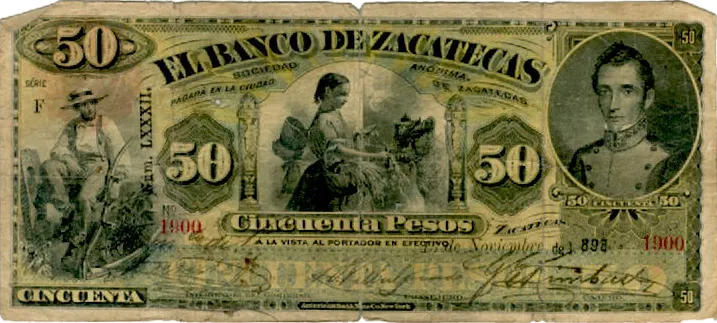
Obverse
Banco de Zacatecas
Engraved allegorical vignettes: a miner on the left, a female figure with goods in the center, and the profile portrait of a young man on the right
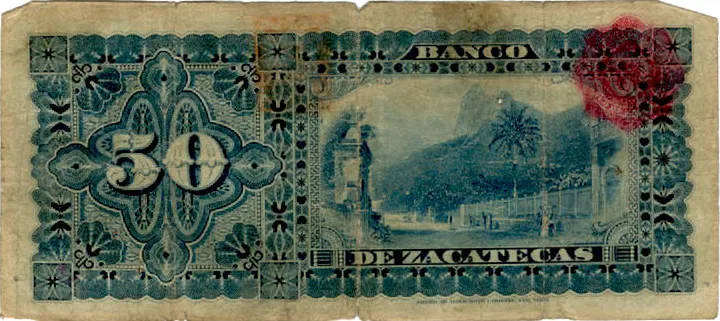
Reverse
Scenes of mining and labor, or a monument set against the mountainous landscape of Zacatecas
About this banknote
Most old paper money from Mexico is worth a modest premium over face, but pre-revolutionary private bank notes are a different animal. The 1898 Banco de Zacatecas 50 pesos note is a genuine collectible piece: depending on condition and how rare the specific issue is, examples trade from roughly 40 USD in worn grades up to several hundred dollars for crisp, well-preserved notes, with the scarcest survivors going higher.
This is not a Banco de México note. It predates Mexico's central bank entirely. In 2026, US and international collectors of world paper money (notaphily) treat these Porfiriato-era private bank issues as one of the more interesting corners of Mexican currency, precisely because so few circulated and even fewer survived intact.
What it actually is
Before Mexico had a single central bank, individual states hosted private banks licensed to print their own paper money, each note backed by silver. Zacatecas was mining country, so the Banco de Zacatecas issued notes whose vignettes speak directly to that: the silver in the ground was the guarantee behind the paper. This system of multiple issuing banks ended in 1925, when the Banco de México was founded and given the sole right to print currency.
The face of the note carries engraved allegorical vignettes: a miner on the left, a female figure with goods at center, and the profile portrait of a young man on the right. The back shows scenes of mining and labor, or a monument set against the mountainous Zacatecas landscape. These are engraved, intaglio-printed notes, which is one of the first things separating an original from a flat reproduction.
How much it is worth
This is historical paper money more than a century old, so its value is purely collector value. Two things drive the price: condition and the rarity of the specific issue. Private bank notes from the Porfiriato and the paper scrip of the Revolution have their own dedicated market. Some issues are relatively common, others are genuinely scarce, and many circulated so briefly that finding a complete, undamaged example today is the real challenge.
Condition is graded on the same international scale collectors use worldwide, running from Good and Fine at the low end through Very Fine, Extremely Fine, About Uncirculated, and Uncirculated (Unc / crisp). A note with heavy folds, tears, or missing corners sits near the bottom of the range. A crisp, unfolded example with strong color and full margins can be worth several times more.
| Item | Year | Approx. collector value (USD) | Notes |
|---|---|---|---|
| Banco de Zacatecas 50 pesos, well-circulated | 1898 | 40 to 120 | Folds, edge wear, still complete |
| Banco de Zacatecas 50 pesos, Very Fine | 1898 | 150 to 350 | Light handling, good color |
| Banco de Zacatecas 50 pesos, crisp / Uncirculated | 1898 | 400 and up | Scarce in this state |
These are indicative ranges for the general collector market. The scarcest signature or plate varieties can bring more, and a note with a low or repeated serial number carries an added premium. If you have one, do not trust the first price you see online. Post it in the Pesoteca forum or check with a serious dealer from the Pesoteca shop directory before you sell.
The myth to avoid
Age alone does not make a note valuable. "It's over 100 years old" is not a price tag. Plenty of Porfiriato-era paper survives, and a battered, taped, or trimmed note is worth a fraction of a clean one. What actually moves value is a combination of genuine scarcity for that specific bank and issue, strong condition, and demand from world-paper-money collectors. A common issue in poor shape stays cheap no matter how old it is.
How to tell if yours is genuine
Originals from this era are engraved, intaglio-printed on quality paper. Run your fingertip across the design: you should feel slight relief where the ink sits. Reproductions and modern prints tend to have smooth, flat paper and flat, photographic-looking color. Compare the vignettes, the paper texture, and the printed signatures against reference images of authentic Banco de Zacatecas notes. If anything looks off, ask in the forum with clear photos of both sides before you buy or sell.
How to check what yours is worth
- Photograph both faces in good, even light, flat and in focus.
- Note the serial number. A low number, a repeated (radar/palindrome) number, or an off-center or double-printed serial can all add value.
- Assess condition honestly: folds, tears, stains, and missing corners all pull the price down.
- Look for printing errors. Genuine factory errors (misaligned cuts, ink smears, off-center printing) can turn a common note into a rarity. Normal wear from handling is not an error.
- Get a second opinion from a verified dealer in the Pesoteca directory or from collectors in the forum before accepting an offer.
Have one of these notes sitting in a drawer or an inherited album? Post clear photos of the front and back in the Pesoteca forum and let collectors help you pin down the issue, the condition, and a fair price.
Historical context
Toward the end of the 19th century, the Banco de Zacatecas consolidated a stable issue of high-denomination notes, intended for substantial commerce and financial operations. Founded in 1891, it operated backed by specie and with circulation limited to its territory, within the system of private banks of issue.
This 50-peso note of 1898 belongs to the mature years of the Porfiriato, when regional bank paper was a common part of economic life. Its obverse shows the series' three vignettes: the miner evoking Zacatecas's silver wealth, a female figure with goods in the center, and the portrait of a young man in profile on the right, with mining scenes on the reverse. The printing was carried out by the American Bank Note Company of New York, a guarantee of quality against counterfeiting. This model of state issuance would be replaced by the Banco de México's monopoly starting in 1925.
Frequently asked questions
How much is the 1898 Banco de Zacatecas 50 pesos note worth?
Value is purely collector value, since this is not legal tender. Well-circulated examples typically bring around 40 to 120 USD, Very Fine notes 150 to 350 USD, and crisp uncirculated pieces 400 USD and up. Scarce varieties or notes with special serial numbers go higher. Condition and rarity of the specific issue drive the price.
Is the 1898 Banco de Zacatecas note rare?
Some Porfiriato private-bank issues are common, others are genuinely scarce. Many of these notes circulated only briefly, so finding a complete, undamaged example today is the real difficulty. A crisp, well-preserved note is much harder to find, and that scarcity is what pushes the value up.
Where can I sell an 1898 Banco de Zacatecas 50 pesos note?
The safest routes are a verified dealer from the [Pesoteca shop directory](/tiendas), who can appraise it on the spot, or the [Pesoteca buy-and-sell forum](/foro/compra-venta) among collectors. Photograph both sides in good light, note any low or repeated serial number or printing error that raises value, and avoid dumping it to the first buyer on social media.
How can I tell if my note is genuine?
Originals are engraved and intaglio-printed on quality paper, so you can feel slight relief in the design when you run a finger over it. Compare the vignettes, paper texture, and signatures against authentic Banco de Zacatecas reference images. Reproductions usually have smooth paper and flat, photographic color. When in doubt, post clear photos in the [Pesoteca forum](/foro).
Características Banxico
Firmas autógrafas, LXXXII
Familia PRIV
This banknote belongs to the BIL-PRIV family within the Sistema PSM . Explore all the banknotes that share origin, era and design with this piece.
Ver todos los billetes de la familia PRIV →