
Mexican 50 Pesos Banknote (1899): Banco de Zacatecas
Familia PRIV · algodón
Period: Bancos privados de emisión
Design
Banxico
Obverse
Banco de Zacatecas
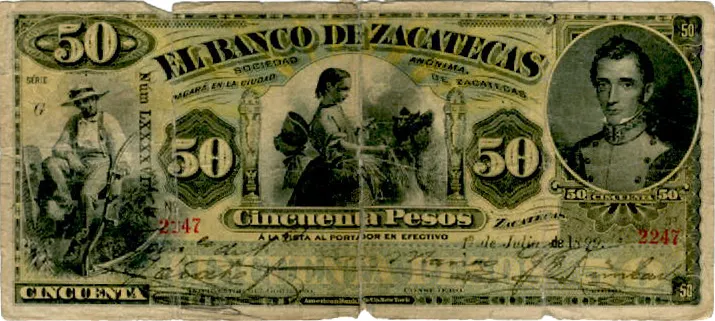
Engraved allegorical vignettes: a miner on the left, a female figure with goods in the center, and the profile portrait of a young man on the right
Reverse
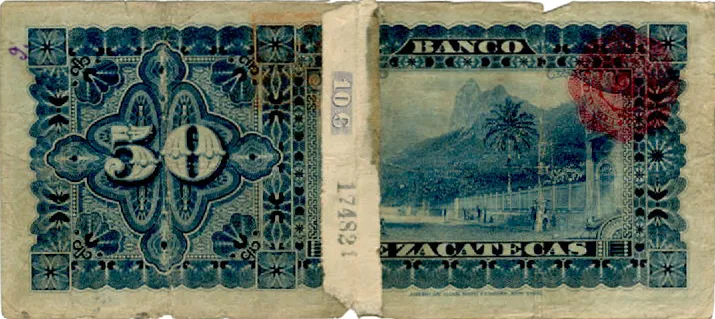
Scenes of mining and labor, or a monument set against the mountainous landscape of Zacatecas
About this banknote
If you found a Mexican 50 pesos note dated 1899 from the Banco de Zacatecas, it is not spendable money and it is not worth 50 dollars at a bank. It is a piece of collectible paper money from the Porfiriato era, and depending on condition it can run from around 20 USD for a worn, common example to several hundred dollars for a crisp, uncirculated one. Rarity of the issuing bank and grade are what decide the number.
What you actually have
This is a note from the Banco de Zacatecas, one of many state-chartered private banks that printed their own money in Mexico before a single central bank existed. Under President Porfirio Díaz (the "Porfiriato" period, roughly 1876 to 1911), individual banks were licensed to issue paper money backed by silver. Zacatecas was one of Mexico's great silver-mining regions, which is why the vignettes on this note lean on mining imagery: the metal in the ground was the guarantee behind the paper.
This system of multiple issuing banks ended when the Banco de México was founded in 1925 as the country's sole note-issuing authority. That makes every private-bank note like this one a closed, historical series, which is exactly what world paper money collectors (a hobby called notaphily) look for.
Design details
- Obverse (front): engraved allegorical vignettes. A miner on the left, a female figure with goods at center, and the profile portrait of a young man on the right.
- Reverse (back): scenes of mining and labor, or a monument set against the mountainous Zacatecas landscape.
- Issuer: Banco de Zacatecas, a Porfiriato-era state issuing bank.
- Date: 1899.
How much is it worth in USD?
The honest answer for most inherited notes: this is collector-only value, and the range is wide. A single factor swings it more than anything else, and that is condition (collectors call it grade).
| Condition | What it looks like | Rough value (USD) |
|---|---|---|
| Well-worn / damaged | Heavy folds, tears, stains, pieces missing | 15 to 40 |
| Circulated, complete | Folds and handling but intact | 40 to 120 |
| Uncirculated / crisp | No folds, sharp corners, original paper | 150 to 500+ |
These are ranges, not guarantees. Some Zacatecas issues are relatively available and some are genuinely scarce, because many of these notes circulated so little (or were redeemed and destroyed) that few survive complete today. A rare signature combination, a low serial number, or a printing error can push a note well past the top of that table. Verify against actual sales before you accept any offer.
A note on "remainders": some private-bank notes survive as unissued remainders, meaning they were printed but never put into circulation, so they often look pristine. These can be more common than an issued, hand-signed note in the same grade, which is why professional grading and a knowledgeable buyer matter here.
The myth to avoid
Age alone does not make a banknote a fortune. A 125-year-old note that survives in poor shape, from a bank whose notes are well represented in collections, is still a modest piece. What drives real money is the combination of a scarce issuer, high grade, and demand. Do not assume "1800s = thousands of dollars." Most Porfiriato bank notes trade in the low hundreds at best.
How to tell if yours is genuine
Reproductions and reprints of attractive Mexican bank notes do exist. Check these:
- Paper: genuine notes are printed on banknote-grade paper with texture and a slight rag feel. Modern reproductions often use smooth, bright white paper.
- Engraving: authentic vignettes show fine, sharp intaglio lines you can sometimes feel. Fakes look flat and slightly blurry when magnified.
- Color: original inks have depth; reproductions print flat, uniform color.
- Signatures and serial numbers: issued notes carry hand-applied signatures and a printed serial. Compare against reference images before you trust it.
When in doubt, post clear photos of both sides in the Pesoteca forum and let collectors weigh in, or submit it to a grading service like PMG for authentication and a numeric grade.
Where to sell it
To get a fair price, avoid dumping it to the first buyer on social media. Better options:
- A verified numismatic dealer from the Pesoteca shop directory, who can appraise it on the spot.
- The Pesoteca buy-and-sell forum, where collectors of Mexican paper money trade directly.
- For higher-grade or scarce examples, a specialist auction house that handles world paper money, since serious Porfiriato collectors watch those sales.
Before you sell, photograph both sides in good light, note the serial number, and check for anything unusual (low serial, error, remainder). Those details can multiply the value.
Got a Banco de Zacatecas note or another Porfiriato private-bank issue in the drawer? Post the front and back in the Pesoteca forum and we will help you pin down the issuer, the grade, and a realistic figure.
Historical context
As the nineteenth century closed, the Banco de Zacatecas was one of the most solid financial institutions in the region, with a capital of 600,000 pesos and branches in Aguascalientes and San Juan de los Lagos. Its high-denomination notes circulated backed within the private banknote-issuing system regulated by the Law of 1897.
This 50-peso note of 1899 belongs to the last year of the century, with the bank fully established. The 50 pesos served commercial transactions of some weight and formal operations. Its obverse brings together the characteristic iconography: a miner on the left, emblem of Zacatecan silver, a female figure with merchandise at the center, and a young man in profile on the right; on the reverse, mining motifs and a mountainous landscape. Engraved by the American Bank Note Company of New York, it reflects the link between the note's backing and the state's mining economy. This form of issue would end with the creation of Banco de México in 1925.
Frequently asked questions
How much is the 1899 Banco de Zacatecas 50 pesos note worth?
It has no face value today, only collector value. A worn, common example runs roughly 15 to 40 USD, a complete circulated note 40 to 120 USD, and a crisp uncirculated example can reach 150 to 500 USD or more. Grade and the rarity of the specific issue decide the price. A low serial number or a genuine printing error can push it higher.
Is this Porfiriato private-bank note rare?
It depends on the exact issue. Some Banco de Zacatecas notes survive in reasonable numbers, others are genuinely scarce because they circulated briefly or were redeemed and destroyed. Many are hard to find complete and undamaged. Unissued remainders exist and are often more common than hand-signed issued notes in the same condition.
How can I tell if my 1899 50 pesos note is genuine?
Check the paper (real notes use textured banknote paper, not smooth white stock), the engraving (sharp intaglio lines versus flat, blurry reproductions), and the ink depth. Compare the design, signatures, and serial format against reference images. If unsure, post clear photos of both sides in the Pesoteca forum or submit it to a grading service like PMG.
Where can I sell a Banco de Zacatecas banknote?
Use a verified dealer from the Pesoteca shop directory for an on-the-spot appraisal, or the Pesoteca buy-and-sell forum to reach collectors directly. Higher-grade or scarce examples do best at a specialist world-paper-money auction house. Photograph both sides, record the serial number, and avoid selling to the first social-media offer.
Características Banxico
Firmas autógrafas, LXXXXVIII
Familia PRIV
This banknote belongs to the BIL-PRIV family within the Sistema PSM . Explore all the banknotes that share origin, era and design with this piece.
Ver todos los billetes de la familia PRIV →