
Mexican 50 Pesos Banknote (1912): Banco de Zacatecas Value
Familia PRIV · algodón
Period: Bancos privados de emisión
Design
Banxico
Obverse
Banco de Zacatecas
Engraved allegorical vignettes: a miner on the left, a female figure with goods in the center, and the profile portrait of a young man on the right
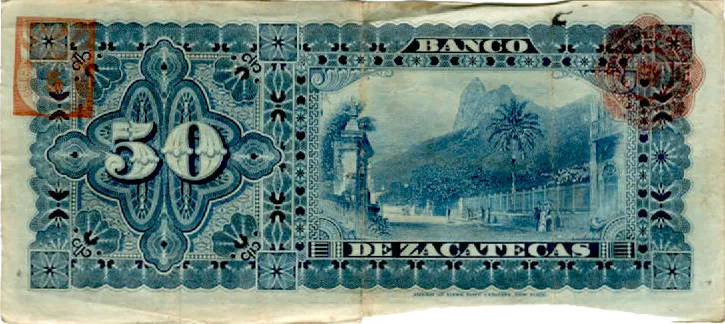
Reverse
Scenes of mining and labor, or a monument set against the mountainous landscape of Zacatecas
About this banknote
If you inherited a 1912 Mexican 50 pesos banknote, here is the honest answer: most examples in worn condition sell for roughly 30 to 100 USD, but crisp uncirculated notes from the Banco de Zacatecas can reach several hundred dollars. Condition and the issuing bank drive everything.
This is not a Banco de México note. It comes from the era before Mexico had a single central bank, when individual states ran private banks licensed to print their own paper money, each note backed by silver. The Banco de Zacatecas was one of them, and this piece is a genuine slice of Porfirian-era finance (the Porfiriato, the long rule of President Porfirio Díaz that ended in 1911).
What it is
Zacatecas was one of Mexico's great silver-mining states, so the bank's silver reserves literally backed the paper. That is why the vignettes on the note celebrate mining: the ore in the ground was the guarantee behind the promise to pay.
On the front (anverso) you get engraved allegorical vignettes: a miner on the left, a female figure with goods at the center, and a young man's profile portrait on the right. The back (reverso) shows mining and labor scenes, or a monument set against the mountainous Zacatecas landscape.
This whole system of multiple issuing banks ended in 1925, when the Banco de México was founded and took over as the country's sole note-issuing authority. That makes these state-bank notes a finite, closed collecting field with no new issues ever again.
How much is it worth in 2026
The face value is meaningless here. These notes were demonetized generations ago, so a 1912 Banco de Zacatecas 50 pesos is worth exactly what a collector will pay, nothing more, nothing less. Value depends on three things: condition, whether the note was actually issued and signed, and how many survive.
Mexican private-bank notes from the Porfiriato trade in an active English-language world paper money market (notaphily). Some issuers are common; others are genuinely scarce. Many of these notes circulated so little, or were redeemed and destroyed, that complete high-grade survivors are hard to find.
| Condition | Typical value (USD) |
|---|---|
| Heavily circulated, tears or repairs | 20 to 50 |
| Circulated, clean, intact | 50 to 120 |
| Crisp, near-uncirculated | 150 to 350 |
| Uncirculated / choice, or scarce signature variety | 300 to 600+ |
One important distinction: many surviving Banco de Zacatecas notes are remainders, meaning they were printed but never signed or put into circulation. These usually cost less than fully issued, hand-signed notes, because issued examples are what serious collectors chase. Check whether your note carries handwritten signatures and a serial number, or if the signature spaces are blank.
The myth to avoid
A century-old banknote is not automatically a fortune. The internet is full of listings quoting wild prices, and those numbers rarely reflect what a piece actually sells for. Age alone does not create value. Rarity, condition, and demand do. A common Zacatecas remainder in average shape is a modest collectible, not a retirement fund.
What makes yours worth more
- Condition first. A crisp note with no folds, tears, pinholes, or foxing (brown spots) can be worth five to ten times a worn example.
- Fully issued and signed notes beat unsigned remainders.
- Low or interesting serial numbers attract collectors.
- Printing errors (misaligned cuts, ink smears, missing overprints) turn a common note into a specialist item. Normal wear is not an error.
How to check what yours is worth
- Grade it honestly. Look at flatness, corners, color, and any damage under good light. Collectors use a scale from Poor up to Uncirculated.
- Verify it is genuine. These are engraved intaglio notes on quality paper. Reproductions and reprints usually have flat, printed-looking detail, smooth modern paper, and colors that sit on the surface instead of biting into it. Compare your note against reference images of Banco de Zacatecas issues.
- Get more than one opinion. Do not accept the first online price. Post clear photos of both sides in the Pesoteca forum or take it to a reputable dealer.
- For high-value examples, consider third-party grading (PMG is the standard for world paper money). A graded, encapsulated note sells faster and for more.
Where to sell it
For the best result, use a specialist channel rather than a general marketplace. A verified dealer from the Pesoteca shop directory can appraise it on the spot, and the buy-and-sell forum puts you in front of collectors who actually want Porfirian bank notes. Major world paper money auctions (Heritage, Stack's Bowers) are worth considering for scarce, high-grade pieces. Photograph both sides in daylight, note the serial number and any signatures, and avoid dumping it to the first bidder on social media.
Got a 1912 Banco de Zacatecas note and not sure if yours is a common remainder or a scarce issued example? Post both sides in the Pesoteca forum and let collectors weigh in before you sell.
Historical context
The Banco de Zacatecas continued issuing high-denomination notes during the first years of the Revolution, despite the instability already striking private banking. Granted a concession in 1891, it had built its prestige on the state's mining wealth, the central motif of all its issues.
This 50-peso note of 1912 bears the date of a Mexico in full transformation, with Madero in the presidency and the tensions that would precede the collapse of the banking system on the rise. The design keeps its traditional imprint: a miner on the left, symbol of Zacatecan silver, a female figure with goods in the center, and a young man in profile on the right, with mining scenes on the reverse. Printed by the American Bank Note Company of New York, it sought to convey confidence in uncertain times. The banking reforms begun in 1913 and the founding of the Banco de México in 1925 would end the private banks' authority to issue paper money.
Frequently asked questions
How much is the 1912 Mexican 50 pesos banknote worth?
It has no legal face value today, so it is worth what collectors pay. Worn examples of the Banco de Zacatecas 50 pesos typically sell for 20 to 100 USD, while crisp, fully issued and signed notes can reach 300 to 600 USD or more. Condition and whether the note was actually issued (not just an unsigned remainder) drive the price.
Is the 1912 Banco de Zacatecas 50 pesos rare?
It depends on the type. Unsigned remainders survive in decent numbers and are affordable. Fully issued, hand-signed notes that actually circulated are much scarcer, especially in high grade, because most were redeemed and destroyed when the multiple-bank system ended in 1925. Low serial numbers and printing errors add rarity value.
Where can I sell my 1912 Mexican 50 pesos note?
Use a specialist channel. A verified dealer from the [Pesoteca shop directory](/tiendas) can value it in person, and the [buy-and-sell forum](/foro/compra-venta) reaches collectors who want Porfirian bank notes. For scarce high-grade examples, world paper money auctions like Heritage or Stack's Bowers are options. Photograph both sides and note the serial number before selling.
How do I tell if the 1912 Banco de Zacatecas note is genuine?
Genuine notes are engraved intaglio prints on quality period paper, so the detail feels sharp and the ink bites into the surface. Reproductions have flat, printed-looking design, smooth modern paper, and colors that sit on top. Compare against reference images of Banco de Zacatecas issues, and if unsure post clear photos in the [Pesoteca forum](/foro) or send it to PMG for grading.
Familia PRIV
This banknote belongs to the BIL-PRIV family within the Sistema PSM . Explore all the banknotes that share origin, era and design with this piece.
Ver todos los billetes de la familia PRIV →