
1904 Mexico 50 Pesos Banknote (Banco Mercantil de Yucatán)
Familia PRIV · algodón
Period: Bancos privados de emisión
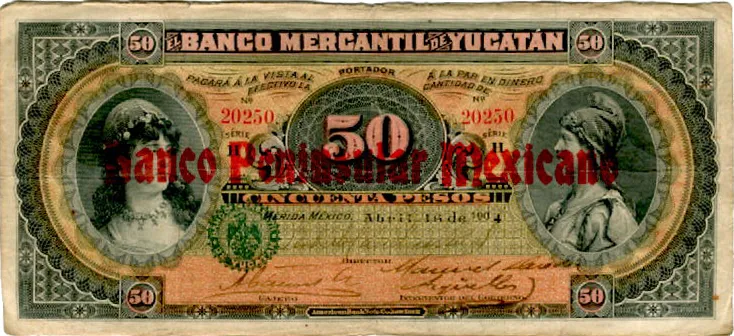
Design
Banxico
Obverse
Banco Mercantil de Yucatán
Two female allegories in ovals flanking the central denomination
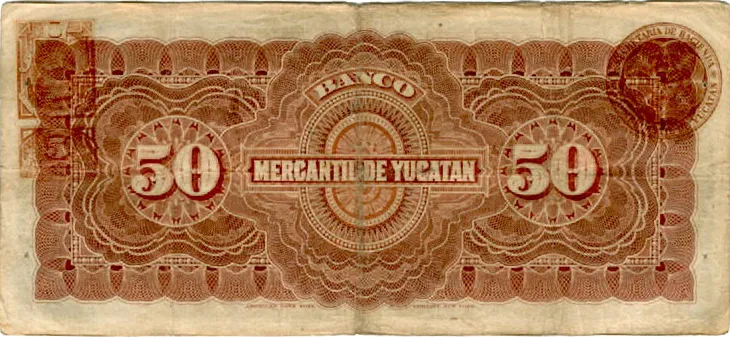
Reverse
Engraved ornamental design in red with the denomination and the name of the bank
About this banknote
Most people who inherit an old Mexican banknote assume it's worthless because it's no longer legal tender. Wrong. A private-bank 50 pesos note from 1904 has real collector value, and depending on condition it can run from a few dollars to several hundred USD. Here's what yours is actually worth and how to check.
What this note is
This is a 50 pesos note issued by the Banco Mercantil de Yucatán, based in Mérida, one of dozens of private banks that printed their own money during the Porfiriato (the long rule of president Porfirio Díaz, roughly 1876 to 1911). Before Mexico had a single national issuing bank, regional banks printed and circulated their own currency backed by their own reserves.
The Banco Mercantil de Yucatán was born during the henequen boom. Henequen, an agave fiber used to make rope and twine, made the Yucatán peninsula one of the richest regions in the country, and its banks reflected that wealth. In 1908 the bank merged with the Banco Yucateco to form the Banco Peninsular Mexicano, which is why many surviving notes carry an overprint (a stamp or overstamp) from that later bank. That overprint matters for identification and can affect value.
Design: The front (anverso) shows two allegorical female figures in oval frames on either side of the central denomination. The back is an ornamental engraved design printed in red, with the denomination and the bank's name.
What it's worth in 2026
This is historic paper money, over a century old, so its value is purely as a collectible. Two things drive the number: condition (grade) and how rare the issuing bank's notes are today.
Private-bank notes from the Porfiriato are a specialized corner of world paper money (notaphily) collecting. Some banks' notes are common; others are genuinely scarce because they circulated in a small region for only a few years before the bank folded or merged. Many of these notes saw heavy use and few survived intact, which is exactly why a clean, uncirculated example commands a real premium.
| Condition | What it looks like | Approximate value (USD) |
|---|---|---|
| Worn / circulated | Folds, soft corners, staining | A few dollars to about 25 USD |
| Very fine to extra fine | Light handling, still crisp | Roughly 40 to 120 USD |
| Uncirculated / high grade | No folds, sharp corners, bright | Several hundred USD for the scarcer varieties |
These are ranges, not fixed prices. A note with a low serial number, a printing error, or a specimen/proof marking can sell for well above the top of these bands. A remainder (a note that was printed but never signed or issued) is a common category for private-bank paper and usually sells toward the lower end.
The myth to kill
"It's from 1904, it must be worth thousands." Age alone does not make a banknote valuable. Millions of old notes exist and most are worth pocket change to a collector. What creates value here is the combination of a scarce issuing bank, strong condition, and clean eye appeal. A ragged, taped, or trimmed note loses most of its collector premium no matter how old it is.
How to check what yours is worth
- Grade it honestly. Look for folds, tears, pinholes, stains, and repairs. Collectors pay for crispness. Do not flatten, iron, or tape a note; that destroys value.
- Read the overprints. Check for a Banco Peninsular Mexicano overstamp or any cancellation. Note whether it's signed (issued) or unsigned (a remainder).
- Check the serial number. Low numbers, repeating digits, or palindrome (radar) serials add demand.
- Look for errors. Misaligned cuts, ink smears, or off-center printing turn a common note into a scarcer one. Normal wear is not an error.
- Get it authenticated. For anything you think is high grade or scarce, third-party grading (PMG is the standard for paper money) confirms both authenticity and grade, and typically raises what a buyer will pay.
Is it genuine?
Compare the paper, the engraving, and the signatures against reference images of Banco Mercantil de Yucatán issues. Genuine notes of this era were printed on quality banknote paper with fine intaglio engraving that has slight relief you can feel. Reproductions and reprints tend to have flat, smooth paper and dull, uniform color. If you're unsure, post clear photos of both sides in the Pesoteca forum and let collectors weigh in before you buy or sell.
Where to sell it
For a note like this, sell where paper-money collectors actually look:
- The Pesoteca buy/sell forum, where collectors of Mexican and world paper money trade directly.
- A verified dealer from the Pesoteca shop directory who can appraise it in person.
- International auction houses and specialist world-paper-money platforms if the grade is high or the variety is scarce.
Photograph both sides in good, even light, note the serial number and any overprints, and don't dump it on a general marketplace to the first bidder. Have you inherited a Porfiriato-era private bank note and want a second opinion on the variety? Post it in the Pesoteca forum and the community will help you pin down what it is.
Historical context
Yucatán was one of the few Mexican states that sustained more than one issuing bank, driven by the wealth of the henequen boom of the late nineteenth century. The Banco Mercantil de Yucatán was the first of those henequen banks to open its doors, backed by the group of Eusebio Escalante Bates, traditional merchants with strong family roots in the south and west of the state.
This 50-peso note of 1904 circulated in the final years of the bank's independent life. Its two female allegories in ovals, flanking the central denomination, followed the aesthetic of the era: classical figures that evoked the prosperity and commerce of a Mérida enriched by the henequen fiber it exported to the world.
A year later, in 1905, the Banco Mercantil de Yucatán merged with the Banco Yucateco to form the Banco Peninsular Mexicano, a move that the region's financial crisis would ultimately precipitate. Pieces like this are, therefore, testimony to an institution of brief but intense life.
Frequently asked questions
How much is the 1904 50 pesos Banco Mercantil de Yucatán note worth?
It has no face value today since the bank is long gone, so its worth is purely as a collectible. A worn example runs from a few dollars up to about 25 USD, a crisp very-fine-to-extra-fine note roughly 40 to 120 USD, and an uncirculated example of a scarcer variety can reach several hundred USD. Condition and rarity decide the price.
Is the 1904 Banco Mercantil de Yucatán note rare?
It's scarce rather than ultra-rare. It's a private-bank note issued only in the Yucatán region for a few years before the bank merged into the Banco Peninsular Mexicano in 1908, so few high-grade examples survive. Notes with a Peninsular overprint, a low or palindrome serial number, or a printing error are the most sought after.
Where can I sell a 1904 Mexican 50 pesos banknote?
Sell where paper-money collectors gather: the [Pesoteca buy/sell forum](/foro/compra-venta), a verified dealer from the [Pesoteca directory](/tiendas), or an international world-paper-money auction if the grade is high. Photograph both sides clearly, record the serial number and any overprints, and avoid selling to the first bidder on a general marketplace.
How can I tell if my 1904 50 pesos note is genuine?
Compare the paper, engraving, and signatures to reference images of Banco Mercantil de Yucatán issues. Real notes use quality banknote paper with fine engraving that has slight relief you can feel, while reproductions have flat, smooth paper and dull color. For certainty, submit it to a paper-money grading service like PMG or post photos in the [Pesoteca forum](/foro).
Características Banxico
Firmas autógrafas, Banco Peninsular Mexicano
Familia PRIV
This banknote belongs to the BIL-PRIV family within the Sistema PSM . Explore all the banknotes that share origin, era and design with this piece.
Ver todos los billetes de la familia PRIV →