
Mexico 50 Pesos (1914) Revolution Treasury Note: Value & Prices
Familia REV · algodón
Period: Revolución Mexicana
Design
Banxico
Obverse
Erario Federal
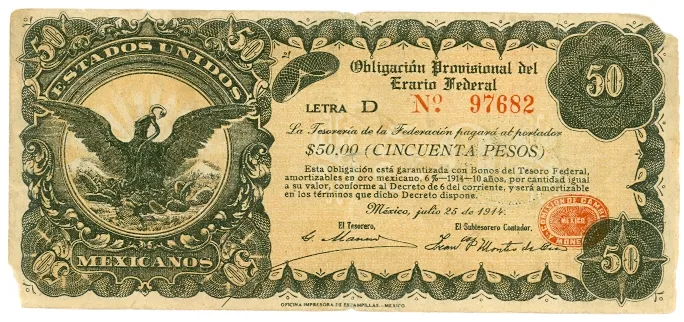
The Mexican eagle and the text of the provisional obligation of the Federal Treasury
Reverse
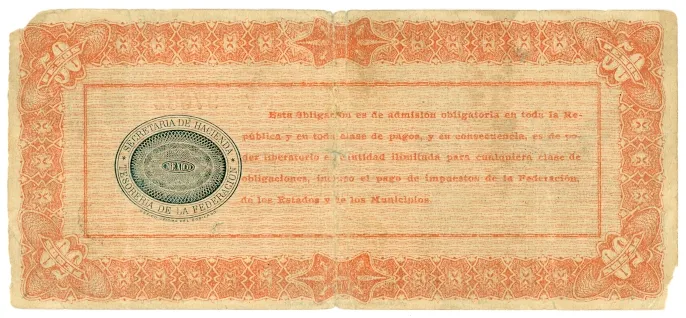
Text of the obligation, guaranteed by Federal Treasury bonds
About this banknote
Most surviving 1914 Mexican Revolution paper is worth from a few dollars to maybe 40 or 50 USD in average condition. A crisp, uncirculated example of a scarce issuer can bring several hundred. This one, a 50 pesos "Obligación Provisional del Erario Federal" (Provisional Obligation of the Federal Treasury), sits in that historic-collectible range, not the fortune range some listings claim.
If you inherited or found this note and want the quick answer: it has no face value today (it was pulled from circulation over a century ago), so every dollar it's worth is collector demand. Condition and the specific issuer drive the price. Below is what actually matters.
What this note actually is
During the Mexican Revolution (roughly 1910-1920), the government ran out of hard currency. To keep commerce moving, the Federal Treasury (Erario Federal) issued "provisional obligations": short-term government debt, backed by Treasury bonds, that people spent hand to hand like regular banknotes. That's what your 50 pesos piece is. Legally it was an IOU. In practice it circulated as money because there wasn't enough of anything else.
That blurred line between public debt and paper money is exactly what makes Revolution-era Mexican paper interesting to collectors of world paper money (the hobby is called notaphily). You're holding a physical record of a country improvising a currency during a civil war.
Design details, keep these to identify yours:
- Obverse (front): the Mexican eagle and the text of the provisional obligation of the Federal Treasury.
- Reverse (back): the obligation text, stating it is guaranteed by federal Treasury bonds.
- Denomination: 50 pesos.
- Date: 1914.
What it's worth in 2026
This is historic paper money, more than a century old, so its value is purely collector value. Two things decide the number:
- Condition. A note with heavy folds, tears, stains, or missing corners is worth a fraction of a clean one. An uncirculated or lightly handled note commands a large premium.
- The issuer and issue type. Revolution paper ranges from common to genuinely rare. Some issues were printed in huge quantities and are cheap today. Others circulated so briefly that intact survivors are hard to find.
For 1914 Federal Treasury obligations in average, circulated condition, realistic collector prices run from a few dollars up to roughly 40 to 60 USD. A crisp, problem-free example, or one from a scarcer variety, can reach into the low hundreds. Pieces "worth thousands" exist in Revolution paper, but they are specific rarities in top grade, not the typical inherited note.
| Note | Date | Condition | Approx. collector value (USD) |
|---|---|---|---|
| 50 pesos Federal Treasury Obligation | 1914 | Heavily circulated (folds, wear) | 5 to 20 |
| 50 pesos Federal Treasury Obligation | 1914 | Circulated, clean | 20 to 60 |
| 50 pesos Federal Treasury Obligation | 1914 | Uncirculated / scarce variety | 100 to several hundred |
These are collector ranges, not a hammer price on a specific certified example. The exact figure depends on the precise issue and grade. Before you sell, get it checked against a catalog rather than trusting the first internet listing.
The myth: "it's from 1914, so it's worth a fortune"
Age alone doesn't make paper money valuable. Millions of pieces of Revolution-era scrip were printed, and plenty survived. What drives price is scarcity of the specific issue plus condition. A 100-year-old note that everyone else also has is still cheap. Don't let a Facebook Marketplace listing at an absurd price set your expectations.
How to tell if yours is worth more
Check for the features that turn a common note into something collectors chase:
- Grade. No folds, no tears, no stains, sharp corners. Uncirculated is where the money is.
- Low or special serial numbers. A very low serial (like 000012) or a radar/palindrome number reads the same forwards and backwards and adds a premium.
- Printing errors. Genuine factory errors (misaligned cuts, ink smears, printing offsets, mismatched or doubled serials) can multiply the value. Normal wear and handling damage is not an error.
If you think your note has a real error or an unusual serial, post clear photos of both sides in the Pesoteca forum and let the community weigh in before you assume it's rare.
How to tell if it's genuine
Reproductions and modern fakes of Revolution paper exist. Compare your note to official Banco de México and catalog reference images:
- Paper feel. Original notes are on period paper. Reproductions often use smooth, modern paper.
- Color. Genuine notes show the printing character of the era. Fakes tend to look flat and uniform.
- Design and signatures. Match the layout, text, eagle, and signatures against reference images.
When in doubt, ask before you buy or sell. Post it in the forum for a second opinion.
Where to sell it
To sell your 1914 50 pesos note safely:
- A verified numismatic dealer from the Pesoteca shop directory can appraise it in person.
- The Pesoteca buy-and-sell forum puts you in front of collectors who actually want Revolution paper.
Photograph both sides in good light, note the serial number and condition, and check for low serials or errors before setting a price. Avoid dumping it to the first buyer on a general marketplace, where these notes routinely sell for well under their real collector value.
Have one of these 1914 Treasury notes in a box of inherited paper? Post the serial and both sides in the Pesoteca forum and let collectors tell you what you're actually holding.
Historical context
This Provisional Obligation of the Federal Treasury for 50 pesos, dated 1914, is part of the emergency money produced by the Mexican Revolution. More than a traditional bank note, it is a state debt instrument that circulated as cash, guaranteed (on paper) with Federal Treasury bonds.
The context is that of a country at war and out of funds. Between 1913 and 1916 there was no reliable national money: silver was hidden away, commerce ground to a halt, and the authorities issued paper to cover expenses they could not otherwise pay. The obverse shows the Mexican eagle and the legal text of the obligation; the reverse, the promise of payment backed by bonds, in an attempt to sustain the confidence that was so scarce.
These obligations circulated alongside Constitutionalist, Villista, and local-government notes, in an atmosphere of rising inflation that made the paper lose value almost as fast as it was printed. Because of its high denomination, this 50-peso bill is a striking example of how the state tried to finance the Revolution with printed credit instead of metal.
Frequently asked questions
How much is the 1914 Mexican 50 pesos note worth?
It no longer has face value, so it's worth collector demand only. In circulated condition, realistic values run from a few dollars up to roughly 40 to 60 USD. A crisp, uncirculated example or a scarcer variety can reach into the low hundreds. Condition and the specific issuer decide the number.
Is the 1914 50 pesos Treasury note rare?
Some Revolution-era issues are common and some are genuinely scarce. This 50 pesos Federal Treasury obligation is a historic collectible rather than a top rarity, but a clean uncirculated example, a low or palindrome serial number, or a genuine printing error can make yours worth several times a typical copy.
Where can I sell my 1914 Mexican 50 pesos note?
The safest routes are a verified dealer from the Pesoteca shop directory (/tiendas), who can appraise it in person, or the Pesoteca buy-and-sell forum (/foro/compra-venta) where collectors of Revolution paper gather. Photograph both sides, note the serial and condition, and don't sell to the first buyer on a general marketplace.
How do I know if my 1914 50 pesos note is genuine?
Compare it to official Banco de México and catalog reference images. Genuine notes use period paper and show the printing character of the era, while reproductions often feel smooth and look flat and uniform. Check the eagle, text, and signatures against references. When unsure, post photos in the Pesoteca forum (/foro) before buying or selling.
Familia REV
This banknote belongs to the BIL-REV family within the Sistema PSM . Explore all the banknotes that share origin, era and design with this piece.
Ver todos los billetes de la familia REV →