
500 Pesos Note (1891), Banco de Zacatecas
Familia PRIV · algodón
Period: Bancos privados de emisión
Design
Banxico
Obverse
Banco de Zacatecas
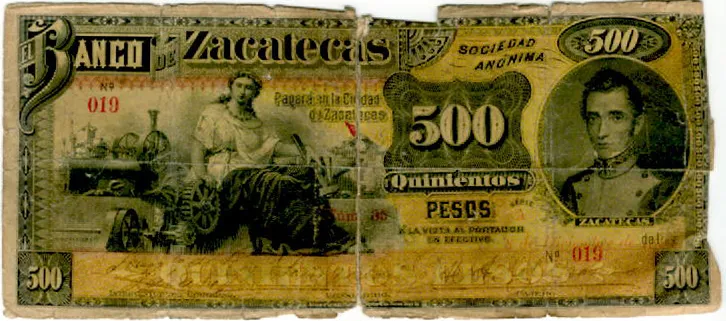
Engraved allegorical vignettes: a miner on the left, a female figure with goods in the center, and the profile portrait of a young man on the right
Reverse
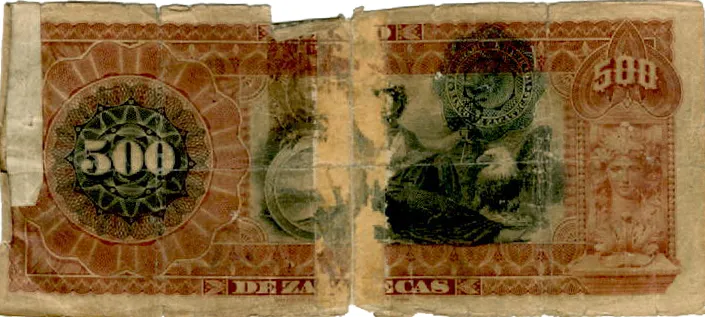
Scenes of mining and labor, or a monument set against the mountainous landscape of Zacatecas
About this banknote
Most 19th-century Mexican banknotes that turn up in the US are worth a modest amount, but private-bank notes like the 1891 Banco de Zacatecas 500 pesos are a different case. Genuine, well-preserved examples of these Porfiriato-era issues trade in the hundreds of US dollars, and the scarcest signature and series combinations reach into the low thousands at specialized auctions. This is collector paper money, not spending money, so condition and rarity decide everything.
What it actually is
Before Mexico had a single central bank, individual states chartered private banks that were allowed to print their own paper money, each note backed by silver. The Banco de Zacatecas was one of them. Zacatecas is classic silver-mining country, which is why the vignettes on the note reference mining: the metal was the guarantee behind the paper.
This system of multiple issuing banks ended when the Banco de México was founded in 1925. That makes any surviving Banco de Zacatecas note a relic of a banking era that no longer exists, which is part of why collectors want it.
On the face (anverso) you'll find engraved allegorical vignettes: a miner on the left, a female figure with goods in the center, and the profile portrait of a young man on the right. The back shows scenes of mining and labor, or a monument set against the mountainous Zacatecas landscape. These are steel-engraved, high-detail designs typical of 19th-century American Bank Note Company work, which is the standard many of these Mexican private notes were printed to.
What it's worth in 2026
This is historic paper money, well over a century old, so its value is purely collector value. There is no face-value floor here: nobody is spending an 1891 Zacatecas note, and it is not silver you can melt. What you have is worth exactly what a notaphily collector will pay, and that depends on three things: the condition of the note, how scarce the specific bank and issue are, and whether the note is issued (with serial numbers and signatures) or a remainder/specimen (unsigned, never put into circulation).
Porfiriato private-bank notes and later Revolution-era scrip have their own active market. Some are common and cheap; others are genuinely rare because they circulated so little, or so hard, that few survived intact. As a working guide for the Banco de Zacatecas type:
| Condition | What it looks like | Approximate value (USD) |
|---|---|---|
| Well-worn, issued | Heavy folds, soft edges, staining | 40 to 120 |
| Mid-grade, issued | Some folds, still crisp, clean | 150 to 400 |
| Uncirculated / specimen | No folds, full color, original body | 500 to 1,500+ |
Treat these as ranges, not quotes. A specimen or proof, a rare signature combination, or an exceptional grade from a third-party service can push well past the top of that table. A washed, repaired, or trimmed note drops well below it. If you have one, do not trust the first price you see online. Ask in the Pesoteca forum or with a serious dealer before you sell.
The myths worth clearing up
"It's old, so it must be worth a fortune." Age alone means very little in paper money. There are 19th-century Mexican notes that sell for under 50 US dollars because they survived in quantity. Rarity and condition drive price, not the date printed on it.
"The high denomination makes it valuable." A 500 pesos face value from 1891 does not translate to 500 of anything today. Collectors pay for the note as an object, and a common low-denomination note in pristine condition can easily beat a battered high-denomination one.
"Any Zacatecas note is rare." Some Banco de Zacatecas denominations and remainders are relatively available and priced accordingly. The rarity is specific: certain issues, certain signatures, certain conditions. That is why identifying exactly what you have matters.
How to tell if yours is genuine
Reproductions and modern reprints of attractive 19th-century notes exist. Check the paper first: original notes are printed on banknote stock with a distinct feel and often visible fibers, while reproductions tend to have smooth, flat paper and dull, flat color. Look for the crisp relief of steel-engraved lines under magnification; reprints look soft and dotted. Compare the design, signatures, and serial-number style against reference images of authenticated Banco de Zacatecas notes. If anything looks off, post clear photos of both sides in the forum before you buy or sell.
How to check what yours is worth, and where to sell
Start by grading it honestly. Any fold, stain, pinhole, or trimmed edge lowers the grade, and grade is most of the price. Then identify the exact issue: denomination, series, signatures, and whether it's an issued note or an unsigned remainder.
To sell, your safest options are a verified numismatic shop from the Pesoteca dealer directory, which can appraise it on the spot, or the Pesoteca buy-and-sell forum where collectors of this exact material gather. Photograph both faces in good, even light and note anything unusual about the serial numbers or printing. Avoid dumping it on a general marketplace to the first offer, that is how genuinely scarce notes get sold for a fraction of what a specialist would pay.
Have a Banco de Zacatecas note, or another Porfiriato private-bank issue, sitting in a drawer? Post photos of both sides in the Pesoteca forum and let collectors who know this series tell you what you're holding.
Historical context
The Banco de Zacatecas opened with a concession from March 1891, and this 500-peso note bears precisely that founding date: it belongs to the first batch of paper money the institution put into circulation. The 500 pesos was the bank's highest denomination, an instrument reserved for the great financial operations of the Porfiriato.
Its allegorical vignettes express the house's program: the miner, symbol of the silver that gave Zacatecas its centuries-old fame; the female figure with merchandise, emblem of commerce; and the youthful portrait in profile. The reverse, with mining and mountains, anchored the piece in its territory.
Printed by the American Bank Note Company of New York, a 500-peso note like this circulated very little hand to hand: it was the money of bankers and great commercial houses, in an economy where most people transacted with silver coin.
Frequently asked questions
How much is the 1891 Banco de Zacatecas 500 pesos note worth?
As collector paper money, not currency, it typically ranges from about 40 US dollars for a well-worn example to 500 or more for an uncirculated note or specimen. Rare signature combinations and top grades can reach the low thousands. There is no face-value floor, since these notes no longer circulate.
Is the 1891 Banco de Zacatecas note rare?
It depends on the specific issue. Some Banco de Zacatecas denominations and unsigned remainders are relatively available, while certain signed, issued examples in high grade are genuinely scarce because so few survived intact. Rarity is tied to the exact issue, signature, and condition, not just the age.
Where can I sell an 1891 Banco de Zacatecas 500 pesos note?
The safest options are a verified numismatic shop from the [Pesoteca dealer directory](/tiendas), which can appraise it immediately, or the [Pesoteca buy-and-sell forum](/foro/compra-venta) among collectors of Porfiriato-era paper money. Photograph both sides in good light and note any unusual serial numbers before selling.
How can I tell if my 1891 Banco de Zacatecas note is genuine?
Check the paper (original banknote stock has a distinct feel and visible fibers, reprints are smooth and flat), look for the sharp relief of steel-engraved lines under magnification, and compare the design, signatures, and serial-number style to authenticated reference images. If in doubt, post clear photos of both sides in the [Pesoteca forum](/foro).
Características Banxico
35
Familia PRIV
This banknote belongs to the BIL-PRIV family within the Sistema PSM . Explore all the banknotes that share origin, era and design with this piece.
Ver todos los billetes de la familia PRIV →