
500 Pesos (1909) Banco de Zacatecas Banknote: Value Guide
Familia PRIV · algodón
Period: Bancos privados de emisión
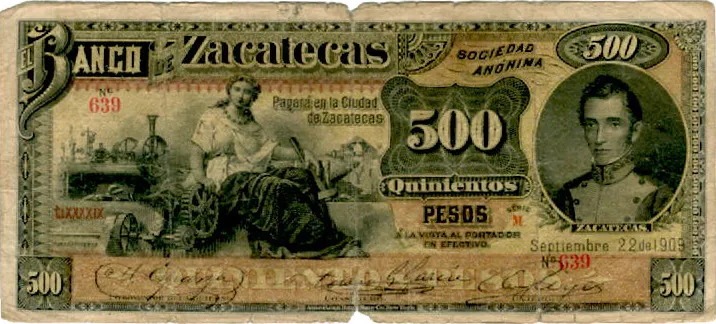
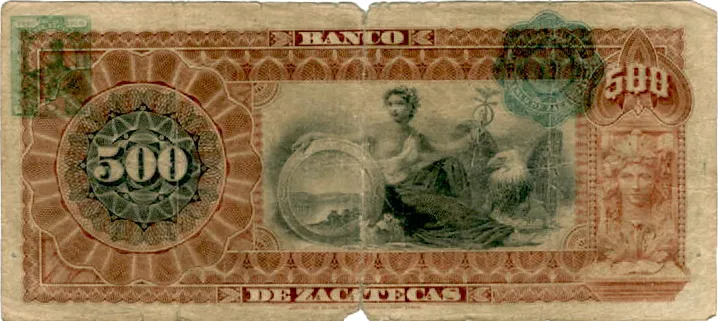
Design
Banxico
Obverse
Banco de Zacatecas
Engraved allegorical vignettes: a miner on the left, a female figure with goods in the center, and the profile portrait of a young man on the right
Reverse
Scenes of mining and labor, or a monument set against the mountainous landscape of Zacatecas
About this banknote
If you inherited a large old Mexican note reading "Banco de Zacatecas" and "Quinientos Pesos," you are holding a piece of pre-central-bank paper money, not a modern peso note. Its value is entirely collector value: most Porfiriato private-bank notes trade from a few tens of dollars up to several hundred, and the rarest issues in high grade can reach four figures at auction. Condition and how many survived decide everything.
This is not currency you can spend. The bank that printed it stopped issuing paper long before the modern peso existed, so there is no face value to redeem. What you have is a collectible from Mexico's era of state bank notes.
What this note actually is
Before Mexico had a single central bank, each state licensed private banks to print their own paper money, each note backed by silver held in reserve. The Banco de Zacatecas was one of these issuers. Zacatecas was mining country, so the note's engravings speak to mining: the silver in the ground was the guarantee behind the paper. This system of multiple issuing banks ended when the Banco de México was founded in 1925, which is why any Banco de Zacatecas note is by definition pre-1925 and historical.
The face (anverso) carries allegorical engraved vignettes: a miner on the left, a female figure with goods at center, and a young man's portrait in profile on the right. The back (reverso) shows mining and labor scenes, or a monument set against the mountainous Zacatecas landscape. These are classic banknote-engraving motifs of the period, printed on quality paper by specialist security printers of the day.
How much is it worth in 2026
Because this is historical paper money more than a century old, the value is purely to collectors and swings hard on two things: condition and how rare the issuing bank's notes are.
Porfiriato-era private bank notes and later Revolution-era scrip form their own collecting market. Some issues are common and change hands for modest sums. Others are genuinely scarce, and many circulated so little (or were redeemed and destroyed) that surviving complete examples are hard to find today. A worn, folded, or torn example sits at the bottom of the range. A crisp, uncirculated note with strong color and full margins can be worth many times more.
A few honest guidelines for what drives the number:
- Grade. Notaphily uses a scale from Poor up through About Uncirculated (AU) to Crisp Uncirculated (CU). Folds, pinholes, stains, and tears each cut value. A flat, bright note beats a limp, soft one every time.
- Rarity of the issuer. Not all state banks survive in equal numbers. Some Banco de Zacatecas denominations and dates are far scarcer than others.
- Specimens and proofs. Some of these notes exist as "Specimen" pieces (marked, hole-punched, never issued) that were kept by printers and banks. These are often more available in high grade than issued notes and are collected in their own right.
- Serial numbers and errors. Low serial numbers, matched pairs, or genuine printing errors add a premium.
| Item | Detail |
|---|---|
| Issuer | Banco de Zacatecas (state issuing bank) |
| Denomination | 500 pesos |
| Era | Porfiriato, pre-1925 (before Banco de México) |
| Backing | Silver reserves |
| Value basis | Collector only (no redeemable face value) |
| Typical range | Tens to hundreds of USD; rare high-grade examples into four figures |
The myth vs. reality
The common belief is that a giant, hundred-year-old, high-denomination note must be worth a fortune. Not automatically. High face value on old private-bank paper does not translate to high collector value, because these were never gold or silver in your hand, and many higher denominations survive as unissued remainders or specimens. What creates real money is a genuinely scarce issue in genuinely high grade, verified as authentic. A common note with heavy wear is a display piece worth a modest sum, and that is fine, but it is not a lottery ticket.
How to tell if yours is genuine
Old Mexican bank notes have been reproduced, both as period counterfeits and as modern reprints sold to tourists. Check the paper first: authentic notes are printed on quality banknote paper with a distinct feel, while reproductions usually sit on smooth, flat modern stock with dull, flat color. Look for the fine engraved detail in the vignettes; genuine engraving shows crisp lines under magnification, whereas reprints look fuzzy or dotted. Compare the design, signatures, and typography against reference images from established catalogs before you assume it is real. If anything looks off, get a second opinion before you buy or sell.
Where to sell it
World paper money (notaphily) is an active English-language market, so you have real options:
- Grading and auction. Companies like PMG grade world banknotes and encapsulate them; a graded note sells faster and for more. Auction houses such as Heritage and Stack's Bowers run world paper money sales where Mexican private-bank notes appear regularly.
- Specialist dealers. A dealer who knows Mexican and Latin American paper money will value it on the spot.
- Collector community. The Pesoteca buy-and-sell forum connects you directly with collectors who know these issues.
Photograph both faces in good, even light, note any serial number, and mention any folds, holes, or repairs honestly. Do not dump it to the first Facebook offer, and do not accept a lowball just because you do not recognize the bank.
Have a Banco de Zacatecas note or another Porfiriato private-bank issue you can't identify? Post clear photos of both sides in the Pesoteca forum and let collectors who track these issues weigh in on grade and value.
Historical context
Around 1909, the Banco de Zacatecas was still issuing notes of up to 500 pesos within a banking system that would soon face the revolutionary storm. This example circulated in the last years of the Porfiriato, when regional banking enjoyed a calm that would prove deceptive.
Its iconography repeats the house program: the miner of Zacatecan silver, the female figure of commerce, and the young man in profile, with scenes of mining and mountain landscape on the reverse. It was the visual language with which the bank asserted its identity and its backing.
Printed by the American Bank Note Company of New York, this note of very high denomination belonged to the world of large transactions. Barely five years later, the capture of Zacatecas by Francisco Villa in 1914 would force the bank to close its head office and relocate to Mexico City.
Frequently asked questions
How much is the Banco de Zacatecas 500 pesos (1909) note worth?
It has no spendable face value; its worth is purely to collectors. Most Porfiriato-era private-bank notes trade from a few tens of dollars to several hundred, and a genuinely scarce issue in crisp uncirculated grade can reach four figures at auction. Condition and rarity of the issuing bank decide the number.
Is the 1909 Banco de Zacatecas note rare?
It depends on the specific denomination and how many survived. This was a state private bank from before the Banco de México existed, so all its notes are over a century old. Some issues are common; others circulated very little and are hard to find complete today. Specimen and proof examples exist and are collected separately.
Where can I sell a Banco de Zacatecas 500 pesos note?
Options include a PMG-graded submission followed by a world paper money auction (Heritage, Stack's Bowers), a dealer who specializes in Mexican or Latin American banknotes, or the [Pesoteca buy-and-sell forum](/foro/compra-venta) among collectors. Photograph both faces, note the serial number, and disclose any folds or damage before selling.
How can I tell if my Banco de Zacatecas note is genuine?
Check the paper and the engraving. Authentic notes use quality banknote paper with crisp engraved lines and rich color; reproductions sit on smooth modern stock with flat, dull ink and fuzzy detail. Compare the design, signatures, and typography with catalog reference images, and get a second opinion in the [Pesoteca forum](/foro) if anything looks off.
Características Banxico
CLXXXXVIII
Familia PRIV
This banknote belongs to the BIL-PRIV family within the Sistema PSM . Explore all the banknotes that share origin, era and design with this piece.
Ver todos los billetes de la familia PRIV →