
500 Pesos Banknote (1914) — Banco de Zacatecas
Familia PRIV · algodón
Period: Bancos privados de emisión
Design
Banxico
Obverse
Banco de Zacatecas
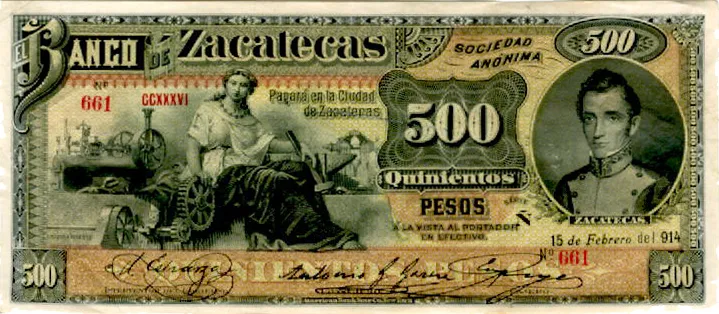
Engraved allegorical vignettes: a miner on the left, a female figure with goods in the center, and the profile portrait of a young man on the right
Reverse
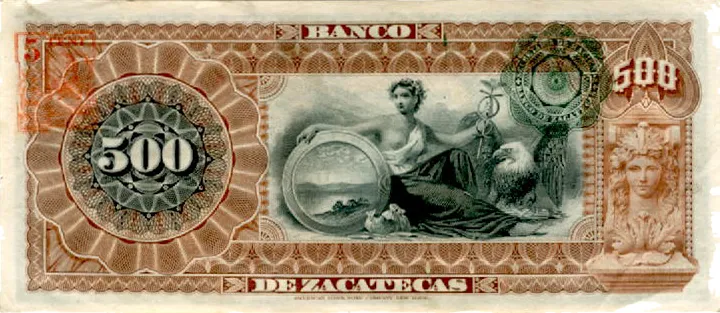
Scenes of mining and labor, or a monument set against the mountainous landscape of Zacatecas
About this banknote
Most people who inherit an old Mexican banknote assume it's worth a fortune because it's over a hundred years old. Usually it isn't. A 1914 Banco de Zacatecas 500 pesos note is a collector item, not a lottery ticket, and its value in 2026 runs from a few US dollars in worn condition to a few hundred for a crisp, uncirculated example. The exact figure depends on grade and how many survived.
This note is not from the Banco de México. It predates Mexico's central bank entirely. Understanding that is the first step to pricing it correctly.
What this note actually is
Before Mexico had a single central bank, individual states chartered private banks that were legally allowed to print their own paper money, backed by silver. This was the Porfiriato era (the long rule of Porfirio Díaz) and the chaotic Revolution years that followed. The Banco de Zacatecas was one of these state banks of issue.
Zacatecas was mining country, one of the richest silver regions in the Americas. That's why the vignettes on the note reference mining: the metal in the ground was the guarantee behind the paper. This system of multiple issuing banks ended in 1925 when the Banco de México was founded and took over all note issuance.
Design and identification
- Front (obverse): Engraved allegorical vignettes. A miner on the left, a female figure with goods in the center, and the profile portrait of a young man on the right.
- Back (reverse): Scenes of mining and labor, or a monument set against the mountainous Zacatecas landscape.
- Denomination: 500 pesos.
- Issuer: Banco de Zacatecas (a private state bank, not the federal government).
- Period: Around 1914, during the Revolution.
If your note says "Banco de Zacatecas" and shows those mining scenes, you have a private-bank issue from this era, not a modern central-bank note.
How much is it worth in 2026
This is historic paper money, more than a century old, so its value is purely collector-driven. It has nothing to do with the 500 face value printed on it, that currency is long demonetized. Two things decide the price: condition and how rare the specific bank and issue are.
Private-bank notes from the Porfiriato and the promissory notes (vales) of the Revolution have their own active market among world paper money collectors. Some issues are common. Others are genuinely scarce because they circulated so little, or were destroyed, that few complete examples survive today.
As a general range for collectible Mexican revolutionary and private-bank notes:
| Condition | Typical value (USD) |
|---|---|
| Heavily worn, torn, or repaired | A few dollars |
| Circulated but complete, moderate wear | 15 to 60 dollars |
| Lightly circulated, clean, no tears | 50 to 150 dollars |
| Crisp uncirculated, sharp corners | 150 to several hundred dollars |
These are broad brackets. A scarce signature variety, a low serial number, or a printing error can push a common note well above these numbers. A common note in poor shape can sit at the bottom of the range regardless of its age.
Honest warning: don't trust the first price you see online. Sellers routinely list revolutionary notes at inflated "buy it now" prices that never actually sell. Ask in the Pesoteca forum or with a serious dealer before you buy or sell anything.
What actually raises the value
A few specific things turn a common note into one collectors chase:
- True uncirculated condition: no folds, no soft corners, original crispness. This is the single biggest factor.
- Low or repeating serial numbers: a low folio (like 00001) or a palindrome serial reads the same both ways and attracts specialists.
- Genuine printing errors: misaligned cuts, ink smears, factory folds, or off-center serials. These are rare and command a premium.
Normal wear from handling is not an error and does not add value. Damage is damage.
How to tell if yours is genuine
Reproductions and outright fakes of revolutionary-era Mexican notes exist because collectors want them. Check these points:
- Paper feel. Period notes were printed on quality paper with a distinct texture. Modern reproductions often use smooth, flat printer paper.
- Color depth. Real engraved notes have depth and fine line detail. Copies show flat, solid color blocks and blurred lines under magnification.
- Compare the design. Match the vignettes, signatures, and typography against verified reference images of Banco de Zacatecas issues.
- Serial and signatures. Authentic notes carry hand-applied or printed serials and specific authorized signatures for the issuing bank.
When in doubt, post clear photos of both sides in the forum and let experienced collectors weigh in before you spend money.
Where to sell it
For a private-bank note like this, your best options are:
- A verified dealer from the Pesoteca shop directory, who can value it on the spot without middleman markup.
- The Pesoteca buy-and-sell forum, where collectors trade directly.
- International paper money auctions and specialist world-currency sellers if you believe you have a scarce variety.
Photograph both faces in good, even light. Note the serial number and check for any error or low folio, since those raise the price. Avoid dumping it on a general social media marketplace to the first offer, that's where good notes sell for a fraction of their worth.
Have a 1914 Banco de Zacatecas note, or another Porfiriato private-bank issue you can't identify? Post the serial number and photos of both sides in the Pesoteca forum and the community will help you place it.
Historical context
The year 1914 closed the issuing era of the Banco de Zacatecas, and this 500-peso note bears that decisive date. It was the year of the capture of Zacatecas by the División del Norte of Francisco Villa, a crucial battle of the Revolution after which the bank provisionally closed its head office and withdrew to Mexico City.
The piece preserves the house's iconography (the miner of Zacatecan silver, the female allegory of commerce, and the young man in profile, with mining on the reverse), but it circulated in a country where the system of private issuing banks was crumbling amid civil war and revolutionary issues.
Engraved by the American Bank Note Company, this 500-peso note belongs to the end of an era. The bank would survive on paper until 1931, when it passed to the Liquidating Committee, in a Mexico where the Banco de México had already monopolized issuance since 1925.
Frequently asked questions
How much is the 1914 Banco de Zacatecas 500 pesos note worth?
As a collector item, it typically ranges from a few US dollars for a worn, damaged example to several hundred dollars for a crisp uncirculated one. The printed 500 face value is meaningless, that currency is demonetized. Condition and how many survived decide the real price.
Is the 1914 500 pesos Banco de Zacatecas note rare?
It's a private state-bank note from Mexico's revolutionary era, so scarcity varies by specific issue and signature variety. Some are common, others circulated so little that few complete, high-grade examples survive today. Low serial numbers and printing errors make certain examples much scarcer.
Where can I sell my 1914 Banco de Zacatecas banknote?
Use a verified dealer from the [Pesoteca shop directory](/tiendas), who values it on the spot, or the [Pesoteca buy-and-sell forum](/foro/compra-venta) between collectors. For a scarce variety, consider a specialist world paper money auction. Photograph both sides and note the serial before selling.
How can I tell if the note is genuine?
Check the paper texture (real notes are not smooth printer paper), the depth and fine line detail of the engraving, and match the vignettes, signatures, and typography against verified Banco de Zacatecas reference images. Reproductions show flat colors and blurred lines. If unsure, post photos of both sides in the [forum](/foro).
Características Banxico
CCXXXVIII
Familia PRIV
This banknote belongs to the BIL-PRIV family within the Sistema PSM . Explore all the banknotes that share origin, era and design with this piece.
Ver todos los billetes de la familia PRIV →