
En resumen
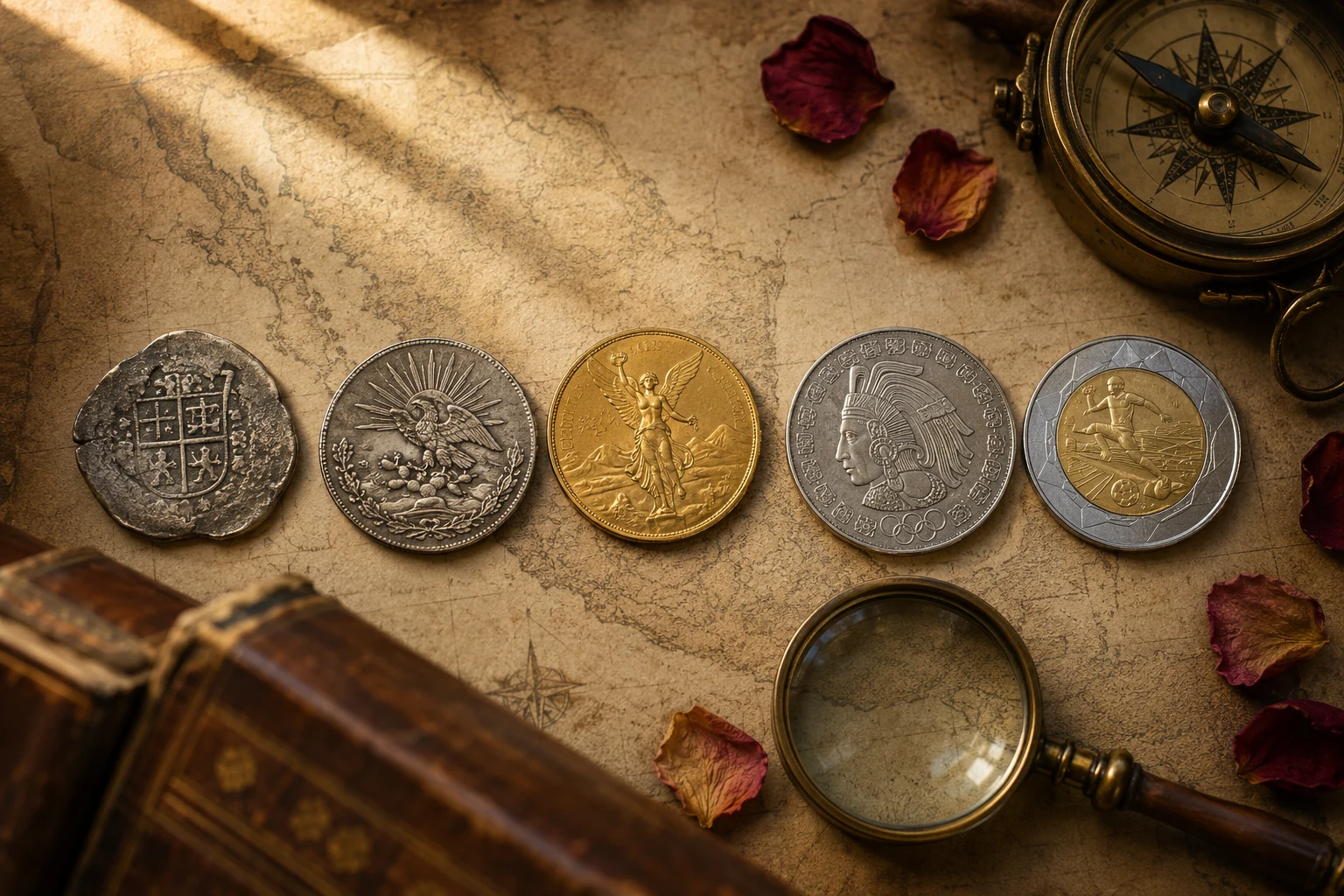
Mexico has struck coins without interruption since 1536. Most are worth a few dollars, but a handful command tens of thousands. Here is the complete timeline, with real prices.
Most Mexican coins you inherit are worth a few dollars over their metal value. But a small group commands real money: an 1822 Iturbide 8 escudos sells for 40,000 to 90,000 dollars at auction, and rare imperial gold from Maximiliano can pass 15,000 dollars. Mexico has struck coins continuously since 1536, longer than any mint in the Americas, and that 490-year run is why its numismatics run so deep. Below is the full timeline, era by era, with what actually drives value and where the money is.
The short answer: which Mexican coins are worth real money
Age alone means almost nothing. What drives value is genuine rarity (how few survive), collector demand, grade (condition), and metal content. The most valuable Mexican coins come from short-lived regimes and mints: the First Empire under Iturbide (1822 to 1823), the Second Empire under Maximiliano (1864 to 1867), colonial gold 8 escudos, and Revolution-era emergency issues. Everyday silver from the 1900s to 1980s is worth close to melt value, sometimes with a small premium.
| Coin | Year | Real price range (USD) | Where it sells |
|---|---|---|---|
| 8 escudos gold, Iturbide | 1822 | 40,000 to 90,000 (XF to AU) | Heritage, Stack's Bowers |
| 8 escudos gold, Carlos II | 1695 | 15,000 to 60,000 | Heritage, Stack's Bowers |
| 20 pesos gold, Maximiliano | 1866 | 14,000 to 50,000+ (by grade) | International auction |
| Zapata Guerrero 2 pesos silver | 1914 | 1,000+ authenticated | Specialist auction |
| Villa Chihuahua 5 pesos | 1913 | 800+ even in low grade | Specialist auction |
| Caballito peso, silver | 1913 | 650+ in VF | Auction and dealers |
| Centenario 50 pesos gold | 1921+ | Melt value of 37.5g gold + premium | Bullion dealers |
| Onza Libertad, silver | 1982+ | Spot silver + small premium | Bullion dealers |
Any purchase over a few thousand dollars should carry NGC or PCGS certification. No exceptions.
Before coins: pre-Hispanic money (before 1535)
Before the Spanish arrived, Mesoamerica had no struck coins but did have money: cacao beans (a tomato cost 1 bean, a rabbit 100), T-shaped copper axe-money called tajaderas used along the Pacific coast, and elite currency in jade beads, quetzal feathers, and fine cotton mantles. Fray Bernardino de Sahagun documented all three in the Florentine Codex. Authentic pieces belong in museums. If someone offers you a "pre-Hispanic coin" for sale, it is a modern tourist fake.
Colonial era: 1535 to 1821
On May 11, 1535, a royal decree signed by Carlos I of Spain founded the Casa de Moneda de Mexico (the Mexico City Mint), the first mint in the Americas. It struck its first coins in 1536 and has never stopped operating. The earliest pieces were hammered silver reales, crudely cut by hand in a technique called macuquina (the source of the English word "cob"), used until 1732.
Key colonial milestones:
- 1572: The "piece of eight" (8 reales) is formalized at roughly 27.4 grams and .931 fineness. It becomes the world's first global trade coin, circulating from Manila to China to the American colonies.
- 1732: Mechanical striking begins. The 8 reales columnario (Pillar Dollar) is born, with the Pillars of Hercules and the motto PLUS ULTRA. These are the most common entry point into colonial collecting. A decent VF example runs roughly 175 to 450 dollars today.
- 1772: Carlos III replaces the pillar design with a royal bust. Gold 8 escudos from this and earlier reigns are among the most valuable Mexican coins in existence.
- 1810: The War of Independence begins. Insurgent and royalist mints spring up across the country.
A warning on gold 8 escudos: the official coin weighs 27.06 grams at .917 fineness. Anything lighter than 26.5 grams is a cast fake. These pieces sell at Heritage Auctions for 15,000 to 60,000 dollars depending on year and grade, so counterfeits are everywhere.
First Mexican Empire: 1821 to 1823
Independence was won in September 1821, and Agustin de Iturbide crowned himself emperor in May 1822. His reign lasted ten months. In that window, the first coins of independent Mexico were struck, and they are among the most sought-after pieces in the entire catalog. The obverse shows Iturbide's profile; the reverse introduced the crowned eagle on a cactus, a symbol still on Mexican currency today.
The gold 8 escudos of 1822 ranks with the three most valuable Mexican coins ever, selling for 40,000 to 90,000 dollars in XF to AU grades. The silver 8 reales is more attainable but still climbs into five figures in top condition.
Iturbide coins are also among the most counterfeited in Mexican numismatics, with fakes ranging from 19th-century casts to modern struck dies. Never buy an Iturbide piece without NGC or PCGS certification.
Federal Republic: 1823 to 1863
The Republic was proclaimed in 1824. The royal bust vanished and the eagle-and-serpent shield appeared, still in use today. Denominations stayed colonial (8, 4, 2, 1 reales in silver; escudos in gold), and this era saw an explosion of provincial mints, each with its own mark:
- Chihuahua (Ca), Zacatecas (Zs), Durango (Do), Guadalajara (Ga), Guanajuato (Go)
- San Luis Potosi (Pi), Estado de Mexico at Tlalpan (EoMo, closed by 1830)
- Hermosillo (Ho), Culiacan (Cn), Oaxaca (Oa), Alamos (A)
- Real de Catorce (Ce, 1863 to 1864), the shortest-lived mint of all
The typical coin of the period is the 8 reales "resplandor," showing a radiant Phrygian cap over the shield. Common examples run 45 to 100 dollars in VF. But the Real de Catorce (Ce) mint pieces are exceptionally rare because it operated less than a year; any 8 reales from that mint commands well over 5,000 dollars. Collecting by mint mark is one of the most addictive pursuits in the hobby.
Second Empire, Maximiliano: 1864 to 1867
Maximiliano of Habsburg, an Austrian archduke installed by Napoleon III, ruled for three years before being executed in 1867. He left two permanent changes:
The decimal system. His 1866 decree replaced reales with centavos: one peso divided into 100 centavos. That system has survived to the present, even outlasting the 1993 currency reform.
European-style design. Coins carried his bust with the legend MAXIMILIANO EMPERADOR and a European-crowned eagle.
Maximiliano pieces are chased by two markets at once, Mexican numismatists and international Habsburg collectors, which pushes prices up:
- 20 pesos gold, 1866: roughly 14,000 to 50,000 dollars and up by grade
- 1 peso silver, 1866: roughly 200 to 850 dollars
- 1 centavo, 1864: roughly 20 to 140 dollars
When the Republic returned under Juarez, it kept the 100-centavo peso because it was simply more efficient. Maximiliano failed politically but permanently reshaped Mexico's money.
Restored Republic and Porfiriato: 1867 to 1905
Under Juarez and later Porfirio Diaz, Mexico consolidated the silver peso as its national coin. This is the era of the "peso fuerte," and Mexico became the world's largest silver producer between 1870 and 1910.
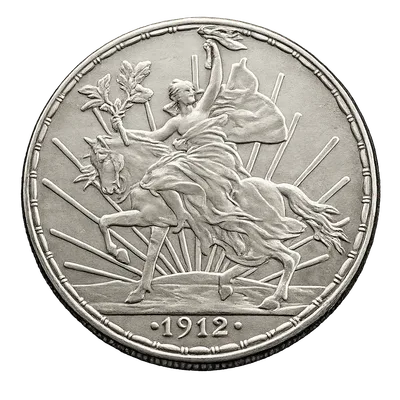
The standout piece is the Caballito peso of 1910, commissioned by Diaz for the centennial of independence and designed by Charles Pillet. The reverse shows a woman on horseback with a torch, an allegory of the Republic. Struck in silver (.903 fineness, 27.073 grams, 39mm) from 1910 to 1914, it is prized for its artistry. The 1913 issue is the rarest, struck during the most violent phase of the Revolution: a VF example passes 650 dollars, versus roughly 90 to 200 dollars for a common 1910 in the same grade.
The post-1897 peso fuerte is the easiest way into serious Mexican silver: entry prices of 10 to 35 dollars in lower grades, huge availability. If a relative kept "Revolution coins" in a tin, they are almost certainly these.
The 1905 Limantour reform
Finance Minister Jose Yves Limantour restructured the entire monetary system in 1905, the most ambitious reform since 1535. Mexico adopted the gold standard, closed nearly all provincial mints (leaving only Mexico City), and introduced new gold denominations. The peso was fixed at two per US dollar until the Revolution broke that stability in 1913.
Every 20th-century Mexican gold coin, the Centenario 50 pesos, the Hidalgo 10 pesos, the Azteca 20 pesos, inherits the .900 fineness set in 1905. The Centenario 50 pesos you can still buy from bullion dealers today (41.67 grams, containing 37.5 grams of pure gold) is a direct descendant, and remains Mexico's premier gold investment coin.
The Mexican Revolution: 1910 to 1920
From 1910 to 1920, Mexico lived through its greatest monetary chaos. Every faction and local commander struck its own money.
- 1913: Pancho Villa strikes emergency copper and low-silver coins in Chihuahua, marked MONEDA PROVISIONAL, with irregular weights.
- 1914: Emiliano Zapata strikes silver 2 pesos and lead 1 peso pieces in Guerrero. These are genuinely rare; any authentic example passes 1,000 dollars.
- 1913 to 1914: Carranza's Constitutionalists strike 5 pesos coins marked EJERCITO CONSTITUCIONALISTA.
- 1917: The Constitution is promulgated in Queretaro, laying the legal groundwork for later monetary centralization.
Revolution coins are among the most counterfeited categories in the whole catalog. Villa Chihuahua 1913, Zapata Guerrero 1914, and Constitutionalist issues are the most copied. Rules: never buy without NGC or PCGS certification, check exact catalog weight (Villa Chihuahua 5 pesos is 27.073 grams), and be suspicious of anything that looks too perfect. A genuine Villa coin passes 800 dollars even in low grade.
Modern Mexico before 1992: 1920 to 1992
The Bank of Mexico was founded in 1925, and the modern catalog opens up.
- 1921: The Centenario 50 pesos gold coin is issued for the centennial of independence. Designed by Emilio del Moral, it shows the Winged Victory of the Independence Column. It became the benchmark of the Mexican gold standard and is restruck to this day for investors.
- 1935 to 1957: A wave of iconic silver: the Cuauhtemoc peso, the 50 centavos with the "Diana Cazadora" (Diana the Huntress), the 5 pesos Cuauhtemoc (.900 silver, 30 grams), the 5 and 10 pesos Hidalgo.
- 1977: The 100 pesos Morelos, the last large silver coin struck for circulation, with collectible date varieties ("siete largo" and "siete bajo").
- 1981 to 1982: The Onza Libertad debuts.
What is an Onza Libertad? It is Mexico's bullion (investment) coin, first sold in July 1981 in gold and 1982 in silver. Each contains one troy ounce (31.103 grams) of pure metal. The design shows the Winged Victory ringed by the volcanoes Popocatepetl and Iztaccihuatl, and it is still struck every year with the same imagery. As a bullion coin, its value floors at the melt value of its metal, with a small premium for certain low-mintage years.
Silver from 1947 to 1980 is probably the most undervalued part of the catalog. A 1947 Cuauhtemoc 5 pesos in VF runs 15 to 35 dollars; a 1957 Morelos silver peso, 4 to 10 dollars. These carry real silver and real history, and people keep melting them.
New Pesos and the present: 1993 to 2026
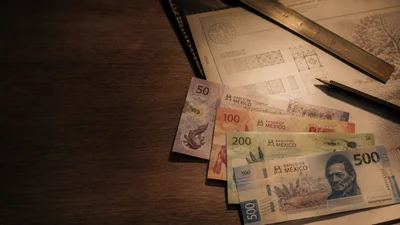
On January 1, 1993, the "Nuevo Peso" took effect: three zeros were dropped from the currency. A 100,000 old-peso note equaled 100 new pesos. Purchasing power did not change; only the way the number was written. The reform was accounting and psychology, cleaning up decades of devaluation. Coins carried an "N$" mark until 1996, when it was dropped and the unit was simply called the peso again. The December 1994 crisis then sent the new peso from 3.4 to 7.5 per US dollar in weeks.
Standout modern issues:
- 2003 to 2006: The 100 pesos Estados de la Republica series, one bimetallic coin for each of Mexico's 32 states. A completable 32-piece set, each usually under 25 dollars, ideal for a beginner album.
- 2008 to 2010: A 5 pesos silver series honoring twelve figures of the Revolution (Villa, Zapata, Carranza, Madero, and more).
- 2011 to 2013: The Herencia Numismatica series and one-kilogram pure-silver Aztec Calendar coins for advanced collectors.
- 2025 to 2026: The FIFA 2026 World Cup gold series, twelve 25-peso gold coins for host cities. Issue prices in 2025 ran around 3,000 dollars each and climbed with the price of gold. These are investment pieces dressed as commemoratives.
How to check what your Mexican coins are worth
Work through four questions in order:
- What is it made of? Silver and gold coins have a floor at melt value. Weigh the coin and check its fineness against a catalog (Krause / Standard Catalog of World Coins, or the Banxico numismatic collection). A common silver peso is worth its silver; that is your baseline.
- Is it actually rare? Look up the mintage and the mint mark. Short-lived regimes and mints (Iturbide, Maximiliano, Real de Catorce, Revolution issues) are where the value lives. High mintage means low value regardless of age.
- What grade is it? Condition can swing a coin's price by a factor of ten. Never clean a coin. A cleaned coin loses 30 to 70 percent of its value permanently, and the damage is irreversible.
- Is it authentic? The most valuable Mexican coins are the most faked. For anything worth more than a few thousand dollars, get it certified by NGC or PCGS before you buy or sell. Certified coins also sell faster and higher.
To sell, your best options are established auction houses (Heritage Auctions, Stack's Bowers) for high-value certified pieces, and reputable coin dealers or bullion dealers for common silver and gold. Avoid selling raw high-value coins to walk-in buyers who lowball uncertified material.
Five centuries, one mint
From the hammered macuquina of 1536 to this year's Libertad, Mexico's coinage has never stopped. Kings, republics, empires, and currency reforms came and went; the Mexico City Mint did not close. No other country in the Americas can say the same, which is exactly why Mexican numismatics is the richest on the continent. You can build a 500-year collection, or follow a single mint across centuries, or chase one design for decades.
Have a box of coins and no idea where to start? Post a clear photo of the obverse and reverse in the Pesoteca forum and tell us the weight and any mint mark you can find, and the community will help you identify what you actually have.
Loading comments…