
En resumen
Mexico City's three official 2026 World Cup coins, from a circulating 20-peso piece to pure silver and gold versions, tied to the only stadium on earth to host three World Cups.
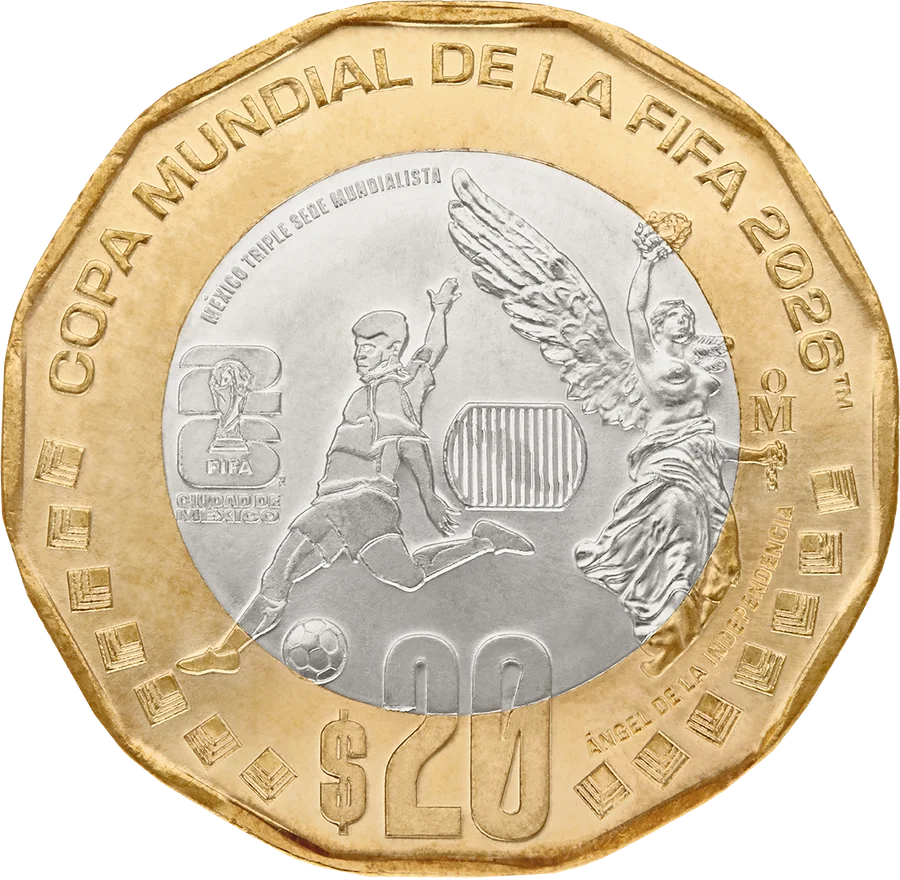
If you found a modern Mexican coin with a soccer player and the World Cup logo, here is the honest answer: the common version is worth its face value of 20 pesos, roughly a little over one US dollar. The precious-metal versions are different. The silver ounce trades around 100 to 175 dollars, and the quarter-ounce gold sells for well over 1,000 dollars. This is the Mexico City piece from Banxico's official 2026 World Cup set, and it carries the strongest historical story of the whole series.
Mexico's central bank (Banco de México, known as Banxico) struck a 12-coin set to mark the 2026 tournament. The Mexico City coins matter because the venue there, now called Estadio Banorte, is the same stadium long known as the Azteca. In 2026 it becomes the first stadium on the planet to host matches at three different World Cups: 1970, 1986, and 2026. No other venue can claim that.
The three official Mexico City coins
Banxico issued three versions of the Mexico City coin. Each targets a different buyer, so it helps to see them side by side before deciding which to chase first.
- Bimetallic 20-peso coin (Mexico City): ordinary circulation strike, 12-sided (dodecagonal) format, 30 mm across, 12.67 grams. Official mintage of 22,000,000 pieces. It entered circulation on May 18, 2026, and passes at its face value of 20 pesos.
- 1 oz pure .999 silver ounce (Mexico City): 40 mm, 31.103 grams, mirror (proof) finish, sold with a protective capsule and an official certificate.
- 1/4 oz pure .999 gold coin (Mexico City): 23 mm, 7.776 grams, mirror finish, capsule and certificate.
All three share the same reverse. The obverse (front) is the standard Mexican coat of arms with the legend ESTADOS UNIDOS MEXICANOS, so the story lives on the reverse.
What each one is worth
Prices for the precious-metal versions track the global spot price of silver and gold plus a numismatic premium, so they move week to week. The figures below reflect authorized dealer ranges converted to US dollars.
| Version | Metal / spec | Mintage | Typical value (USD) |
|---|---|---|---|
| Bimetallic 20 pesos | Base metal, 12.67 g | 22,000,000 | About 1.10 (face value) |
| Silver ounce | 1 oz .999 silver | Limited | About 100 to 175 |
| Quarter-ounce gold | 1/4 oz .999 gold | Limited | About 1,150 to 1,500 |
The premium over spot on the silver ounce has run around 30 to 50 percent, which is normal for an official commemorative in its first year of release.
The reverse: the Angel, not the stadium
Banxico had two obvious icons to represent Mexico City on a World Cup coin. It could have used the Banorte (the old Azteca) and no one would have blinked. Instead, the reverse shows a striker in attacking position about to shoot, with the Columna de la Independencia (the Angel of Independence, Mexico City's famous golden victory column) rising in the background. Monarch butterflies float around the composition as a decorative touch. The legend COPA MUNDIAL DE LA FIFA 2026 runs along the rim with the FIFA logo and the 20-peso denomination.
Why the Angel instead of the stadium? The old Azteca already appears repeatedly on Mexico's 1986 commemorative series, and the Angel works as a civic symbol of Mexico City that anyone recognizes without knowing soccer. The monarch butterflies are a nice detail, a nod to the migration season that overlaps with the start of the tournament. The striker is a generic figure on purpose, not any specific player, so the design ages well and does not get tied to a jersey or a hairstyle.
The historical connection: three World Cups, one stadium
This is where the Mexico City piece separates from the rest of the set. The venue now called Banorte was the Azteca when Pelé lifted the Jules Rimet trophy in 1970. It was the Azteca when Maradona scored the two most famous goals of the century in 1986. And it will be the Banorte when the opening match of the 2026 World Cup kicks off. No other stadium on earth has hosted three World Cups. Wembley reached two. The Maracanã reached two. Three belongs to Mexico City alone.
For collectors building the full 1986 World Cup series, the connection is direct. A Mexico City 1986 coin paired with a Mexico City 2026 coin is the only clean thematic match between the two Mexican World Cups, which gives the bimetallic piece a narrative the other host cities simply do not have. Guadalajara and Monterrey are new hosts. Mexico City is continuity.
How to buy by budget
If you just want the circulating coin: the bimetallic 20-peso piece is in general circulation in Mexico. With 22 million struck, it will not become scarce anytime soon, so there is no reason to pay a premium in the first months. If you are outside Mexico, expect to buy it from a coin dealer or online seller for a small markup over face value.
If you want the silver: the ounce is the sweet spot of the set. Proof finish, capsule, and official certificate, with real metal weight behind it. Buy only from Casa de Moneda de México (the national mint), Multiva, or verified Banxico-authorized dealers to avoid fakes.
If you want all three: budget roughly 1,300 to 1,700 dollars to hold the complete Mexico City trio. The gold coin holds the most metal value, while the silver ounce best balances price against collector demand. If you can only afford one of the two precious-metal versions, the silver wins on story-value per dollar spent.
Which one to keep as an investment
Be honest about scarcity. With 22 million pieces, the bimetallic Mexico City coin will not be the rarest in the set. Coins with smaller mintages, like Hidalgo or Monterrey, may show a steeper scarcity curve. What the Mexico City coin has that the others do not is a locked-in historical story. As long as the Banorte stands, this piece will be the reference point for talking about the three Mexican World Cups.
In uncirculated (UNC) grade, Mexico's family of 12-sided 20-peso commemoratives has historically climbed from face value to the equivalent of a few dollars over five to ten years, with the strongest examples doing better. The Mexico City coin, given its narrative weight, should sit at the top of that curve. If you keep one, store it in a capsule from day one. Do not clean it. Do not rub it. The original mint luster is what carries the value.
The silver ounce follows the spot price of silver plus a numismatic premium. Over a ten-year horizon, intact proof commemoratives from Banxico have traded comfortably above their metal value. As a store of value, the silver is a steadier bet than the bimetallic coin.
Where to learn more
- Complete catalog of the 12 coins in the 2026 World Cup set
- The national jaguar coin (Triple Host)
- The 1986 World Cup series
- How to buy Banxico coins step by step
Do you already have your Mexico City coin, or are you still hoping it turns up in your change? Are you going for the complete trio or just the bimetallic piece? Tell us how the hunt is going in your city over on the forum.

Loading comments…