
En resumen
Mexico's central bank issued three official coins for Guadalajara as a 2026 World Cup host city: a 20-peso bimetallic, a 1 oz silver, and a 1/4 oz gold. Here is what each is worth and why collectors are chasing this one.
Most modern commemorative coins are worth close to face value the day they land, and the Guadalajara 2026 World Cup coins are no exception at the low end. The circulating 20-peso version is pocket change. But the silver and gold editions carry real metal value and collector demand, and the whole set has a design choice that makes this host city stand out. Here is the honest breakdown.
Why Guadalajara is the host city collectors chase
Mexico's central bank, Banxico, put three host cities into its 2026 FIFA World Cup coin set. Of the three, Guadalajara is generating the most conversation among collectors, and not for sentimental reasons. It combines a newer stadium (Estadio Akron, opened in 2010), a reverse design that puts the Minerva sculpture in the background instead of a stadium, and a city that has already hosted two previous World Cups.
Mexico City is the obvious pick, with the historic Estadio Azteca. Guadalajara is the one that connects with collectors outside the capital who have been assembling these bimetallic commemoratives since 2017. That built-in audience is part of why the city's set moves.
The 3 official Guadalajara coins
Banxico struck three versions with the Guadalajara motif inside the 2026 World Cup set. Each targets a different budget. Know the differences before you go looking.
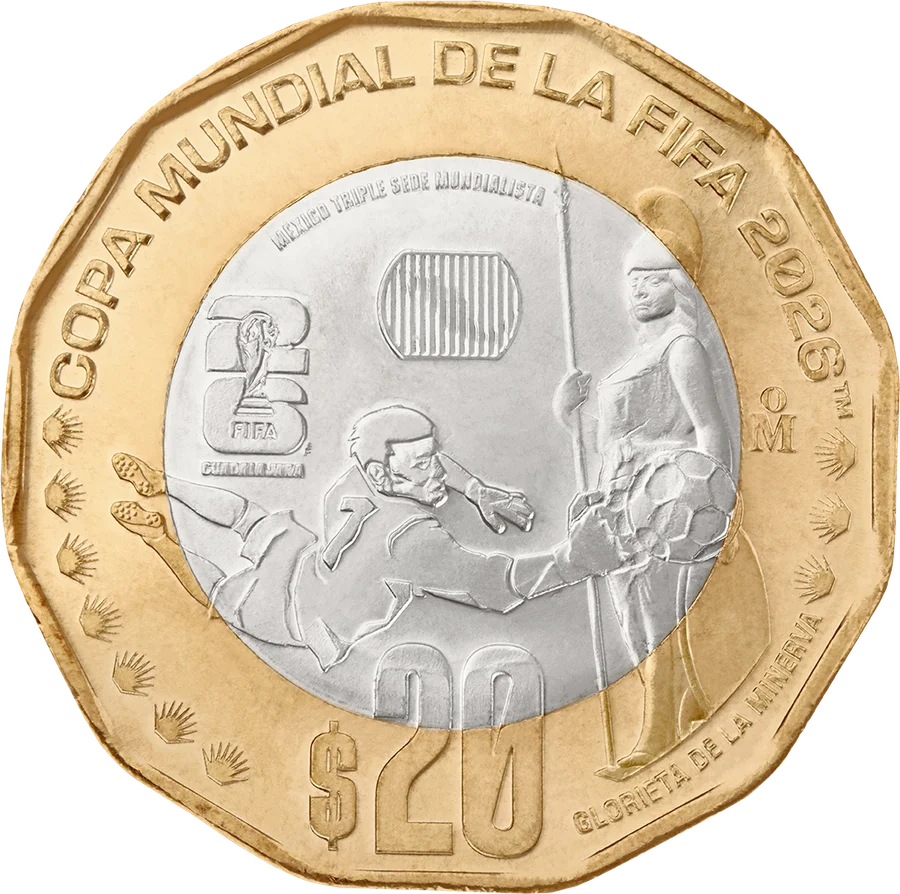
- 20-peso bimetallic (KM family C1): standard circulating strike, 12-sided (dodecagonal), 30 mm, 12.67 g. Enters circulation on May 18, 2026. Official Banxico mintage: 21,500,000 pieces. Face value: 20 pesos, roughly a little over 1 US dollar. This is the popular piece, the one anyone can pull from change.
- 1 oz pure silver .999: 40 mm, 31.103 g, mirror (proof) finish, capsule and Banxico certificate. Dealer price runs from about 105 to 175 US dollars depending on the seller.
- 1/4 oz pure gold .999: 23 mm, 7.776 g, mirror finish. Dealer price runs from about 1,215 to 1,585 US dollars depending on the dealer and the gold spot at the time. This is the high-end version for collectors who build full sets in gold.
All three share the same obverse: the Mexican National Coat of Arms with the legend ESTADOS UNIDOS MEXICANOS, the standard format for the C1 family. The reverse is where each host city gets its own identity.
Coin specs and values at a glance
| Coin | Diameter / Weight | Metal | Mintage | Approx. value (USD) |
|---|---|---|---|---|
| 20-peso bimetallic | 30 mm / 12.67 g | Bimetallic | 21,500,000 | Face value, about 1 to 4 |
| 1 oz silver | 40 mm / 31.103 g | .999 silver | Limited | 105 to 175 |
| 1/4 oz gold | 23 mm / 7.776 g | .999 gold | Limited | 1,215 to 1,585 |
The silver and gold prices track the metal spot, so they move over time. The bimetallic does not carry meaningful precious metal, so its value stays near face outside of premium collector demand for high-grade early strikes.
The design: Minerva as the star
The Guadalajara reverse shows a player controlling the ball in the foreground, with the Minerva sculpture behind. The legend reads COPA MUNDIAL DE LA FIFA 2026, alongside the FIFA logo and the 20-peso denomination.
Minerva is not a random choice. The sculpture, at the traffic circle of the same name on Avenida López Mateos, has been one of Guadalajara's most recognizable civic symbols since 1956. To a resident of Guadalajara, it carries the same weight the Angel of Independence carries in Mexico City.
Banxico skipped the obvious landmarks. It could have used the cathedral, the Teatro Degollado, or Estadio Akron itself. It chose Minerva, a figure tied to classical ideas of victory and wisdom. For collectors who buy on iconography, that is a design decision with real intent behind it rather than generic tourism imagery.
Early strikes show a sharp die, based on what collectors are reporting. If grade matters to you, chase early pieces, because bimetallic dies wear quickly once a mintage passes 20 million.
Jalisco, Akron, and the World Cup chain
There is a thread connecting this coin to Mexican soccer history. Guadalajara hosted matches in the 1970 World Cup, when Estadio Jalisco staged memorable games from Brazil's group. It hosted again in 1986, also at Estadio Jalisco. Now, in 2026, the duty falls to Estadio Akron, opened in 2010 and home to the Chivas club.
That move from Estadio Jalisco to Estadio Akron is what sets Guadalajara apart in the set. Mexico City keeps the Azteca across all three of its World Cups. Guadalajara changed venues. The coin does not say this outright, but by placing Minerva in the background instead of the stadium, the design represents the city rather than the building. That choice is likely to age well in a collection.
How to buy each version
The 20-peso bimetallic is the entry point. You can find it in change, in official bags from Casa de Moneda de México (the national mint), or by asking at a bank if the teller cooperates. During the first month, resale groups may ask a premium; there is no reason to overpay when 21.5 million pieces are entering circulation. It will settle back toward face value within about six months. Patience wins here.
The 1 oz silver is the middle option and probably the best value for someone starting a quality collection. For roughly 105 to 175 US dollars you get a .999 ounce with a proof finish, capsule, and official certificate. You will not find it at a commercial bank. Buy it directly from Casa de Moneda de México branches, from authorized premium distributors, or from Banxico-authorized private dealers. If someone offers a "World Cup silver" with no certificate, it is a replica. Skip it.
The 1/4 oz gold is for collectors who already build sets in gold or who treat the piece as an appreciation vehicle. Expect 1,215 to 1,585 US dollars depending on the dealer and gold spot. This one usually has to be reserved in advance; it is rarely sitting on a counter.
Which one to keep for the long run
For a complete 2026 World Cup set, all three are required. For a selective collector, the silver is the most balanced bet: a smaller run than the bimetallic, an accessible price, and the Minerva design giving it identity. The gold is an appreciation play over three to five years, especially if the gold spot follows the trend it has held in recent cycles.
The bimetallic is worth what it is worth as a historical piece and as a doorway into the set. Do not expect it to jump in value soon. Its role is to document the moment. Collect it clean and store it without overpaying.
If you just want one representative World Cup coin without tying yourself to a host city, look at the national jaguar issue, which carries the symbolic weight of Mexico as host. But if you have roots in Guadalajara, this is the one that counts for you.
Learn more
- Full catalog of the 12 coins in the 2026 World Cup set
- How to buy Banxico coins: face-value exchange and authorized distributors
- The national jaguar coin (triple host issue)
Have you tracked down the Guadalajara coin in any of its three versions? Did you pull the bimetallic from change or have to go to a bank for it? Tell us in the Pesoteca forum what grade you found it in, and whether you noticed a die difference between the first strikes and later ones. That data helps everyone.

Loading comments…