
En resumen
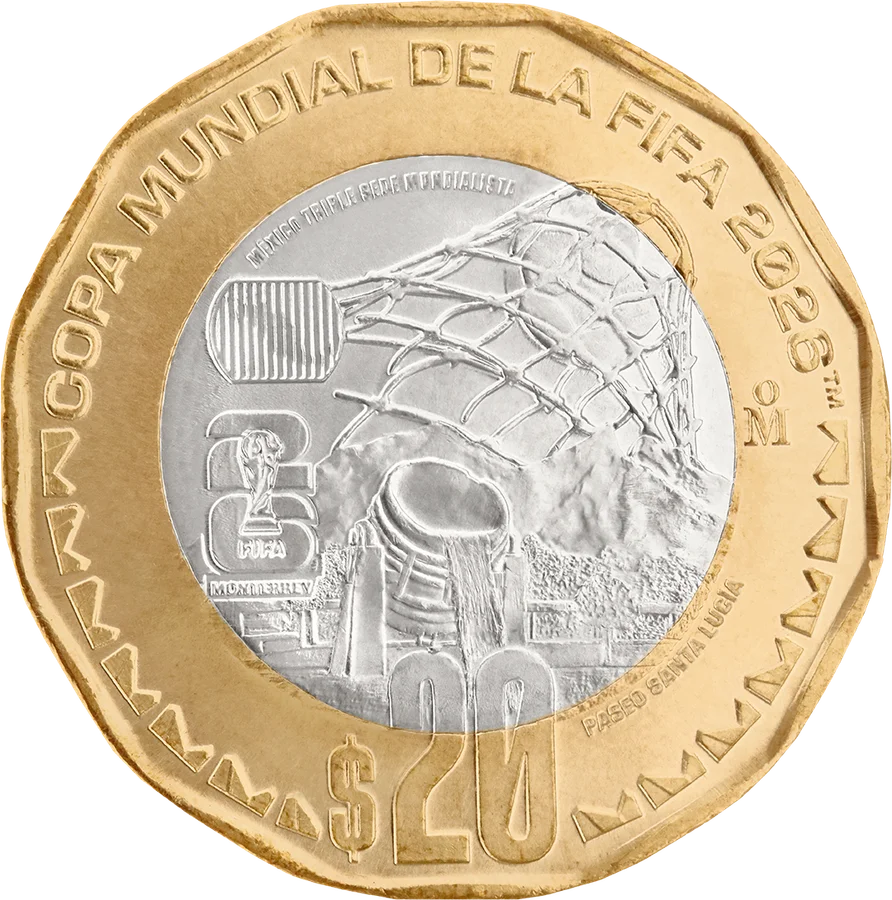
Monterrey returns to the World Cup 40 years after 1986. Three official Banxico coins with one unusual detail: the reverse shows El Crisol Fountain and Cerro de la Silla, with no soccer player. The only host coin in the set that breaks the pattern.
Monterrey is one of three Mexican host cities for the 2026 FIFA World Cup, and for the first time it appears on an official Bank of Mexico (Banxico) coin. Three versions exist: a 20-peso bimetallic circulating coin, a 1 ounce pure silver piece, and a 1/4 ounce pure gold piece. The silver runs roughly 105 to 175 USD and the gold roughly 1,200 to 1,600 USD at authorized dealers, depending on the spot price at the time of sale.
If you are holding one and wondering whether it is worth money, the honest answer depends on which version you have. The bimetallic is a general-circulation coin with a huge mintage and is worth its face value plus a small collector premium. The silver and gold carry real bullion value that sets a floor no matter what. Below is what each one is, what drives its value, and which one actually makes sense to hold.
Monterrey returns to the World Cup 40 years after 1986
Monterrey hosted World Cup matches in 1986, when the old Estadio Tecnológico staged games featuring Germany, England and Uruguay in one of the most remembered tournaments in history. Four decades later, the city is back on the FIFA calendar, but now with a different stadium, a new generation of fans, and, for the first time, an official Banxico coin that puts it into national circulation.
That generational gap is what makes this piece interesting to collectors. The 1986 stadium that actually existed, the Tecnológico, was demolished in 2019. The stadium that hosts the 2026 matches, Estadio BBVA, opened in 2015 and had never appeared on a coin before. So even though the city repeats as a host, the coin has no earlier local numismatic parallel.
The 3 official Monterrey host coins
Banxico struck three Monterrey versions inside the 2026 World Cup set.
- 20-peso bimetallic: standard circulation strike, 12-sided (dodecagonal), 30 mm, 12.67 g. In circulation since May 18, 2026. Official Banxico mintage: 21,500,000 pieces. Face value: 20 pesos.
- 1 ounce pure silver (.999): 40 mm, 31.103 g, mirror (proof-like) finish. Authorized dealer price roughly 105 to 175 USD depending on the point of sale and the silver spot at the moment.
- 1/4 ounce pure gold (.999): 23 mm, 7.776 g, mirror finish. Dealer price roughly 1,200 to 1,600 USD.
The obverse on all three is the Mexican National Coat of Arms with the legend ESTADOS UNIDOS MEXICANOS, the standard on any official Mexican coin. The difference, as with the rest of the host set, lives on the reverse.
The design: El Crisol Fountain and Cerro de la Silla, no player
Here is the detail worth slowing down for. Compare the Monterrey reverse against Mexico City and Guadalajara and you notice it right away: the other two show a soccer player in action. Monterrey does not. The reverse of the Monterrey coin shows the El Crisol Fountain in front and Cerro de la Silla (the city's saddle-shaped mountain) behind it, with the legend COPA MUNDIAL DE LA FIFA 2026, the FIFA logo and the 20-peso value. No player, no ball, no goal.
Banxico made a design choice that went almost unnoticed in the launch coverage. It chose to tell the story of Monterrey through its urban and geographic landscape rather than through the game. The El Crisol Fountain, a sculpture by Cuauhtémoc Zamudio that stands in front of Estadio BBVA, anchors the sports setting without falling back on the generic-player cliché. Cerro de la Silla behind it seals the reading: this is Monterrey, not just any stadium.
This has precedent in Mexican commemorative coinage. When the Mexican Mint (Casa de Moneda) wants a city to carry the design, it reaches for identifiable landmarks rather than figures, the way the Numismatic Heritage of Mexico silver series consistently favors architecture over action. Monterrey getting that treatment inside a soccer set makes it a genuine outlier within the series.
Tecnológico 1986 vs BBVA 2026
Estadio Tecnológico, Monterrey's 1986 venue, was demolished in 2019. Estadio BBVA, opened in 2015, is the newest of the three Mexican venues for 2026 (the Azteca opened in 1966 and Guadalajara's Akron in 2010). That gap matters for understanding the piece.
In 1986 there was no host-city commemorative coin. Banxico issued the Copa Mundial México 86 series with generic tournament motifs, not pieces dedicated to each host city. The Monterrey 2026 is therefore the first time the city appears as a host on an official Mexican coin with its own reverse. Within the set, that gives it an unusual position: the only Mexican host that combines real World Cup heritage with a first-ever numismatic appearance.
| Coin | Metal | Weight | Mintage | Approx. price (USD) |
|---|---|---|---|---|
| 20-peso bimetallic | Nickel/aluminum-bronze | 12.67 g | 21,500,000 | Face value + small premium |
| 1 oz silver | .999 silver | 31.103 g | Low (proof issue) | 105 to 175 |
| 1/4 oz gold | .999 gold | 7.776 g | Low (proof issue) | 1,200 to 1,600 |
How to buy each one by budget
If you just want the circulating coin: the bimetallic. A mintage of 21.5 million means it will turn up in everyday change across Mexico throughout 2026 and much of 2027. Do not overpay on online marketplaces. If you want an uncirculated example, wait for the official Banxico blister packs with the four-host set and keep that complete pack. That is where set value lives.
If you have about 100 to 175 USD: the 1 ounce silver. Buy it directly from Casa de Moneda, from an authorized Banxico distributor, or on the secondary market. It is not sold through commercial banks. Expect a waiting list in the first month; wait two or three weeks and you can usually find it at the listed price without paying a reseller markup.
If you are going for gold: budget roughly 1,200 to 1,600 USD. The 1/4 ounce is the entry point into the 2026 World Cup gold, sized so you do not have to commit to the full gold ounce, which runs well above 3,500 USD.
For the full purchasing process across all three channels, see the guide on how to buy the Banxico 2026 World Cup coins.
Which one to hold
This is a judgment, not financial advice. The Monterrey 1/4 ounce gold has three things going for it over a 5 to 10 year horizon: low gold mintage (Banxico gold always is), solid regional demand (Nuevo León has purchasing power and local collectors pay for their own), and a design that is unique in the set because it drops the player.
That last point matters more than it looks. When someone opens a complete 2026 host set years from now, the four player coins will look much alike. Monterrey stands out by contrast. In numismatics, the piece that breaks the pattern of a set tends to command the better price at auction once the set is assembled and completing it depends on whoever holds the odd one out.
The silver ounce plays a different game, closer to metal-plus-numismatic value. If you buy at dealer price and silver holds its trend, the numismatic premium over the metal content should climb slowly but steadily while the generation that lived 1986 keeps collecting.
The bimetallic is for collecting, not investing. The mintage is enormous. What you can do: keep one protected uncirculated example and, if you can, set aside a few more for family. Thirty years out, that is the piece that carries meaning in a Monterrey household.
To go deeper
- Full catalog of the 12 World Cup 2026 coins
- Analysis of the national jaguar coin (Triple Host)
- How to buy the Banxico 2026 World Cup coins
Your turn
Are you going for all three Monterrey coins or just one? Do you like the no-player design, or does it feel empty next to Mexico City and Guadalajara? And for anyone who was at the Tecnológico in 1986, what does it mean to see the BBVA on a coin 40 years later? Bring it to the Pesoteca forum and let us know which version you are keeping.

Loading comments…