
10 Centavos 1937 (Cupronickel): Value & How to Spot the Real One
Prices updated: August 2026
Centavos cupronickel 1937.
Centavos cupronickel 1937.
Design
Banxico
Reverse
Outer rings of the Sun Stone (Aztec calendar) surrounding the denomination 10 CENTAVOS, with the year 1937 and the mint mark M of the Mexico City Mint.
Obverse
Obverse with the Mexican National Coat of Arms and the legend "ESTADOS UNIDOS MEXICANOS" per the official convention. Struck by the Mexico City Mint under Banxico decree.
How much is the 10 Centavos 1937 (Cupronickel): Value & How to Spot the Real One worth?
The market value of the 10 Centavos 1937 (Cupronickel): Value & How to Spot the Real One is not yet documented with enough data to give a firm range. Weigh and measure your piece, compare it against the specifications, and check the forum for a second opinion.
The real price depends on four factors: the grade of preservation (a circulated piece is worth the low end of the range; an uncirculated one, or one still in its official blister pack, the high end), the finish (satin vs mirror/proof), the rarity within the series based on the mintage, and the metal spot price on the day of the deal when the piece is silver or gold. Check the value-by-grade table above and compare with equivalent pieces before buying or selling.
Where to buy or sell this coin?
Browse the national directory of numismatic shops or the community forum to trade directly with other collectors.
Description
The 1937 Mexican 10 centavos in cupronickel is worth about 8 USD in worn condition and up to 250 USD in near-mint grade. It has no silver, so all of its value is collector demand, and a low mintage year (3,000,000 pieces) makes it one of the more sought-after dates in its series. Here is what yours is actually worth and how to check it is genuine.
What it's worth in 2026
This coin carries zero metal value. It is 80% copper and 20% nickel, so you cannot melt it for a profit. Every dollar it commands comes from collectors, and that means condition (grade) decides almost everything.
Using catalog references (Silver Age Coins) as a guide, here is the range:
| Grade | Approx. value (USD) |
|---|---|
| Good (heavily worn) | 8 |
| Fine | 45 |
| Very Fine | 98 |
| Extra Fine (EF) | 215 |
| About Uncirculated (AU) | 250 |
A heavily circulated example is easy to find and sells for very little. The money is in the high grades: EF, AU, and Uncirculated pieces with original luster are where prices climb. If your coin looks crisp, with sharp detail on the outer rings of the design, it is worth getting a real grade opinion before you sell.
Why the 1937 is a "key date"
The 1937 belongs to the 1936 to 1946 cupronickel series. Its mintage was 3,000,000 pieces, lower than most other years in the run, which is why many sellers label it a key date. That said, plenty of them circulated hard, so worn examples are not rare. The genuine scarcity, and the real value, sits in well-preserved high grades. Do not overpay for a beat-up one just because you saw the words "key date."
What the coin actually looks like
This is a small, gray-white coin. Getting the specs right is the fastest way to confirm you have the correct type (KM#432):
- Weight: 5.5 grams
- Diameter: 23.5 mm
- Thickness: 1.75 mm
- Edge: plain (smooth)
- Composition: cupronickel, 80% copper / 20% nickel (no silver)
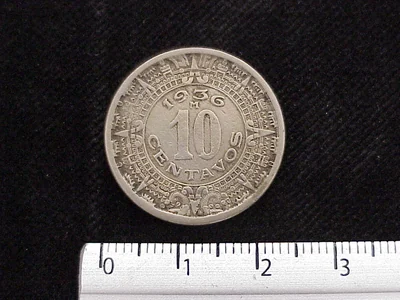
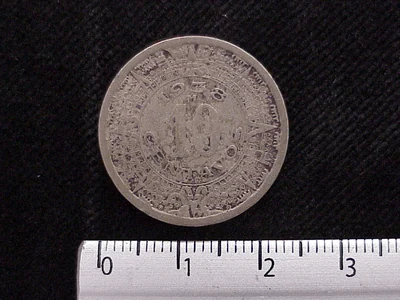
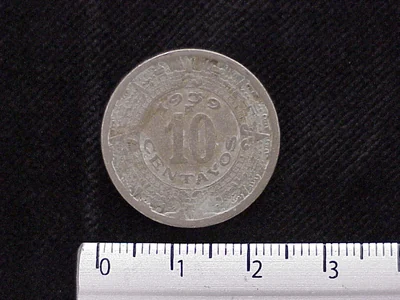
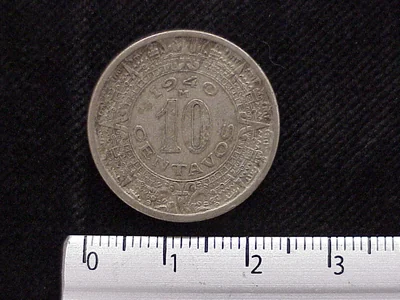
The reverse shows the outer rings of the Piedra del Sol (the Aztec Sun Stone, often called the Aztec calendar), with the denomination 10 CENTAVOS in the center, the date 1937, and the mint mark M for the Casa de Moneda de México. The obverse carries the Mexican national coat of arms (an eagle on a cactus with a snake). The design is by Manuel Luna Negrete.
A quick note on the source description: if you find a listing calling this coin 1.52 grams and 15 mm, that refers to a different, smaller type. The 1937 cupronickel 10 centavos (KM#432) is the 5.5 gram, 23.5 mm piece described above. Check the weight and diameter first.
How to tell if yours is genuine
Counterfeits of a low-value coin like this are uncommon, but wrong-type confusion is very common. Run these checks:
- Weight: it should hit 5.5 grams. A digital scale settles most doubts.
- Diameter: 23.5 mm across.
- Edge: plain and smooth, no reeding.
- Color and magnetism: cupronickel is a silvery gray, not golden. It is only weakly magnetic at most. A strongly magnetic coin is not this type.
- Design: the reverse rings of the Sun Stone should be sharp, with a clear M mint mark.
If the numbers are off or the metal looks wrong, you are likely holding a different denomination or a later restrike, not the 1937 cupronickel.
Where to sell it
Don't take the first offer, especially if your coin grades EF or better. A worn example is worth a few dollars and moves easily; a high-grade piece is where you want a second opinion. Compare prices and grades with established dealers before you commit. You can browse the Pesoteca dealer directory to see what real sellers are asking for the same date and grade, and ask for a grade reference on any coin you think is high-end.
If you inherited a mix of old Mexican coins, this one is a good example of why "old" does not mean "valuable": age alone means little, and the real drivers are mintage, demand, and grade. Have any of your coins graded before assuming a windfall. What grade do you think yours is in? Post clear photos in the Pesoteca forum and let collectors weigh in.
Historical context
Centavo coins form the base of the Mexican monetary system. Banxico has modified their diameters, materials, and alloys several times over the past decades to optimize minting costs. The 10-centavo Cupronickel piece struck in 1937 belongs to the Banxico Numismatic Collection catalog documented on its official site.
For Mexican collectors, centavo pieces have value when they capture a change of material, a die error, or an atypically low mintage. Banxico has published annual mintages in CM10 since the year 2000. For earlier pieces the data may not be available. This entry follows the convention of the PSM System, one ID per distinct physical piece, not per shared design.
This piece belongs to the era
México Moderno (pre-1992) →Explore all the Mexican coins of this era, their historical context and how they connect to the monetary system of the period.
Value range of this piece
Value range without enough data for this piece.
See the full breakdown by grade (VG, F, VF, EF, AU, MS-60, MS-63, MS-65) for the whole series →
Same denomination, other years
10 centavos Cuproníquel · Centavos Mexicanos
Frequently asked questions
How much is a 1937 Mexican 10 centavos worth?
It depends entirely on grade, since the coin has no metal value. Catalog references (Silver Age Coins) run from about 8 USD in Good, roughly 45 USD in Fine, about 98 USD in Very Fine, around 215 USD in Extra Fine, and about 250 USD in About Uncirculated. Worn examples are cheap; high grades are what pay well.
Is the 1937 10 centavos rare or a key date?
It is one of the more sought-after years in the 1936 to 1946 cupronickel series. The mintage was 3,000,000 pieces, lower than most other dates, so many sellers call it a key date. However, plenty circulated, so worn coins are not rare. The genuine value is in well-preserved high grades (EF, AU, or better).
What metal is the 1937 10 centavos made of?
It is cupronickel: 80% copper and 20% nickel. There is no silver in it, so its price is purely numismatic with no intrinsic melt value. The color is a silvery gray, not golden.
How can I tell if my 1937 10 centavos is genuine?
Check the weight (5.5 grams), diameter (23.5 mm), and a plain smooth edge, and confirm the metal is cupronickel (silvery gray, not golden or strongly magnetic). The reverse should show the outer rings of the Piedra del Sol with the mint mark M. If the numbers are off, you likely have a different type. When in doubt, have a dealer from the directory review it.
Conversation
0 comments
Sources
- Ejemplar de la Coleccion Numismatica Banco de Mexico . inv. 12220
- Ejemplar de la Coleccion Numismatica Banco de Mexico . inv. 12221
- Ejemplar de la Coleccion Numismatica Banco de Mexico . inv. 12222
- Ejemplar de la Coleccion Numismatica Banco de Mexico . inv. 12223
Images for informational and educational purposes, attributed to their original source. Reference values; the real price depends on the grade, the specific variant and demand.
Loading comments…