
1977 Mexican 10 Centavos (Cupronickel): Value & Facts
Prices updated: August 2026
Centavos cupronickel 1977.
Centavos cupronickel 1977.
Design
Banxico
Reverse
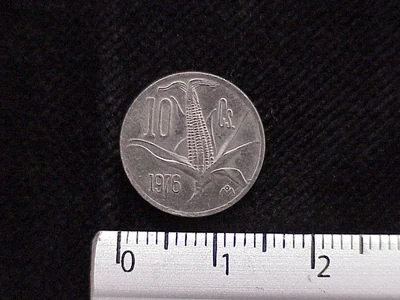
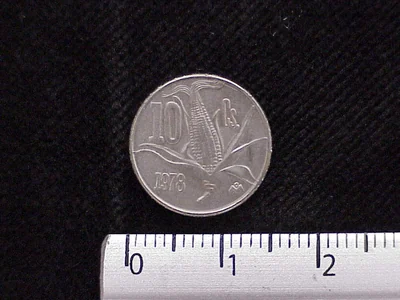
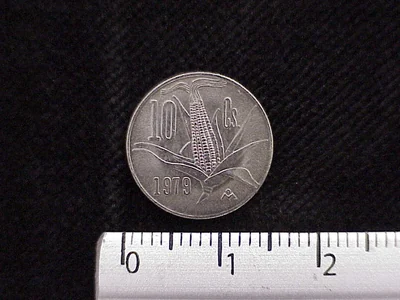
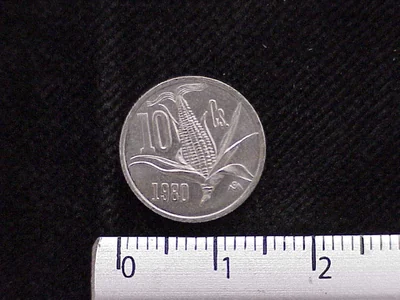
Upright ear of corn (standing), with the legend "10 Cs." and the year to the left. Design by the engraver Alfonso Rodriguez Facio. It is the series popularly known as "maicito" for the ear-of-corn motif.
Obverse
Obverse with Mexican National Coat of Arms and legend "ESTADOS UNIDOS MEXICANOS" per official convention. Struck by the Mexico City Mint under Banxico decree.
How much is the 1977 Mexican 10 Centavos (Cupronickel): Value & Facts worth?
The market value of the 1977 Mexican 10 Centavos (Cupronickel): Value & Facts is not yet documented with enough data to give a firm range. Weigh and measure your piece, compare it against the specifications, and check the forum for a second opinion.
The real price depends on four factors: the grade of preservation (a circulated piece is worth the low end of the range; an uncirculated one, or one still in its official blister pack, the high end), the finish (satin vs mirror/proof), the rarity within the series based on the mintage, and the metal spot price on the day of the deal when the piece is silver or gold. Check the value-by-grade table above and compare with equivalent pieces before buying or selling.
Where to buy or sell this coin?
Browse the national directory of numismatic shops or the community forum to trade directly with other collectors.
Description
If you found a small silver-gray Mexican coin dated 1977 marked "10 Centavos," here is the honest answer: it is worth a few cents in 2026, not a fortune. Mexico struck 144,650,000 of them, so it is one of the most common coins of its era. Only pristine, uncirculated examples bring more than pocket change.
What this coin actually is
The 1977 10 centavos is a small cupronickel coin made by the Casa de Moneda de México (the Mexican Mint). "Centavos" are the fractional units of the peso, the same way cents divide a dollar. This one is part of a series that circulated through the 1970s, when a centavo still had real buying power.
Collectors nicknamed it maicito ("little corn"), because the reverse shows a standing ear of corn. That design ran across the entire 10 centavos series from 1974 to 1980, engraved by Alfonso Rodríguez Facio. The other side carries Mexico's national coat of arms: the eagle devouring a serpent.
Specifications, exactly as struck:
| Feature | Detail |
|---|---|
| Denomination | 10 Centavos |
| Year | 1977 |
| Metal | Cupronickel (75% copper, 25% nickel) |
| Weight | 1.52 grams |
| Diameter | 15 mm |
| Edge | Reeded (segmented in pairs) |
| Mintage | 144,650,000 |
| Design | Ear of corn (reverse), eagle coat of arms (obverse) |
How much is a 1977 10 centavos worth?
For almost anyone reading this, the answer is: very little. In circulated condition (worn, from actual use), it is worth cents, essentially face value to a collector filling a set.
An uncirculated (UNC) example, one that never entered circulation and keeps its original mint luster, is where the small premium lives. Numista and dealer tables put a clean UNC piece at roughly a dollar or a bit more, depending on eye appeal. That is the whole ceiling for a normal, error-free 1977.
The value driver here is condition, not date. Because this is a soft-metal coin that saw heavy use, high-grade survivors with no nicks on the edge and full original shine are the only ones that command a premium.
Is it rare? No.
With 144,650,000 coins minted, 1977 is one of the common dates in the series. The years right after it were even higher: 271 million in 1978, 375 million in 1979. You will find the 1977 easily in mixed lots of old Mexican coins. Rarity is not what makes this piece interesting.
If you want a coin from this period that a collector chases individually, it comes down to grade and to genuine, verified mint errors, not the date on a standard 1977.
The "is it valuable?" myth
Age alone does not make a coin valuable. A 1977 coin sounds old to a US reader used to modern quarters, but in numismatics 1977 is recent, and 144 million pieces is a flood, not a rarity. The idea that any pre-1980 foreign coin is worth "a lot" does not hold here.
One real exception: a verified error. Genuine double strikes or wrong-planchet mistakes (a coin struck on the wrong metal blank) can be worth real money, but they are rare and need authentication. Ordinary die varieties, distinguished by the sharpness of the corn stalk or the spacing of the date, are catalogued differences, not price-moving errors. Do not confuse a die variety with a valuable error.
How to tell if yours is genuine (and worth checking)
- Weight and size: it should weigh 1.52 grams and measure 15 mm across. Off numbers are a red flag.
- Edge: the rim is reeded in paired segments, not smooth. A smooth edge on a coin this size is a sign to look closer.
- Metal: cupronickel is silver-gray, not the yellow brass of some same-era coins. It contains no silver and no precious metal, so there is no melt value.
- Condition: hold it to the light. If it has full original luster and no scratches, that is the one worth setting aside.
Where to sell it
Because the per-coin value is so low, selling a single circulated 1977 on its own is not worth the effort. Your best move is to sell it as part of a lot with other Mexican coins from the same era.
A single high-grade uncirculated example is the one exception a collector might buy on its own, purely for the grade. To find reputable dealers, check the Pesoteca shop directory at /tiendas. For fractional peso coins like this one, it also helps to understand the broader series before you sell, so you know if any piece in your box is the good one.
If you inherited a full jar of old Mexican coins, this 1977 is a great teaching piece: completing the cupronickel 10 centavos date run is an affordable way to learn how to grade condition without overpaying. What else did you find in the box? Post photos in the Pesoteca forum and we will help you tell the common dates from the ones worth keeping.
Historical context
Centavo coins form the base of the Mexican monetary system. Banxico has modified their diameters, materials, and alloys several times over the past decades to optimize minting costs. The 10 centavos Cupronickel piece struck in 1977 belongs to the Banxico Colección Numismática catalog documented on its official site.
For Mexican collectors, centavo pieces have value when they capture a change of material, a die error, or an atypically low mintage. Banxico has published annual mintages in CM10 since the year 2000. For earlier pieces the data may not be available. This entry follows the convention of the Sistema PSM, one ID per distinct physical piece, not per shared design.
This piece belongs to the era
México Moderno (pre-1992) →Explore all the Mexican coins of this era, their historical context and how they connect to the monetary system of the period.
Value range of this piece
Value range without enough data for this piece.
See the full breakdown by grade (VG, F, VF, EF, AU, MS-60, MS-63, MS-65) for the whole series →
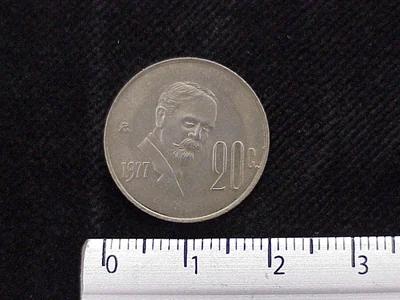
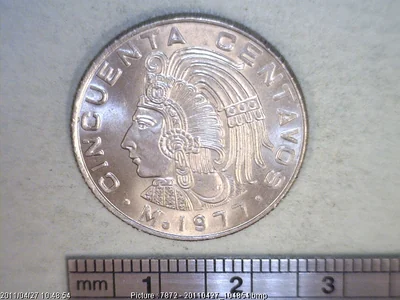
Other denominations from 1977
Centavos Mexicanos · Cuproníquel
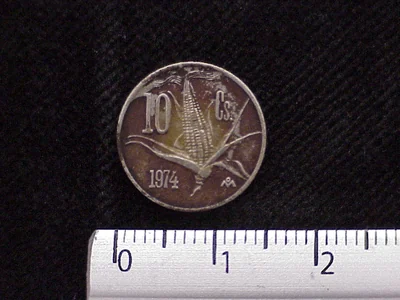
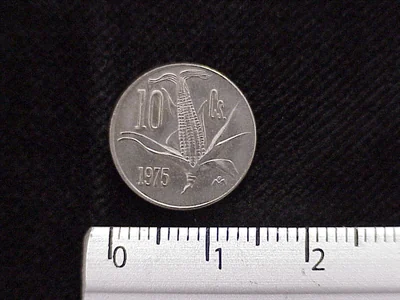
Same denomination, other years
10 centavos Cuproníquel · Centavos Mexicanos
Frequently asked questions
How much is a 1977 Mexican 10 centavos worth?
Very little. It is a common date with 144,650,000 struck. In circulated condition it is worth cents. A pristine uncirculated (UNC) example with full original luster runs about a dollar or a bit more per Numista and dealer tables. Value depends almost entirely on grade.
Is the 1977 10 centavos rare?
No. With 144,650,000 coins minted it is one of the common dates in the series, and later years were even higher (271 million in 1978, 375 million in 1979). It turns up easily in mixed lots of old Mexican coins.
Does this coin contain silver?
No. It is cupronickel, an alloy of 75% copper and 25% nickel. There is no silver or any precious metal, so it has no melt or bullion value. Its worth comes only from condition and collector demand.
Where can I sell my 1977 10 centavos?
Because the per-coin value is low, sell it in a lot with other coins from the era rather than on its own. Check the Pesoteca shop directory at /tiendas for trustworthy dealers. Only a clean, uncirculated example is worth selling individually for its grade.
Conversation
0 comments
Sources
- Ejemplar de la Coleccion Numismatica Banco de Mexico . inv. 12273
- Ejemplar de la Coleccion Numismatica Banco de Mexico . inv. 12274
- Ejemplar de la Coleccion Numismatica Banco de Mexico . inv. 12275
- Ejemplar de la Coleccion Numismatica Banco de Mexico . inv. 15727
- Ejemplar de la Coleccion Numismatica Banco de Mexico . inv. 15728
Images for informational and educational purposes, attributed to their original source. Reference values; the real price depends on the grade, the specific variant and demand.
Loading comments…