
Mexican 10 Pesos Coin (2017): What It's Really Worth
Prices updated: August 2026
Circulating coin EUM 2017, bimetallic, satin finish.
Circulating coin EUM 2017, bimetallic, satin finish.
Design
Banxico
Reverse
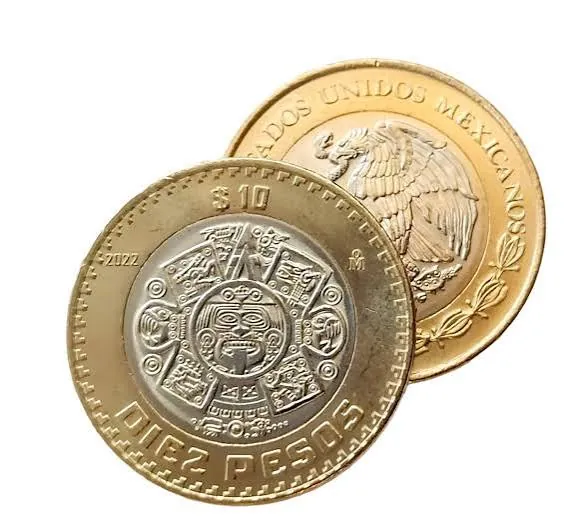
Reverse: at the center, the central disc of the Sun Stone (Aztec Calendar) representing Tonatiuh with the fire mask. Around it, the number "10", the legend "DIEZ PESOS", the "Mo" mint mark of the Mexican Mint, and the minting year 2017. The whole design sits on the cupronickel core within the aluminum-bronze ring.
Obverse
Obverse with the Mexican National Coat of Arms (eagle devouring a serpent on a nopal cactus) in high relief at the center, legend "ESTADOS UNIDOS MEXICANOS" in an upper arc. The canonical circulation design of the post-1996 reform.
How much is the Mexican 10 Pesos Coin (2017): What It's Really Worth worth?
The market value of the Mexican 10 Pesos Coin (2017): What It's Really Worth is not yet documented with enough data to give a firm range. Weigh and measure your piece, compare it against the specifications, and check the forum for a second opinion.
The real price depends on four factors: the grade of preservation (a circulated piece is worth the low end of the range; an uncirculated one, or one still in its official blister pack, the high end), the finish (satin vs mirror/proof), the rarity within the series based on the mintage, and the metal spot price on the day of the deal when the piece is silver or gold. Check the value-by-grade table above and compare with equivalent pieces before buying or selling.
Where to buy or sell this coin?
Browse the national directory of numismatic shops or the community forum to trade directly with other collectors.
Description
If you inherited or found a Mexican 10 pesos coin dated 2017, here's the honest answer: in normal circulated condition it's worth its face value, about 0.50 USD at recent exchange rates. It contains no silver or gold. The only versions worth real money are uncirculated examples in high grade or coins with a verified mint error.
This is the two-tone coin millions of people carry in their pockets across Mexico. It belongs to what Banxico (Mexico's central bank) calls the Familia C series, struck without interruption since 1997. It is not rare, and no amount of age is going to change that. Let's break down what yours is actually worth and how to spot the rare exceptions.
Quick value snapshot
| Condition | What it's worth |
|---|---|
| Circulated (worn, from your change) | Face value, about 0.50 USD |
| Uncirculated (no wear, mint luster) | A few dollars to a collector |
| Verified mint error (rotated center, double strike) | Case by case, potentially higher |
The key phrase there is "verified." A worn coin with no documented error is spending money, not a collectible.
What the coin is made of
The 10 pesos is bimetallic (two metals). The outer ring is aluminum-bronze (copper, aluminum, nickel) and the center disc is cupronickel or alpaca (copper, zinc, nickel). No precious metal is involved, which is why it has no melt value floor the way a silver or gold coin would. Anyone telling you this coin is "worth a fortune because it's old" is wrong.
Specifications, identical across the whole circulating series since 1997:
- Weight: 10.329 grams
- Diameter: 28 mm
- Edge: reeded (grooved)
Those exact measurements matter, because they're the fastest way to catch a fake or a coin from a different denomination.
What's actually on the coin
A lot of listings describe the reverse as "just a number 10," which is wrong. The center reproduces the central disc of the Piedra del Sol (the Aztec Sun Stone, often called the Aztec Calendar): the face of Tonatiuh with the fire mask. Around it you'll see the number 10, the words DIEZ PESOS (ten pesos), the Mo mint mark of the Casa de Moneda de México (Mexico's national mint), and the year 2017.
The obverse carries the Mexican national coat of arms (the eagle on the cactus with the serpent) and the legend ESTADOS UNIDOS MEXICANOS, the official name of the country.
Does it have any silver?
No. This is the question we get most, and the answer is a flat no. The 10 pesos coins that did have a silver center belong to the earlier series (the large coins of the 1980s and 1990s, sometimes called Familia B). The current version, including your 2017, is 100 percent base metal. If you have a large 10 pesos coin with a bright center, that's a different coin worth checking separately.
When a 2017 coin is worth more than face value
Two scenarios put money on the table:
1. Uncirculated grade. A coin with zero wear and full mint luster can interest a collector building a complete date set. Even then, we're talking a few dollars, not a windfall.
2. A genuine mint error. These are what drive value on any bimetallic coin: a rotated center (the disc turned relative to the ring), a double strike, or a center and ring that were assembled wrong. Errors like these are rare and have to be verified piece by piece by someone who knows what they're looking at. Without a real, confirmed error, the coin is worth face value regardless of what a forum post claims.
How to tell if yours is genuine
- Check the weight: it should be 10.329 grams.
- Check the diameter: 28 mm.
- Confirm the edge is reeded.
- The ring and center should be clearly different colors and well centered.
- The reverse should show the face of Tonatiuh, not a plain number.
- The obverse should show the coat of arms with ESTADOS UNIDOS MEXICANOS.
Measurements outside those numbers are a red flag for an imitation.
Where to sell or get it checked
For ordinary circulated examples there is no market. They circulate as change and no dealer will pay a premium. If you have an uncirculated piece or a suspected error and want a real opinion, or you're looking to buy select examples, start with the Pesoteca shop directory and contact numismatists who can grade the actual piece.
To see how this coin fits into the full run, check the circulating 10 pesos bimetallic series or the broader context of the Nuevos Pesos era.
Think you might have an error coin or an uncirculated example? Post clear photos of both sides in the Pesoteca forum and let collectors weigh in before you assume it's just face value.
Historical context
When Banxico dropped the N$ prefix from the peso starting in 1996, the circulating pieces kept the same physical format as their Nuevos Pesos counterparts under the decree of June 22, 1992. This bimetallic 10-peso coin struck in 2017 is part of that continuity: same technical specifications, same base design with the National Coat of Arms on the obverse, only the face value shown on the reverse changed. That is why, when you line up the dates, you see long sequences with very little variation.
For the Mexican collector building a year-by-year set, these pieces are the ones that fill the basic gaps before chasing the rare commemorative versions. Banxico has documented mintages in its Monetary Circular CM10 since the year 2000, so for 2017 you can verify the exact mintage against that source. Pesoteca catalogs each year as a distinct physical piece under the PSM System family C, following our convention of one ID per collectible piece, not per shared design.
This piece belongs to the era
Nuevos Pesos y actualidad →Explore all the Mexican coins of this era, their historical context and how they connect to the monetary system of the period.
Go deeper on this coin
Nueva moneda de 10 pesos 2026: cambia a acero y esto pasa con las viejas
El DOF ya lo hizo oficial: el centro de la moneda de 10 pesos pasa de alpaca a acero recubierto de níquel. Te contamos qué cambia, por qué, y lo que ningún medio dice: qué pasa con tus monedas actuales y cuáles sí valen para el coleccionista.
Read the full article →Value range of this piece
Value range without enough data for this piece.
See the full breakdown by grade (VG, F, VF, EF, AU, MS-60, MS-63, MS-65) for the whole series →
Same denomination, other years
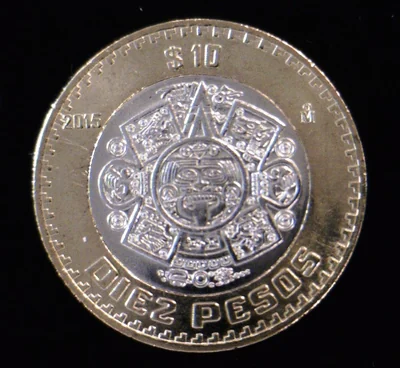
10 pesos Bimetálica · 10 Pesos Bimetálica
Frequently asked questions
How much is a 2017 Mexican 10 pesos coin worth?
In normal circulated condition it's worth exactly its face value, 10 pesos (about 0.50 USD). It's a mass-produced coin with no precious metal, so there's no intrinsic value above that. It only sells for more as an uncirculated high-grade example or with a verified mint error.
Does the 2017 10 pesos coin contain any silver?
No. It's bimetallic base metal only: an aluminum-bronze outer ring and a cupronickel or alpaca center. The 10 pesos coins that had a silver center belong to the older 1980s-1990s series. The 2017 coin has no silver or gold and no melt value.
How can I tell if my 10 pesos coin is genuine?
Check the weight (10.329 grams), diameter (28 mm), and that the edge is reeded. The ring and center should be different colors and well centered. The reverse should show the face of Tonatiuh from the Aztec Sun Stone, not a plain number, and the obverse should show the coat of arms with ESTADOS UNIDOS MEXICANOS.
Where can I sell a Mexican 10 pesos coin?
For ordinary circulated coins there's no market, they just circulate as change. If you have an uncirculated piece or a suspected mint error, use the Pesoteca shop directory to contact numismatists who can grade the actual coin and tell you what it's really worth before you sell.
Conversation
0 comments
Sources
- Ejemplar de la Coleccion Numismatica Banco de Mexico . inv. 24014
- Ejemplar de la Coleccion Numismatica Banco de Mexico . inv. 24013
- Ejemplar de la Coleccion Numismatica Banco de Mexico . inv. 24015
- Ejemplar de la Coleccion Numismatica Banco de Mexico . inv. 24016
- Ejemplar de la Coleccion Numismatica Banco de Mexico . inv. 24017
Images for informational and educational purposes, attributed to their original source. Reference values; the real price depends on the grade, the specific variant and demand.
Loading comments…