
20 Pesos Plan Marina 2018: Value & How to Sell
The 20 Pesos Plan Marina 2018: Value & How to Sell is worth between $100 and $300 MXN depending on its grade of preservation.
Prices updated: August 2026
Bimetallic commemorative · 50 years of Plan Marina (Navy relief)
Bimetallic commemorative · 50 years of Plan Marina (Navy relief)
Design
Banxico
Reverse
At the center of the field and as the main motif, an equilateral triangle, an internationally accepted symbol of prevention and protection; inside it the legend “50 años”, and behind it, two crossed anchors. Above the triangle are represented the elements of land, air and sea, through which the Mexican Navy carries out its functions of support to the civilian population. The land elements are represented by the pairing of a marine and a dog, essential for the search and rescue of people; the air elements are represented by a helicopter, which facilitates the deployment of personnel and materiel and allows the rescue of victims from hard-to-reach places. Finally, the sea elements are represented by a logistical support ship, used for the transport of provisions, equipment and human resources. The legend “PLAN MARINA” appears in a semicircle at the top, on the left the year “1966” and on the right the year “2016”, and below the mint mark of the Mexican Mint, “M°”. Finally, in the exergue the denomination is shown as the numeral “$20”.
Obverse
The National Coat of Arms in sculptural relief, with the legend ESTADOS UNIDOS MEXICANOS in an upper semicircle.
The 20 Pesos Plan Marina 2018: Value & How to Sell is worth between $100 and $300 MXN depending on its grade of preservation.
Prices updated: August 2026
How much is the 20 Pesos Plan Marina 2018: Value & How to Sell worth?
The estimated value of the 20 Pesos Plan Marina 2018: Value & How to Sell ranges from $100 (circulated, XF) up to $300 (official blister pack), with $227 as a reference for an uncirculated (UNC) piece. The estimate is based on the official mintage and the historical behavior of the family.
The real price depends on four factors: the grade of preservation (a circulated piece is worth the low end of the range; an uncirculated one, or one still in its official blister pack, the high end), the finish (satin vs mirror/proof), the rarity within the series based on the mintage, and the metal spot price on the day of the deal when the piece is silver or gold. Check the value-by-grade table above and compare with equivalent pieces before buying or selling.
Where to buy or sell this coin?
Browse the national directory of numismatic shops or the community forum to trade directly with other collectors.
Description
If you found a Mexican 20 Pesos coin with two crossed anchors and a triangle, and you saw someone online asking 90,000 pesos for it, ignore that. The real value of the 2018 Plan Marina 20 Pesos runs from about 1 dollar (its face value, roughly 20 to 60 pesos circulated) up to 15 dollars for a sealed uncirculated example. It is legal tender, not a rarity.
What this coin actually is
This is a Mexican commemorative 20 Pesos coin marking the 50th anniversary of the Plan Marina, the protocol the Mexican Navy (SEMAR) uses to assist civilians during disasters. The Bank of Mexico (Banxico) struck and released it in 2018, but the reverse is dated 2016 (the year of the actual anniversary). That gap between the release year and the engraved year confuses a lot of sellers, and it is worth understanding before anyone talks you into paying extra for a "rare variant." It is not a variant. It is normal for this issue.
The design shows two crossed anchors of SEMAR above a triangle with the legend "Plan Marina." The triangle is the international symbol of civil protection, standing for the three domains the Navy operates in: land, air, and sea.
Specifications (keep these to check yours)
This is a bimetallic commemorative from Banxico's C1 family: an aluminum-bronze outer ring around a copper-nickel center.
| Feature | Detail |
|---|---|
| Denomination | 20 Pesos |
| Release year | 2018 (dated 2016) |
| Metal | Aluminum-bronze ring, copper-nickel center |
| Weight | 15.945 grams |
| Diameter | 32 mm |
| Mintage | 5,000,000 pieces |
| Legal tender | Yes |
How much is it worth in USD?
With 5 million minted, this is a common coin, not a rare one. Here is the honest range:
- Circulated: essentially face value, roughly 20 to 60 pesos (about 1 to 3 USD).
- Uncirculated (UNC), loose: around 150 to 300 pesos (roughly 8 to 15 USD).
- Sealed in the official Banxico blister pack: reference price of 300 pesos (about 15 USD), per a purchase validated by the Pesoteca catalog in 2026. A sealed blister trades above a loose UNC.
The listings you see for 90,000 pesos are marketplace asking prices, not completed sales. Nobody is paying that. This coin was made in the millions and is still legal tender.
The "error coin worth a fortune" myth
Genuine mint errors (off-center strikes, die rotation, double strikes) can multiply the value of a coin when they are real and verifiable. The problem: most "errors" people post online are post-mint damage, dents, scratches, or corrosion, not factory errors. Damage lowers value; it does not raise it. If you think you have a real error, post clear photos of the front, back, and edge on the Pesoteca forum and let the community check it before you get excited.
How to tell if yours is genuine
- Weigh it. A jewelry scale should read 15.945 grams. Fakes are usually off.
- Measure the diameter. It should be 32 mm with a caliper.
- Check the strike. Real coins have sharp relief and clean color separation between the two metals. Fakes look flat and the colors bleed.
Compare against the specs table above. Wrong weight, wrong diameter, or mushy detail are the red flags.
Where to sell it
For the best result, photograph the coin (front, back, and edge) and check the price range on this page first. Then go to a verified numismatic shop from the Pesoteca shop directory, which can appraise and buy it on the spot, or list it on the Pesoteca buy-and-sell forum among collectors. Avoid dumping it on Facebook to the first buyer who messages you.
Other coins in the same C1 family worth checking if you inherited a set: the 20 Pesos Constitution Centennial 2017 and the 20 Pesos Plan DN-III-E 2017.
Got one in a drawer and not sure what it grades? Post your photos on the Pesoteca forum and we'll help you pin down the value.
Historical context
The Plan Marina is the instrument through which the Ministry of the Navy of Mexico assists the civilian population in disasters and emergencies: evacuation, shelter, food, medical care and reconstruction when a hurricane, a flood or an earthquake hits. Its roots come from the 1950s, with the relief work after the hurricane in Manzanillo (1959) and in Tampico, and it was formalized on January 9, 1966, as the Emergency and Disaster Plan issued by the General Command of the Navy.
This coin celebrates the 50th anniversary of its application, which is why the reverse bears the dates 1966 and 2016. Behind the triangle (international symbol of prevention and protection) are two crossed anchors: the unmistakable mark of the Navy assisting on land.
Banxico put it into circulation on November 23, 2018. It is legal tender, so in theory you could come across one in your change, although today you have to hunt it down bit by bit in the market: a fine piece for putting together the commemorative 20-peso series.
The hurricanes that forced the plan
The Plan Marina was born from two hard lessons. In 1955 Hurricane Hilda destroyed the port of Tampico and made clear that Mexico had no way to provide organized relief. Things got worse in October 1959, when a category 5 hurricane devastated Manzanillo, in Colima: one of the most destructive phenomena of the Mexican Pacific in the 20th century, with more than a thousand deaths. There the Navy understood that it needed a formal protocol, and it arrived on January 9, 1966. Its mission is a single one: to lessen the destructive effect of calamities on the population and their property, acting alone or together with the Army and the other agencies.
How to identify it in the hand
It is dodecagonal (12 sides) and bimetallic. The core carries an alloy of 65% copper, 10% nickel and 25% zinc; the outer ring is 92% copper, 6% aluminum and 2% nickel. The obverse is the family's National Coat of Arms. On the reverse, the equilateral triangle of civil protection represents the three elements through which the Navy assists: land, air and sea; above it are the two crossed anchors of SEMAR, the legend "Plan Marina" in a semicircle, the years "1966" and "2016" on the sides and the mark of the Mexican Mint, the "Mo," below. Although it says 1966-2016, it went into circulation in 2018: there are no year variants, and if someone offers you "the 2016 one" and "the 2018 one" as different, it's the same piece.
What it's really worth, not the 90 thousand from the news story
Every few months the headline reappears of "the Plan Marina that sells for 90 thousand pesos." It's the usual trick: on marketplaces anyone sets whatever price they please, but posting a listing at 90 thousand is not selling it for 90 thousand. It remains a legal tender coin good for paying the subway fare, not a vault rarity. Its real value among collectors runs from 100 to 300 pesos depending on condition: circulated, with wear from use, hovers around its face value (20 to 60 pesos); in good condition 80 to 150; uncirculated (UNC, with shine) from 150 to 300. To appraise or sell it without hustlers, use the store directory, people with a physical address and not a fantasy listing.
Where to get it
Being common, it can be hunted without spending your paycheck: it still turns up in change, especially at banks and cash-heavy businesses, almost at its face value. If you want it brand new for the album, look for it with serious sellers or in a Banxico blister pack. It's one of the easy ones in the series, a good early step while you save your budget for the scarce ones.
This piece belongs to the era
Nuevos Pesos y actualidad →Explore all the Mexican coins of this era, their historical context and how they connect to the monetary system of the period.
Piezas por grado en circulación
Proyección de cuántas piezas sobreviven hoy y cómo se distribuyen entre grados de conservación, a partir de la acuñación oficial y la antigüedad de esta moneda.
| Grado | Piezas | % |
|---|---|---|
| MS-65 Gem | 219,521 | 5.0% |
| MS-60–64 | 790,274 | 18.0% |
| AU-50–58 | 878,082 | 20.0% |
| XF-40–45 | 965,890 | 22.0% |
| VF-20–35 | 790,274 | 18.0% |
| F-12–15 | 439,041 | 10.0% |
| VG / G | 219,521 | 5.0% |
| AG-3 | 87,808 | 2.0% |
| Totales | 4,390,411 de 5,000,000 (87.8%) | |
Estimaciones basadas en la acuñación oficial, la antigüedad y curvas estándar de desgaste numismático (curva conmemorativa moderna (post-1990)). Los valores reales pueden variar según preservación específica, eventos de fundido, y demanda del mercado.
Same denomination, other years
20 pesos Bimetálica · Monedas de 20 pesos
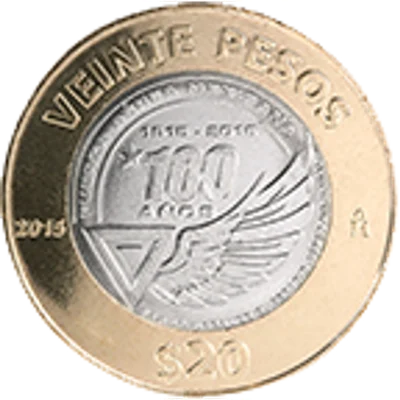
Centenario de la Fuerza Aérea Mexicana
2015
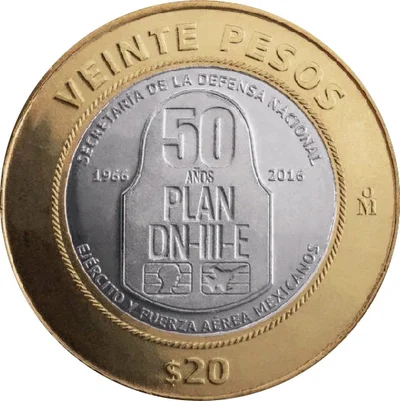
20 Pesos Conmemorativa del Quincuagésimo Aniversario de la aplicación del Plan DN-III-E
2017
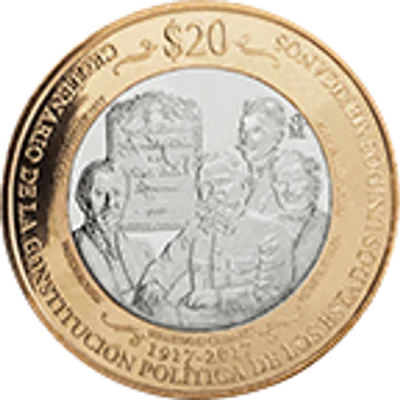
Centenario de la Promulgación de la Constitución Política de los Estados Unidos Mexicanos del 5 de febrero de
2017
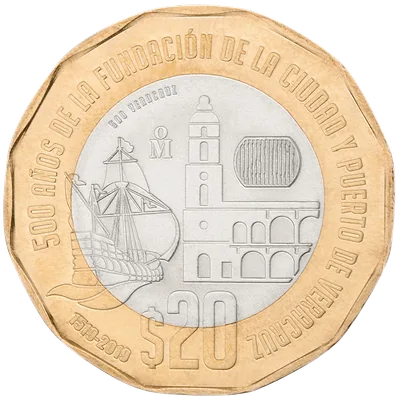
500 aniversario de la fundación de la Ciudad y Puerto de Veracruz
2020
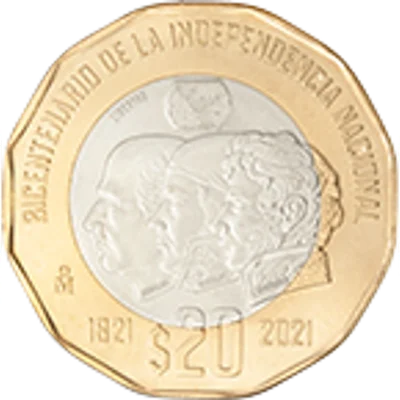
Bicentenario de la Independencia Nacional
2021
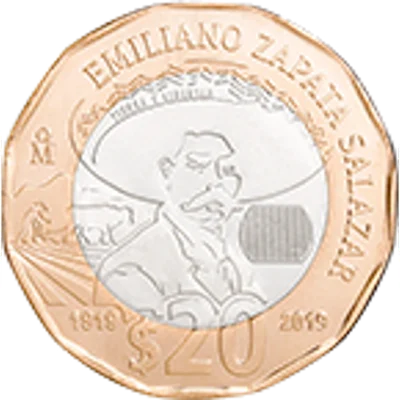
20 Pesos Centenario de la muerte del General Emiliano Zapata Salazar, C1
2021
Official sources
Frequently asked questions
How much is the 2018 Plan Marina 20 Pesos coin really worth?
Between collectors it runs from about 100 to 300 pesos (roughly 5 to 15 USD) depending on condition. Circulated pieces trade near face value (about 1 to 3 USD); an uncirculated or sealed-blister example reaches 8 to 15 USD. The 90,000-peso listings online are marketplace asking prices, not real sales. It is common, legal-tender currency, not a rarity.
Is the Plan Marina 20 Pesos coin rare?
No. Banxico minted 5,000,000 of them, so it is a common commemorative. Value comes from condition, not scarcity. Only a genuine, verifiable mint error would make a single piece worth significantly more.
Where can I sell my Plan Marina 20 Pesos coin?
The safest options are a verified shop from the Pesoteca directory, which values it on the spot, or the Pesoteca buy-and-sell forum among collectors. Photograph the front, back, and edge, and check the price range on this page before selling. Avoid rushing a sale to the first Facebook offer.
How do I know if my Plan Marina coin is genuine?
Weigh it (it should be 15.945 grams) and measure the diameter (32 mm) with a caliper, then compare to the specs above. Counterfeits usually have the wrong weight or diameter, flat relief, or poorly separated colors between the two metals.
Conversation
0 comments
Sources
- Banxico
- Banco de México
Images for informational and educational purposes, attributed to their original source. Reference values; the real price depends on the grade, the specific variant and demand.
Loading comments…