
20 Pesos Kukulkán (Chichén Itzá) 2026
The 20 Pesos Kukulkán 2026 is worth between $59 and $108 MXN depending on its grade of preservation.
Prices updated: August 2026
New circulating $20 · Kukulkán design · DOF reform Jan 2026
New circulating $20 · Kukulkán design · DOF reform Jan 2026
Design
Banxico
Reverse
Design featuring Kukulkan (the feathered serpent deity of the Maya culture). Bimetallic: silvered alpaca (nickel silver) at the center, aluminum bronze in the outer ring. Replaces/relaunches the circulating $20.
Obverse
National Coat of Arms with the legend "ESTADOS UNIDOS MEXICANOS" in the upper semicircle.
The 20 Pesos Kukulkán 2026 is worth between $59 and $108 MXN depending on its grade of preservation.
Prices updated: August 2026
How much is the 20 Pesos Kukulkán (Chichén Itzá) 2026 worth?
The estimated value of the 20 Pesos Kukulkán (Chichén Itzá) 2026 ranges from $59 (circulated, XF) up to $108 (official blister pack), with $90 as a reference for an uncirculated (UNC) piece. The estimate is based on the official mintage and the historical behavior of the family.
The real price depends on four factors: the grade of preservation (a circulated piece is worth the low end of the range; an uncirculated one, or one still in its official blister pack, the high end), the finish (satin vs mirror/proof), the rarity within the series based on the mintage, and the metal spot price on the day of the deal when the piece is silver or gold. Check the value-by-grade table above and compare with equivalent pieces before buying or selling.
Where to buy or sell this coin?
Browse the national directory of numismatic shops or the community forum to trade directly with other collectors.
Description
If you found a heavy 12-sided Mexican coin showing a stepped pyramid, that's the 20 Pesos Kukulkán, and the honest answer is it's worth close to face value: roughly one US dollar. Mexico minted 26 million of them in 2026 to replace the 20-peso banknote. It is not rare, and anyone offering you a fortune for one is counting on you not knowing that.
That said, there is a real, modest upside for pristine examples over the next few years. Here is exactly what you have, what it's worth in 2026, and how to tell a genuine one from a fake.
What this coin actually is
The Kukulkán 20-peso is a circulating coin, not a limited commemorative. It replaced Mexico's most heavily used banknote, the 20-peso note, which wore out fast and cost too much to reprint. Banxico (Mexico's central bank) decided to switch that denomination to a coin, and this is it.
The design shows El Castillo, the main pyramid at Chichén Itzá on the Yucatán Peninsula, also called the Temple of Kukulkán after the Maya feathered-serpent deity. It's one of the most recognizable Maya structures in the world, which is why it landed on the coin.
Technically, it belongs to Mexico's C1 family: a bimetallic, dodecagonal (12-sided) coin. Specs to know if you're holding one:
- Weight: 12.67 grams (exact)
- Diameter: 30 mm (exact)
- Outer ring: aluminum bronze (gold color)
- Center: cupronickel (silver color)
- Year: 2026 only, single year of issue
One quick note for anyone hoping this is a precious-metal find: it contains no silver and no gold. The gold color is aluminum bronze, an alloy. There is no melt value to speak of. Its worth comes from being spendable money and, for collectors, from condition.
How much is the Kukulkán 20 pesos worth?
Face value is 20 Mexican pesos, roughly one US dollar at typical exchange rates. If you got one in change or in a jar of coins, that's what it's worth to a store. Full stop.
For collectors, the picture shifts slightly with condition:
| Condition | Realistic value (pesos) | Approx. USD |
|---|---|---|
| Worn, from circulation | 20 (face value) | ~1 |
| Uncirculated (UNC, no wear) | 100 to 300 (projected, 2 to 5 yrs) | ~6 to 17 |
| Original Banxico blister pack | 400 to 700 (projected, 2 to 5 yrs) | ~22 to 40 |
Those UNC and blister numbers are projections, not current guaranteed prices. They follow the historical curve of earlier C1 bimetallic coins. For comparison, the so-called "cabezones" (an earlier 5-peso type) had mintages around 5 million per year and now trade at 60 to 150 pesos in uncirculated grade. The Kukulkán was minted at 26 million, more than five times that, so scarcity is unlikely to drive it high.
Where scarcity might come from later: not the mintage, but human habit. Circulating coins get spent, scratched, and lost. Pristine, untouched examples become genuinely hard to find over time. If yours is flawless and you keep it that way, you own the version that could appreciate. A worn pocket-change piece will always be worth one dollar.
The "it's worth thousands" myth
Social media and street sellers love to inflate brand-new coins. In Mexico's tourist and downtown areas, expect someone to offer this coin at 300 to 500 pesos in its first year of release. That's a bet on your ignorance. With 26 million struck and full circulation coming, the price settles at face value within 3 to 6 months of general release. Don't overpay, and don't believe you're sitting on a jackpot with a worn one.
The real money in this series is in the commemoratives, not this coin. If you're comparing what's in your collection, see the 20 Pesos World Cup 2026 Guadalajara and 20 Pesos World Cup 2026 Mexico City. Those are limited-mintage commemoratives designed to be saved, which is why they can climb in value while the Kukulkán mostly holds at face.
How to tell if yours is genuine
Counterfeits of a one-dollar circulating coin are rare (it's not worth a forger's time), but here's how to check:
- Weight and size. It must be 12.67 g and 30 mm exactly. Off measurements mean it's not real.
- Metal placement. Gold-colored ring on the outside, silver-colored center inside. Never the reverse.
- Reverse design. El Castillo pyramid, sharply detailed. Fakes show flatter, mushier relief.
- Edge. The C1 family has a distinctive interrupted reeded edge (segments of grooves).
- Compare to Banxico images. Pull up the official mint photos and match the relief detail on the pyramid and the national coat of arms on the front.
Suspect you have a genuine mint error (off-center strike, die rotation, double strike)? Those can multiply value if verified. But most "errors" posted online are post-mint damage: dings, corrosion, wear. A real factory error needs a trained eye or a grading service to confirm.
Should you get it graded?
For a circulating coin worth a dollar, professional grading through NGC or PCGS usually costs more than the coin returns, unless you have a verified rare error or a truly flawless example you plan to hold long term. For most people, a Kukulkán is a Kukulkán. Keep the nice ones in a coin flip, out of your pocket, and check back in a few years.
Where to buy or sell one
If you want a clean example without paying a street markup, use a verified dealer from the Pesoteca shop directory or trade with collectors in the Pesoteca buy-and-sell forum. If you're selling, photograph the front, back, and edge, check the value range on this page first, and get a dealer to appraise it on the spot. Don't dump it to the first Facebook buyer.
Once it hits general circulation, you can also just ask for it as change at a bank (BBVA, Santander, Banorte, HSBC tend to have new coins first) or find it in registers at large stores. No premium needed.
Got a Kukulkán that looks off-center or oddly struck? Post clear photos in the Pesoteca forum and let the community tell you if it's a real error or just a scratch.
Historical context
The Chichén Itzá (Kukulkán) coin is the new circulating 20-peso piece that Banxico issues in 2026 to replace the banknote of that denomination. It is bimetallic and dodecagonal, shows the Temple of Kukulkán (El Castillo of Chichén Itzá) and was struck with a mintage of 26 million pieces (Banxico SIE, July 1, 2026). It is worth its $20 face value in circulation; in uncirculated (UNC) grade it may command a small premium among collectors in its first months. You can get it in everyday change (banks, shops, ATMs) and, once selected in good grade, on the numismatic market.
Kukulkán, "feathered serpent" in Yucatec Maya (k'uk', feather; kan, serpent), was the deity of wind and rain who dominated the Postclassic pantheon in the peninsula. He is the Maya equivalent of the central highlands' Quetzalcóatl, and his cult tied together religion, agriculture and power in the Itzá cities. The temple that appears on this piece, El Castillo of Chichén Itzá (Yucatán), is his most famous monument: a calendar pyramid with 91 steps on each of its four sides plus the upper platform, which add up to the 365 days of the solar year.
Twice a year, at the equinoxes of March and September, the play of light and shadow on the northern staircase draws the body of a serpent that descends to the head carved at the base: the famous "descent of Kukulkán."
Banxico brought that image to the 20-peso coin by decree published in the DOF on January 19, 2026, as part of the redesign of the piece (dodecagonal, lighter, without .925 sterling silver). Its minting began as of February 18, 2026, and it entered circulation gradually that same year.
The coin that replaces the 20-peso banknote
Unlike the Jaguar Coin or the 2026 World Cup coins, the Kukulkán is not commemorative: it is the new ordinary circulating 20-peso piece, the one that will replace the banknote of that denomination that Banxico is retiring. It belongs to the C1 family (bimetallic dodecagonal), but while each commemorative celebrates an event and comes out with a limited mintage, the Kukulkán is the base of the system, the one that will be in bus change and in everyone's pocket.
That is the difference that matters to the collector: commemoratives are kept in blister packs, the Kukulkán will circulate en masse, get marked up in ATMs and lose luster in pockets. You hunt it in uncirculated (UNC) grade in its first months of circulation or you never hunt it at all. Banxico reported in the SIE (Table CM22, July 1, 2026) a mintage of 26 million pieces.
A detail almost no one notices: the Kukulkán is the first Mexican ordinary circulating coin to name a pre-Hispanic heritage site with its full name in the microtext ("CHICHÉN ITZÁ, TEMPLO DE KUKULKÁN"). Not a short-run commemorative: the base of the monetary system carries the name of a Maya site written on it.
Official decree data (DOF, January 19, 2026)
These are the exact specifications published by Banxico in the issuance decree (DOF of January 19, 2026), not estimates:
| Characteristic | Official specification |
|---|---|
| Denomination | 20 pesos ($20.00 M.N.) |
| Shape | Dodecagonal (12 sides) |
| Diameter | 30.0 mm |
| Total weight | 12.67 g (±0.51 g) |
| Edge | Discontinuous reeded |
| Core (silver-plated alpaca) | Copper 65%, nickel 10%, zinc 25%; weight 5.51 g |
| Ring (aluminum bronze) | Copper 92%, aluminum 6%, nickel 2%; weight 7.16 g |
| Mint | Mexican Mint (Mo) |
| Decree | Amendment to Article Two, DOF January 19, 2026 |
| Start of minting | 30 days after publication (as of February 18, 2026) |
Security features (per the decree): on the reverse it carries a microtext with the legend "CHICHÉN ITZÁ, TEMPLO DE KUKULKÁN - PATRIMONIO CULTURAL" and a latent image with the numeral "20" that appears when the piece is tilted according to the angle of the light. The obverse shows the National Coat of Arms in sculptural relief with the legend "ESTADOS UNIDOS MEXICANOS"; the reverse, the Temple of Kukulkán of Chichén Itzá with "$20", "VEINTE PESOS", the year of minting and the Mo mint mark.
This piece belongs to the era
Nuevos Pesos y actualidad →Explore all the Mexican coins of this era, their historical context and how they connect to the monetary system of the period.
Go deeper on this coin
Qué monedas y billetes cambian en México en 2026
Nuevos metales en las monedas de 1 a 10 pesos, el retiro del billete de 20 y la moneda Kukulkán: la guía completa de los cambios de 2026, con fuentes oficiales.
Read the full article →Piezas por grado en circulación
Proyección de cuántas piezas sobreviven hoy y cómo se distribuyen entre grados de conservación, a partir de la acuñación oficial y la antigüedad de esta moneda.
| Grado | Piezas | % |
|---|---|---|
| MS-65 Gem | 1,300,000 | 5.0% |
| MS-60–64 | 4,680,000 | 18.0% |
| AU-50–58 | 5,200,000 | 20.0% |
| XF-40–45 | 5,720,000 | 22.0% |
| VF-20–35 | 4,680,000 | 18.0% |
| F-12–15 | 2,600,000 | 10.0% |
| VG / G | 1,300,000 | 5.0% |
| AG-3 | 520,000 | 2.0% |
| Totales | 26,000,000 de 26,000,000 (100.0%) | |
Estimaciones basadas en la acuñación oficial, la antigüedad y curvas estándar de desgaste numismático (curva conmemorativa moderna (post-1990)). Los valores reales pueden variar según preservación específica, eventos de fundido, y demanda del mercado.
Estimated price by grade
Indicative market ranges by grade of preservation. Silver and gold pieces add a metal floor at the current spot; circulating pieces add a premium over face value.
| Grade | Range MXN | Note |
|---|---|---|
| Circulated | MX$20 - MX$40 | Circulada, valor facial casi puro. |
| XF (Extremely Fine) | MX$30 - MX$80 | XF: detalles claros, brillo mate. |
| UNC (Uncirculated) | MX$100 - MX$300 | UNC: brillo pleno, sin circular. |
| Banxico blister | MX$200 - MX$600 | Blíster Banxico original. Verifica sello y código. |
Circulating pieces: the UNC / blister premium assumes a genuinely uncirculated piece, with full luster and no marks. See the criteria in the grade of preservation guide.
These ranges are indicative, not an official quote. The real price depends on the specific grade, the presence of the original blister and demand at the moment.
Other denominations from 2026
Monedas de 20 pesos · Bimetálica
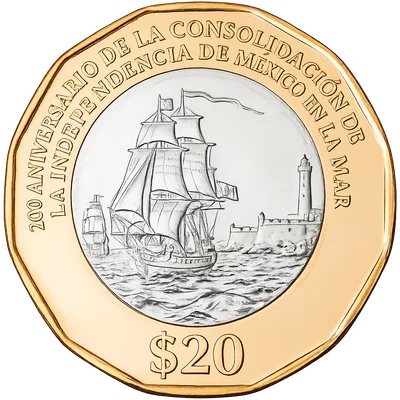
20 Pesos 200 Años de la Consolidación de la Independencia en la Mar
2026
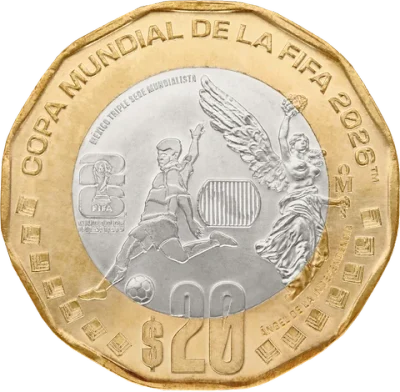
Copa Mundial de la FIFA 2026 TM, organizada por México-Estados Unidos-Canadá, Ciudad de México
2026
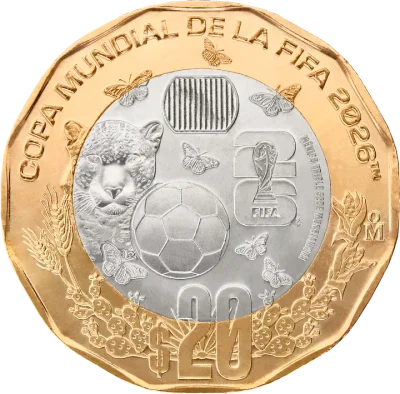
Moneda del Jaguar · 20 Pesos Triple Sede Mundialista FIFA
2026
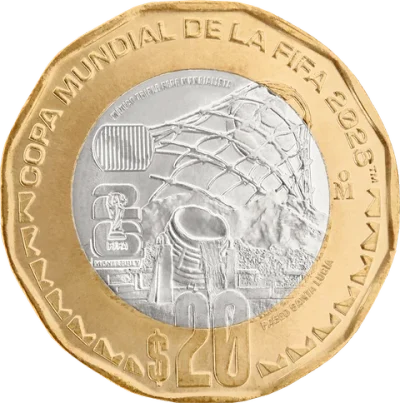
Copa Mundial de la FIFA 2026 TM, organizada por México-Estados Unidos-Canadá, Monterrey
2026
Same denomination, other years
20 pesos Bimetálica · Monedas de 20 pesos
Official sources
Frequently asked questions
How much is the Mexican 20 pesos Kukulkán (Chichén Itzá) coin worth?
Its face value is 20 pesos, roughly one US dollar. A worn coin from circulation is worth exactly that. In uncirculated (UNC) condition, projections based on earlier C1 coins put it at 100 to 300 pesos (about 6 to 17 USD) over 2 to 5 years, and 400 to 700 pesos (about 22 to 40 USD) in an original Banxico blister pack. Those are projected ranges, not guarantees.
Is the 2026 Kukulkán 20-peso coin rare?
No. Banxico confirmed a mintage of 26 million pieces (SIE, table CM22, July 1, 2026). It's a mass-produced circulating coin meant to replace the 20-peso banknote, not a limited commemorative. Any future scarcity would come only from most people spending them rather than saving mint-condition examples.
Where can I sell my Kukulkán 20-peso coin?
The safest options are a verified dealer from the Pesoteca shop directory, who can appraise it on the spot, or the Pesoteca buy-and-sell forum with other collectors. Photograph the front, back, and edge, and check the value range before selling. Avoid selling to the first random online buyer.
How can I tell if my Kukulkán coin is genuine?
It must weigh 12.67 g and measure 30 mm exactly. The gold-colored ring goes on the outside with a silver-colored center inside, never reversed. The reverse shows the El Castillo pyramid in sharp relief, and the edge has the C1 family's interrupted reeding. Fakes typically show flatter, blurrier detail than official Banxico images.
Conversation
0 comments
Loading comments…