
1972 Mexican 5 Centavos (Josefa): Value & Prices
Prices updated: August 2026
Old peso era · Brass
Old peso era · Brass
Design
Banxico
Reverse
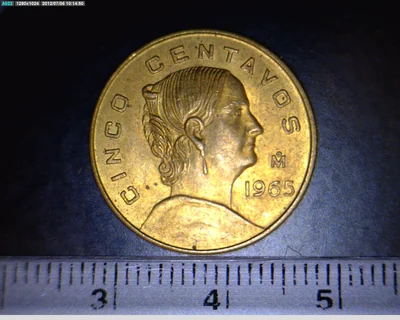
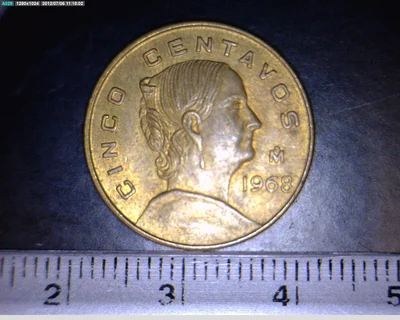
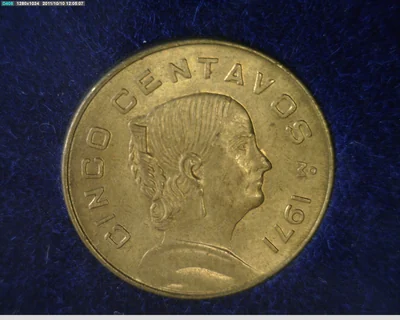
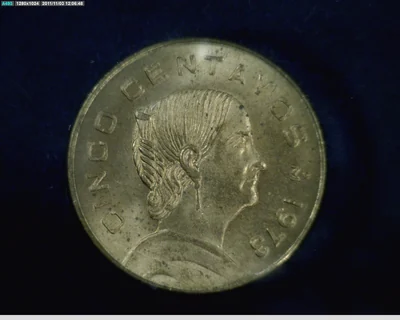
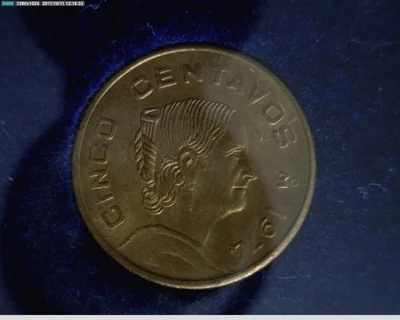
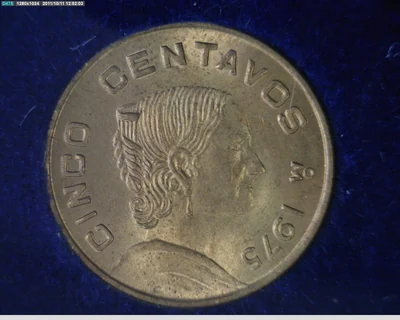
Bust of Josefa Ortiz de Dominguez (La Corregidora) in profile facing right, with the legend CINCO CENTAVOS, the year 1972 and the Mo mint mark of the Mexican Mint. Small type, KM#427.
Obverse
Mexican National Coat of Arms with the inscription "ESTADOS UNIDOS MEXICANOS".
How much is the 1972 Mexican 5 Centavos (Josefa): Value & Prices worth?
The market value of the 1972 Mexican 5 Centavos (Josefa): Value & Prices is not yet documented with enough data to give a firm range. Weigh and measure your piece, compare it against the specifications, and check the forum for a second opinion.
The real price depends on four factors: the grade of preservation (a circulated piece is worth the low end of the range; an uncirculated one, or one still in its official blister pack, the high end), the finish (satin vs mirror/proof), the rarity within the series based on the mintage, and the metal spot price on the day of the deal when the piece is silver or gold. Check the value-by-grade table above and compare with equivalent pieces before buying or selling.
Where to buy or sell this coin?
Browse the national directory of numismatic shops or the community forum to trade directly with other collectors.
Description
If you found a 1972 Mexican 5 centavos coin with a woman's profile on it, here is the honest answer: in circulated condition it is worth a few cents, not millions. Mexico struck 225 million of these in a single year, making it one of the most common Mexican coins ever made. A pristine, uncirculated example can bring 5 to 15 US dollars from a collector, and that is the ceiling for almost everyone.
What this coin actually is
The woman on the coin is Josefa Ortiz de Domínguez, known as La Corregidora, a heroine of Mexican independence. Her bust appears on the reverse looking right, next to the words CINCO CENTAVOS ("five centavos"), the year, and the mint mark Mo, which stands for the Casa de Moneda de México (the Mexican Mint) in Mexico City. The obverse shows the Mexican coat of arms, an eagle perched on a cactus devouring a snake.
This is the small type of the Josefa series, cataloged as KM#427. Its specifications are fixed:
- Metal: brass, an alloy of 85% copper and 15% zinc. No silver, no gold.
- Weight: 2.74 grams
- Diameter: 18.05 mm
- Edge: plain (smooth, no reeding)
Because it contains no precious metal, this coin has no bullion floor. Its value depends entirely on condition and collector demand, and both are low.
How much is a 1972 5 centavos worth in 2026?
| Condition | Realistic value (USD) |
|---|---|
| Circulated (worn, everyday) | A few cents |
| Uncirculated, no luster loss | 5 to 15 dollars |
| Certified high grade (MS-65+) | 20 to 40 dollars at most |
Those figures are the honest range. The single factor that separates a worthless piece from a modestly collectible one is preservation. A coin with full original luster and no corrosion or spots is what a collector will pay a small premium for. A coin that spent years passing hand to hand is a spare-change item.
Why it is not rare
Mexico minted 225 million of these in 1972 alone, all at the Mexico City mint. That is not a typo. With that many surviving pieces, the coin is one of the most common Mexican centavo coins in existence. Finding one is easy; that is exactly why it is cheap. Rarity drives price in numismatics, and this coin has none.
The "worth millions" myth, killed
You have probably seen viral posts claiming this coin, or the Josefa 5 centavos in general, sells for 2 million or 6 million pesos. That is clickbait. There is no real, verifiable sale anywhere near those numbers. A coin with a 225-million mintage in one year cannot be scarce, and scarcity is what creates high prices. Anyone quoting you seven figures for a Josefa 5 centavos is either mistaken or trying to sell you something. Ignore it.
How to tell if yours is genuine
Good news: because this coin is so common and worth so little, counterfeiting it makes no economic sense. Fakes are essentially nonexistent. To confirm authenticity, check the basics:
- It should weigh close to 2.74 grams.
- It should measure about 18.05 mm across.
- The edge should be plain, not reeded.
- The color is a dull, muted brass-gold.
- The obverse carries the national coat of arms; the reverse shows Josefa with the Mo mint mark.
If your coin matches those specs, it is authentic. There is no rare error variety worth chasing on this particular date.
Where to sell it
Be realistic about what you have before you list it. A circulated example is not worth the cost of shipping on its own. These coins are most commonly sold in bulk lots of old Mexican coins rather than one at a time. If you have a genuinely uncirculated piece with full luster, a coin shop or a collector may pay a few dollars for it. To find serious buyers and sellers, and to avoid the "million-peso" trap, use the Pesoteca directory of numismatic shops.
If you inherited a whole box, sort out the silver pieces first, since those carry real value based on metal content, and treat the brass centavos as filler.
Have a jar of old Mexican coins and want to know which ones actually matter? Post a photo of your best pieces in the Pesoteca forum and we will help you separate the spare change from the keepers.
Historical context
The circulating centavo coins in Mexico during the second half of the 20th century were struck in alloys that changed with the cost of metals: copper, bronze and brass in the low denominations (1¢, 5¢, 20¢); cupronickel for the intermediate denominations (25¢, 50¢, late 10¢); and .720 silver for some 25¢ and 50¢ pieces in the 1950s. Each change of alloy produced a distinct variant of the same face value. 1972 corresponds to the period when this variant was in circulation, before the transition to Nuevos Pesos in 1992. The Mexican Mint kept the basic design of the National Coat of Arms on the obverse and the numeric value on the reverse throughout this era.
This piece belongs to the era
México Moderno (pre-1992) →Explore all the Mexican coins of this era, their historical context and how they connect to the monetary system of the period.
Value range of this piece
Value range without enough data for this piece.
See the full breakdown by grade (VG, F, VF, EF, AU, MS-60, MS-63, MS-65) for the whole series →
Same denomination, other years
5 centavos Bronce · Centavos Mexicanos
Frequently asked questions
How much is a 1972 Mexican 5 centavos coin worth?
In circulated condition it is worth only a few cents; it is a very common coin. An uncirculated piece with full original luster and no corrosion can bring roughly 5 to 15 US dollars from a collector. The claims that it is worth millions are clickbait with no real sales behind them.
Is the 1972 5 centavos rare?
No, not at all. Mexico struck 225 million of these in 1972 alone at the Mexico City mint. It is one of the most common Mexican centavo coins in existence, and finding one is easy. Its high mintage is exactly why it stays cheap.
Is it true the Josefa 5 centavos is worth millions of pesos?
No. The viral posts claiming 2 million or 6 million pesos are clickbait with no verifiable sale behind them. With a mintage of 225 million pieces in a single year, this coin cannot reach those prices. Its real value is a few cents circulated.
How can I tell if my 1972 5 centavos is genuine?
It should weigh about 2.74 grams, measure 18.05 mm, have a plain edge, and show a dull brass-gold color. The obverse carries the Mexican coat of arms and the reverse shows Josefa Ortiz de Domínguez with the Mo mint mark. Since it is so common and low-value, it is almost never counterfeited.
Conversation
0 comments
Sources
Images for informational and educational purposes, attributed to their original source. Reference values; the real price depends on the grade, the specific variant and demand.
Loading comments…