
5 Pesos 2010 Josefa Ortiz de Domínguez: What It's Worth
The 5 Pesos 2010 Josefa Ortiz de Domínguez: What It's Worth is worth between $40 and $100 MXN depending on its grade of preservation.
Prices updated: August 2026
Bicentennial of Independence. La Corregidora, who warned of the discovered plan.
Bicentennial of Independence. La Corregidora, who warned of the discovered plan.
The 5 Pesos 2010 Josefa Ortiz de Domínguez: What It's Worth is worth between $40 and $100 MXN depending on its grade of preservation.
Prices updated: August 2026
How much is the 5 Pesos 2010 Josefa Ortiz de Domínguez: What It's Worth worth?
The estimated value of the 5 Pesos 2010 Josefa Ortiz de Domínguez: What It's Worth ranges from $40 (circulated, XF) up to $100 (official blister pack), with $78 as a reference for an uncirculated (UNC) piece. The estimate is based on the official mintage and the historical behavior of the family.
The real price depends on four factors: the grade of preservation (a circulated piece is worth the low end of the range; an uncirculated one, or one still in its official blister pack, the high end), the finish (satin vs mirror/proof), the rarity within the series based on the mintage, and the metal spot price on the day of the deal when the piece is silver or gold. Check the value-by-grade table above and compare with equivalent pieces before buying or selling.
Where to buy or sell this coin?
Browse the national directory of numismatic shops or the community forum to trade directly with other collectors.
Description
If you found a Mexican 5 pesos coin dated 2010 with a woman's face on it, here is the honest answer: the everyday circulation version is worth close to face value, roughly 25 to 50 US cents to a collector. There is one version that is worth real money, the silver proof, and this guide shows how to tell which one you have.
The coin is part of Mexico's Bicentennial program (Bicentenario de la Independencia de México), a large series the central bank, Banco de México (Banxico), released in 2010 to mark 200 years of independence. The face belongs to Josefa Ortiz de Domínguez, known as "La Corregidora," one of the leaders of the independence movement. Dozens of different 5 pesos designs came out of this program, each honoring a different historical figure, so millions of people have ended up with one.
The two versions, and why only one is valuable
There are two very different coins that look nearly identical to an untrained eye.
1. The circulation coin (the common one). This is bimetallic: an aluminum-bronze outer ring around a plain metal center. Banxico made these by the millions for everyday use. In pocket-worn condition it is worth face value. A clean, uncirculated example sells for maybe 1 to 3 US dollars to a collector building the full Bicentennial set. That is the ceiling for the ordinary version.
2. The silver proof coin (the one worth chasing). Banxico also struck a limited proof version with a center made of .925 sterling silver, sold in an official capsule and presentation case. "Proof" means a mirror-finish coin struck for collectors, never meant for circulation. This is the version that carries real value, both from the low mintage and the silver content. Encapsulated proof examples with the original Banxico case typically trade in the range of 30 to 80 US dollars, and premium graded examples can go higher.
If your coin came loose in a jar of change, it is almost certainly the circulation type. If it came sealed in a clear capsule inside a box, look closely: you may have the silver proof.
Specifications
| Feature | Detail |
|---|---|
| Denomination | 5 pesos |
| Year | 2010 |
| Weight | 9.76 g |
| Diameter | 30.52 mm |
| Edge | Plain (smooth) |
| Composition | Aluminum-bronze ring, center .925 silver (proof version) |
| Finish | Proof (encapsulated) and regular circulation |
| Issuer | Banco de México (Banxico) |
Value by type and condition (2026)
| Version | Condition | Approx. value (USD) |
|---|---|---|
| Circulation | Worn / used | Face value (~0.25) |
| Circulation | Uncirculated | 1 to 3 |
| Silver proof | Encapsulated, with case | 30 to 80 |
| Silver proof | Certified high grade (PCGS/NGC) | 80+ |
These are collector ranges based on what these coins actually trade for. Do not expect a payout from the circulation version. The myth that any Bicentennial coin is "rare and worth thousands" is exactly that, a myth. Tens of millions of the ordinary coins exist.
The part people get wrong
Social media posts claim certain 2010 5 pesos coins are worth hundreds or thousands of dollars. In almost every case the coin shown is a normal circulation piece, and the price is invented to farm clicks. Two things separate a genuinely valuable example from a common one: it is the silver proof, or it is a verifiable mint error. Everything else is worth a few dollars at most.
Mint errors do exist and can multiply value: off-center strikes, die rotation, double strikes. But most "errors" people post online are post-mint damage, meaning dings, scratches, and corrosion that happened after the coin left the mint. Damage lowers value; it never raises it.
How to check what yours is worth
Confirm the type first. A magnet won't help here (neither version is strongly magnetic), so check the center: a genuine silver proof center has a bright mirror finish and comes encapsulated. A dull, matte center in a worn coin is the circulation type.
Weigh and measure it. Use a jewelry scale and a caliper. It should weigh 9.76 g and measure 30.52 mm. Counterfeits often have the wrong weight or diameter, flat relief, or off colors between the ring and center.
Grade matters. For the silver proof, condition is everything. Scratches on the mirror surface cut the value hard. If you think you have a clean proof, it may be worth submitting to a grading service like PCGS or NGC.
Get a second opinion before selling. Photograph the front (anverso), back (reverso), and edge (canto) in good light, then compare against the specs above.
Where to sell it
For a fair price, use a verified coin shop from the Pesoteca dealer directory, where you can get it appraised on the spot, or list it in the Pesoteca buy-and-sell forum among collectors. Avoid dumping it on Facebook to the first buyer. If you want to check whether yours is a genuine error or just damage, post clear photos in the Pesoteca forum and the community will weigh in.
Got a 2010 Bicentennial 5 pesos and not sure if it's the silver proof or the common one? Post your photos in the forum and let's identify it.
Historical context
Maria Josefa Crescencia Ortiz Tellez-Giron: corregidora of Queretaro and key participant in the conspiracy of 1810
Maria Josefa Crescencia Ortiz Tellez-Giron, wife of the corregidor Miguel Dominguez (1768-1829) was corregidora of Queretaro and a key participant in the conspiracy of 1810 during the War of Independence.
Josefa Ortiz de Dominguez was part of the conspiratorial circle of Queretaro that was planning an uprising for December 1810. When her husband, the corregidor, received orders to arrest the conspirators, she managed to send a warning to Allende that precipitated the Grito de Dolores in the early hours of September 16.
Context of the year. The piece corresponds to 2010, the year that commemorates her role in triggering the outbreak of the struggle. Without that warning, the conspiracy would have been dismantled ahead of time.
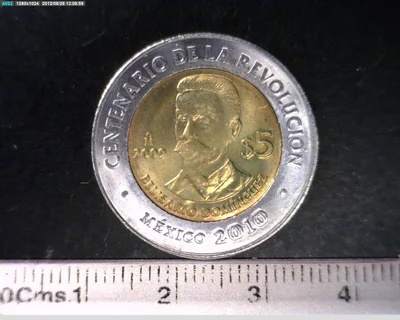
The reverse of the coin. The reverse of this 5-peso piece shows the portrait of Maria Josefa Crescencia Ortiz Tellez-Giron, her engraved signature, and the year 2010, in accordance with the official Bank of Mexico catalog for the commemorative series of the Bicentennial of the start of Independence (1810-2010).
Legacy. She is the only woman who appears on the coat of arms of the state of Queretaro and on the twenty-peso banknote issued by Banxico between 1994 and 2016. Her bust appears in the Jardin Zenea of the city of Queretaro.
This piece belongs to the era
Nuevos Pesos y actualidad →Explore all the Mexican coins of this era, their historical context and how they connect to the monetary system of the period.
Value range of this piece
Market estimate: $40 - $100 MXN depending on the grade of preservation (typical range between a circulated and an uncirculated piece).
See the full breakdown by grade (VG, F, VF, EF, AU, MS-60, MS-63, MS-65) for the whole series →
Other denominations from 2010
5 Pesos Bicentenario Independencia y Centenario Revolución · Bimetálica
Same denomination, other years
5 pesos Bimetálica · 5 Pesos Bicentenario Independencia y Centenario Revolución
Official sources
Frequently asked questions
How much is the 2010 Josefa Ortiz de Domínguez 5 pesos worth?
The everyday circulation version is worth face value to about 1 to 3 US dollars uncirculated. The limited silver proof version, encapsulated with the original Banxico case, typically sells for 30 to 80 US dollars, and certified high-grade examples go higher.
Is this 2010 Mexican coin rare?
The circulation version is not rare; Banxico struck it by the millions as part of the Bicentennial program. Only the .925 silver proof version is scarce and carries real collector value. Genuine, verifiable mint errors are also uncommon and worth more.
Where can I sell my 2010 Josefa Ortiz 5 pesos?
Use a verified coin shop from the Pesoteca dealer directory for an on-the-spot appraisal, or list it in the Pesoteca buy-and-sell forum among collectors. Photograph the front, back, and edge, and check the value range above before selling. Avoid selling to the first random buyer online.
How can I tell if my coin is genuine?
Weigh it (9.76 g) and measure the diameter (30.52 mm) with a jewelry scale and caliper, then compare to the specs. Counterfeits often have the wrong weight or diameter, flat relief, or poorly separated colors between the ring and center. The silver proof should have a bright mirror finish and come encapsulated.
Conversation
0 comments
Loading comments…